ANATOMY AND PHYSIOLOGY · CHAPTER 7 · THE MAJOR BONES
The Bone Case Lab
Follow along with your worksheet, one question at a time.
mrsajdak.com/bonecase
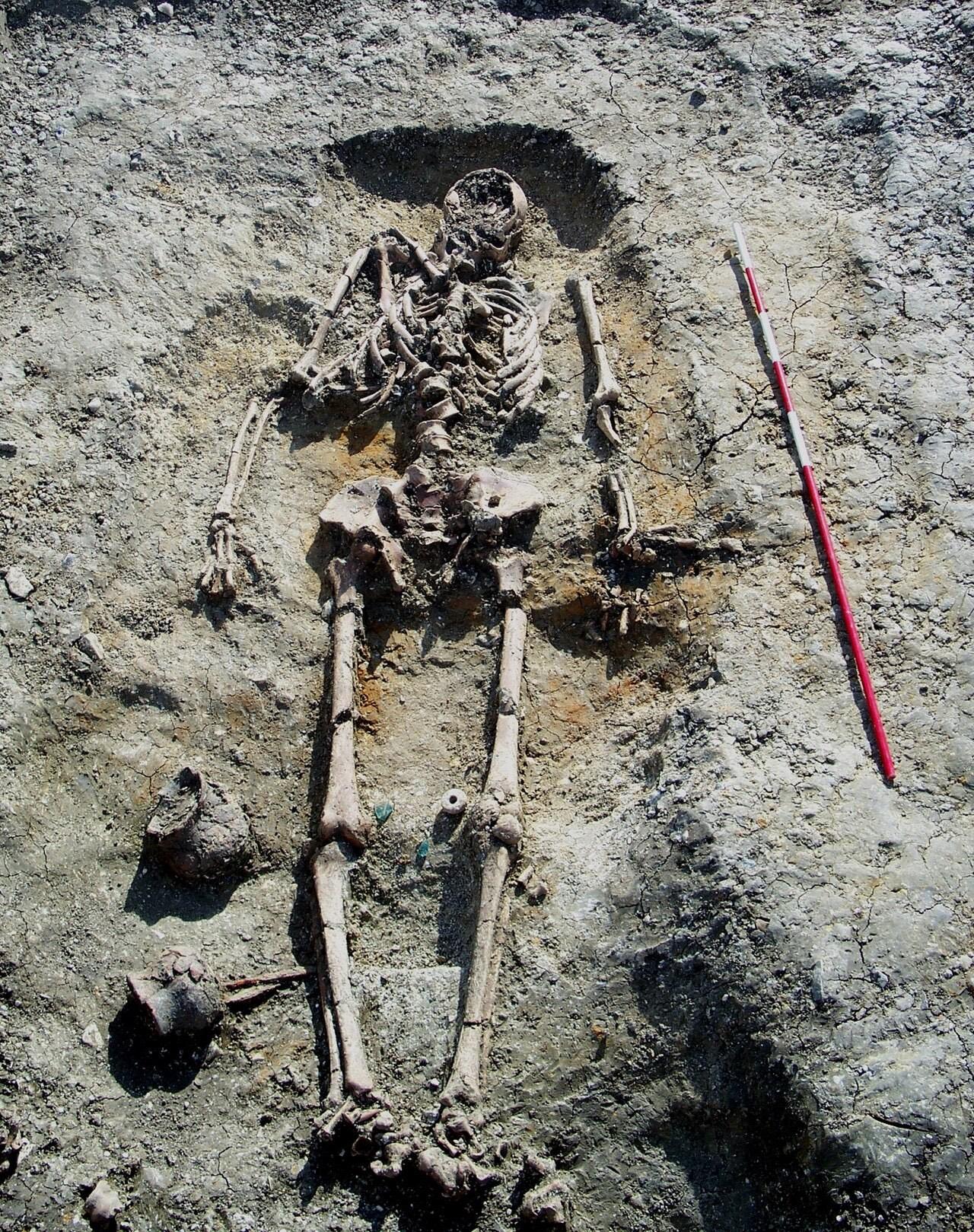
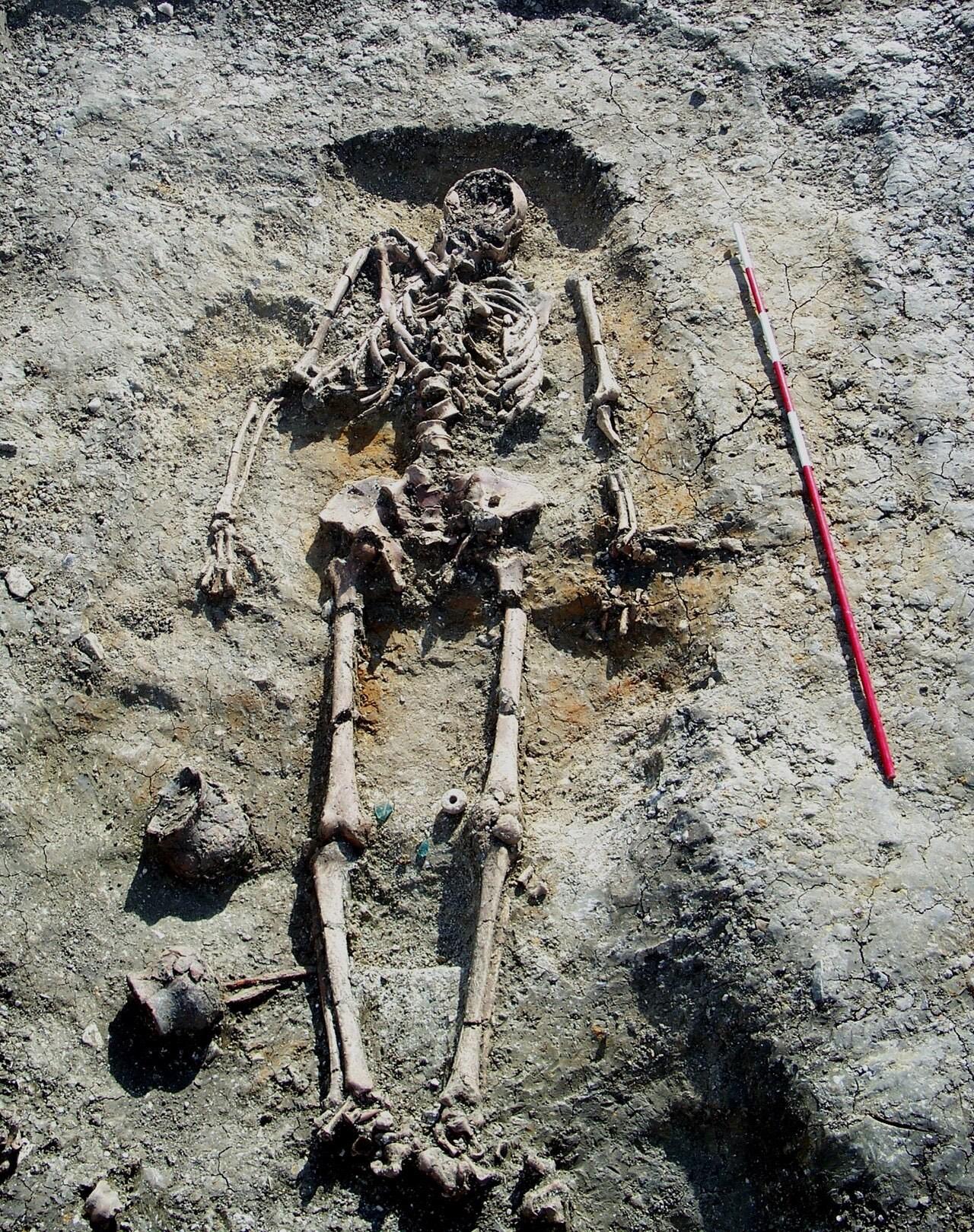
Photo: Oxfordshire County Council, Anni Byard, CC BY-SA 4.0
START HERE · PICK AN OPENER
Choose how to open the lesson
Click a card to jump to it. Every option ends at the same Observe, Wonder, Predict slide and the same driving question.
OPTION A · VIDEO
Whose Bones Are These?
Clip 1 is from NPR: a high school in Erie, Pennsylvania has a skeleton made of real bones, and nobody knows whose they are. A team takes it to forensic scientists, who measure every bone. Clip 2 is a forensic anthropologist in Michigan showing what bones can tell her.
Watch for
How do they know the skeleton is real bone, not plastic?
What did the scientists do first with the bones?
What could measuring a bone tell you about the person?
Videos on YouTube: NPR's Skunk Bear; MLive; ProfCahoon.
OPTION B · TRY IT · 4 MINUTES
Arms Wide
1
Stand with your back against the wall. Stretch your arms out wide, level with your shoulders.
2
A partner puts a piece of tape at the tip of each middle finger.
3
Measure from tape to tape with a meter stick. That is your arm span.
4
Compare it with your height on the wall strip. Is it longer, shorter or about the same?
You need
Masking tape
A meter stick or a cloth tape measure in cm
A height strip on the wall (or the meter stick held upright)
Watch for
Most arm spans come out close to the person’s height.
Tall people have long arms. Short people have shorter arms.
If you found only an arm, could you guess the height?
OPTION C · PHOTOS
Phenomenon: Bones in the Ground
Photos: A, Oxfordshire County Council, Anni Byard, CC BY-SA 4.0; B, Harold9595959, CC BY-SA 4.0
START HERE
Observe, wonder, predict
Both people died hundreds of years ago. Nobody wrote down how tall they were.
OBSERVEWhich bones can you see in Photo A? Point to them. Use any names you know.
WONDERWhat could a scientist learn about a person from their bones?
PREDICTTo guess how tall a person was, which one bone would you measure? Why that one?
Photo A, up close.
Photos: A, Oxfordshire County Council, Anni Byard, CC BY-SA 4.0; B, Harold9595959, CC BY-SA 4.0
DRIVING QUESTION
Nobody wrote down how tall they were. How can a few bones tell us who a person was and how tall they stood?
START HERE
What Happened Here?
Finished observing? Click here to find out.
Photo A is a grave from the early Middle Ages, dug up by archaeologists in West Hanney, England. Photo B is the grave of King Richard III, found in 2012 under a parking lot in Leicester, England: the king from last lesson. Nobody measured him while he was alive, but scientists worked out his height from his bones alone.
Watched the video or tried it? Click here.
The video is a real skeleton from a high school art room. Forensic scientists measured every bone to learn who she was. The arm-span test shows one body part can tell you about the whole body. How scientists turn one bone into a height is what this lab is about.
Today, you will name the bones of a real skeleton, measure four long bones on a bone board, use real forensic formulas to work out a height, and test the method on a king. At the end, you will come back to the driving question.
BEFORE YOU START
What you already know
From the last two lessons
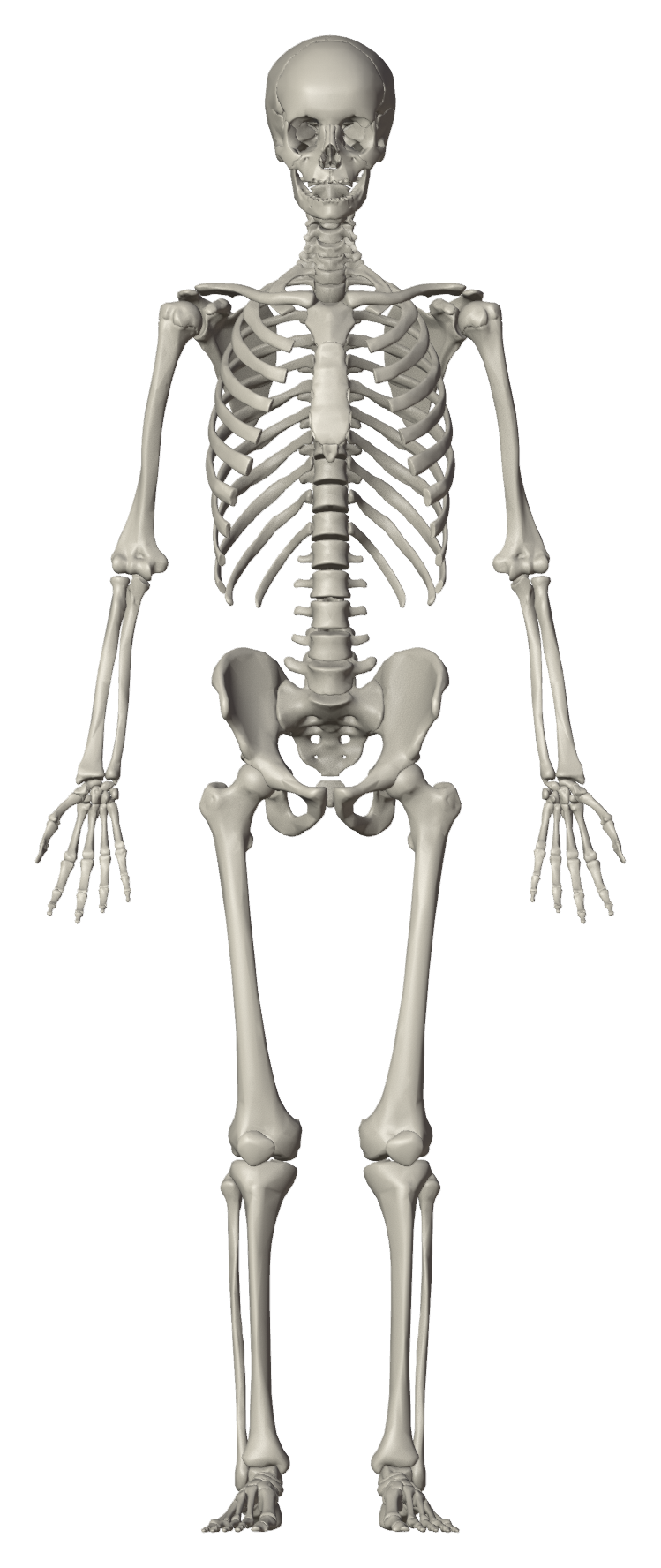
An adult skeleton has 206 bones.
The axial skeleton is the skull, spine and ribs. The appendicular skeleton is the arms, legs and the bones that hold them on.
A long bone is longer than it is wide, like the thigh bone.
Which bones in your body could you find by touch?
Image: Z-Anatomy / BodyParts3D, CC BY-SA 4.0
BEFORE YOU START
What you will learn
I can locate and name the major bones of the human skeleton.
I can measure a long bone and use it to estimate a person's height.
BEFORE YOU START
Get set up
1
Open mrsajdak.com/bonecase on your device.
2
Write your name, the date and your period on the worksheet.
3
Find the tabs at the top of the lab. Each tab goes with one part of the worksheet.
4
Start on Tab 1. Do not skip ahead.

| Tab in the lab | Worksheet | Questions |
|---|---|---|
| 1. The dig | Part 1 | 1 to 4 |
| 2. The bone board | Part 2 | 5 to 8 |
| 3. How tall? | Part 3 | 9 to 12 |
| 4. The king | Part 4 | 13 to 15 |
Screenshot: mrsajdak.com/bonecase
TAB 1 · QUESTIONS 1 TO 4
Part 1. The dig
A skeleton lies in the ground, just as it was buried.
Ten tags mark ten spots on it.
First: what part of the body is each one in?
Photo: Oxfordshire County Council, Anni Byard, CC BY-SA 4.0
PART 1 · QUESTIONS 1 AND 2
Find the region for each tag
1
Keep 1. Region on.
2
Click a numbered tag. A close-up shows up on the right.
3
Pick the part of the body it is in.
4
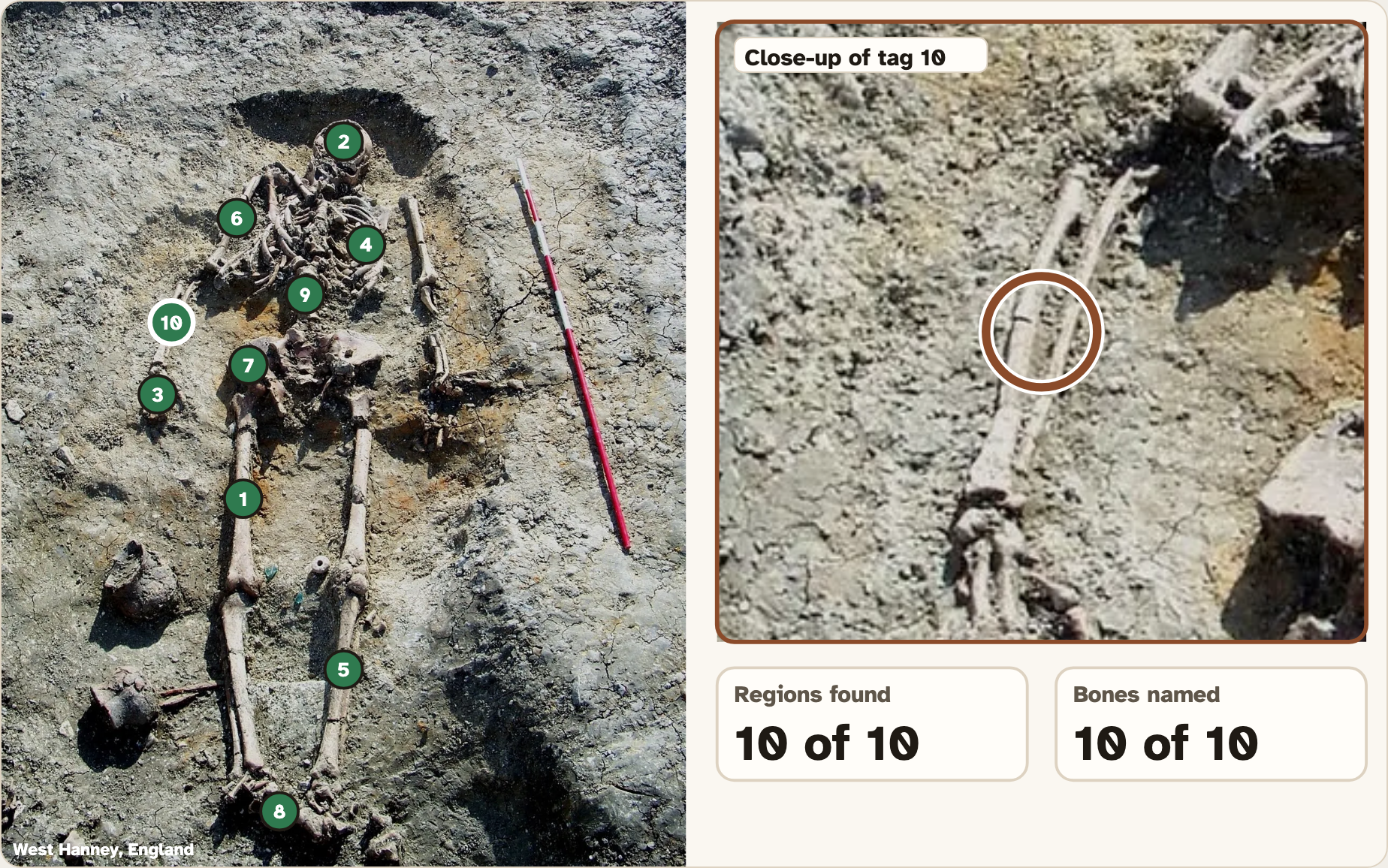
Do all ten tags. Copy them from Your tags.
5
Look closely at tags 5 and 10. One bone, or two?
PART 1 · QUESTION 2
One bone, or two?
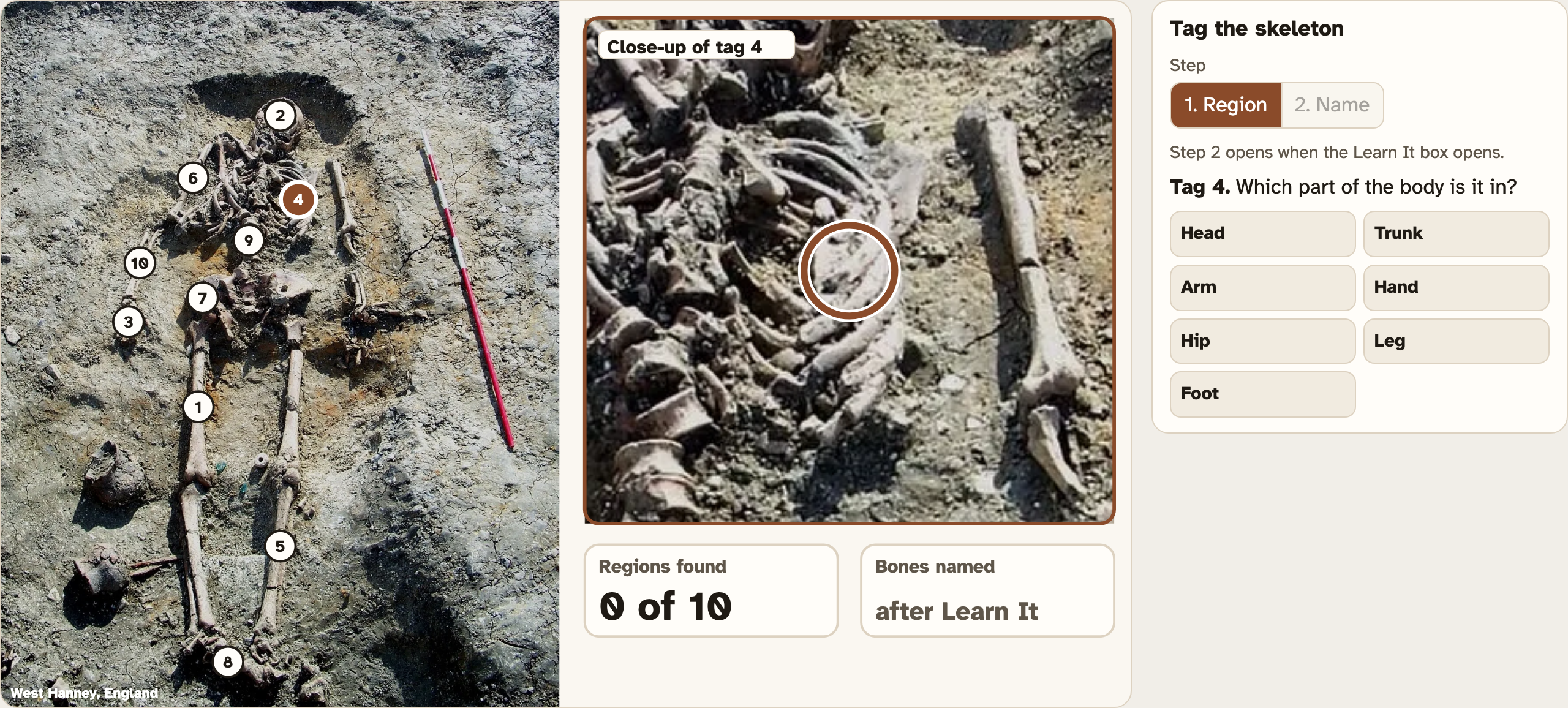
Tag 4, up close. Its region is not picked yet.
QUESTION 2
Look closely at tags 5 and 10
How many bones lie side by side there?
Which part of the body is each tag in?
Screenshot: mrsajdak.com/bonecase, Tab 1
PART 1 · LEARN IT · 1 OF 4
One system, many parts
An adult skeleton has 206 bones. It is one system: many parts that work together. Scientists learn the bones by region, the part of the body they are in.
Photo: Z-Anatomy / BodyParts3D, CC BY-SA 4.0
PART 1 · LEARN IT · 2 OF 4
Head and trunk
The cranium is the bone case around the brain: the frontal, parietal, temporal and occipital bones. The mandible is the jaw. 12 pairs of ribs meet the sternum in front. Vertebrae stack up to make the backbone.
Photo: Z-Anatomy / BodyParts3D, CC BY-SA 4.0
PART 1 · LEARN IT · 3 OF 4
Arm and hand
The upper arm has one bone: the humerus. The forearm has two. The radius is on the thumb side and turns when you flip your hand. The ulna is on the pinky side and makes the point of the elbow. Then carpals, metacarpals, phalanges.
Screenshot: mrsajdak.com/bonecase, Tab 1
PART 1 · LEARN IT · 4 OF 4
Hip, leg and foot
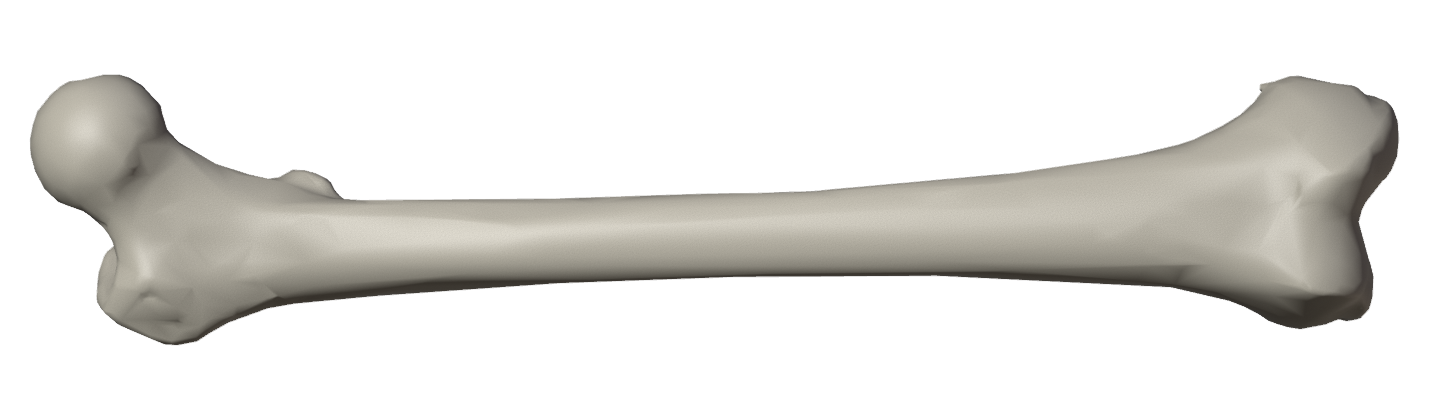
Each hip bone is three bones joined: ilium, ischium, pubis. The thigh has one bone, the femur, the longest in the body. Then the patella (kneecap). The lower leg has the thick tibia and the thin fibula. Then tarsals and metatarsals.
Photo: Z-Anatomy / BodyParts3D, CC BY-SA 4.0
PART 1 · QUESTIONS 3 AND 4
Name them
QUESTION 3
Press 2. Name
Name the bone at each of the ten tags.
A clue appears after two wrong picks.
QUESTION 4
Two bones, side by side
Forearm: which one is on the thumb side? Which makes the point of the elbow?
Lower leg: which is the thick shin bone? Which is the thin one?
PART 1 · THE BIG IDEA
The skeleton is one system of 206 named bones. Each region has its own: one bone in the upper arm and thigh, two in the forearm and lower leg.
IN YOUR WORDSHow can you tell the radius from the ulna on your own arm?
TAB 2 · QUESTIONS 5 TO 8
Part 2. The bone board
To use a bone as evidence, you have to measure it.
Forensic scientists use a bone board.
How do you measure a bone so the number can be trusted?
Image: Z-Anatomy / BodyParts3D, CC BY-SA 4.0
PART 2 · QUESTIONS 5 AND 6
Measure four bones
1
Pick a bone. It touches the fixed block on the left.
2
Slide the block on the right (drag it, or use the buttons) until it turns green.
3
Read the board in mm. Press Record this length.
4
Do all four bones lying straight.
5
Then pick Femur, Crooked, and measure again.
PART 2 · QUESTION 6
Straight or crooked
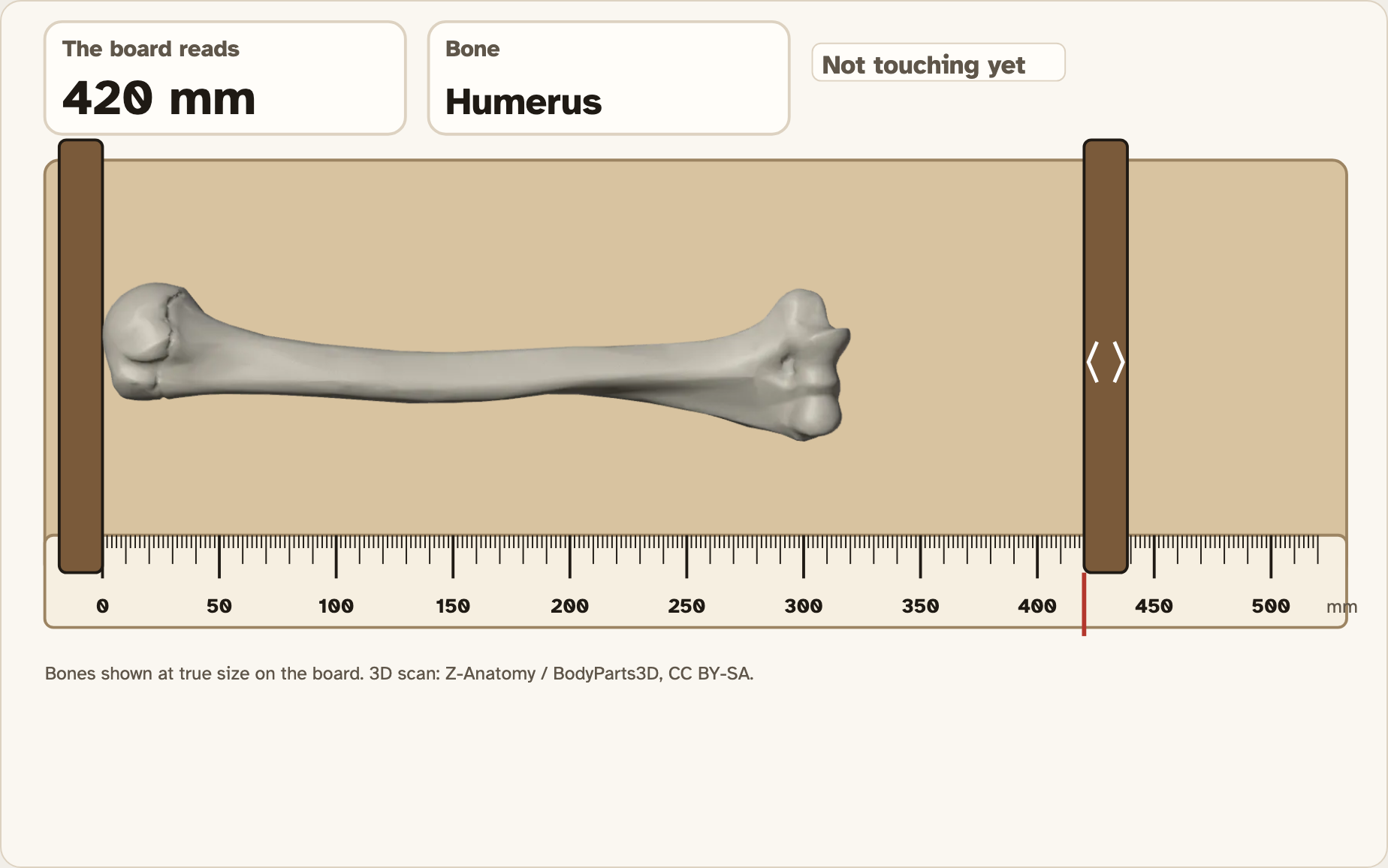
The humerus, block not touching yet.
QUESTION 6
Compare the two femur readings
How many mm shorter was the crooked femur?
Did the bone itself get shorter?
Screenshot: mrsajdak.com/bonecase, Tab 2 · Bones: Z-Anatomy / BodyParts3D, CC BY-SA.
PART 2 · LEARN IT · 1 OF 4
The bone board
Forensic scientists measure long bones on an osteometric board. "Osteo" means bone. One end of the bone touches the fixed block. You slide the other block until it just touches.
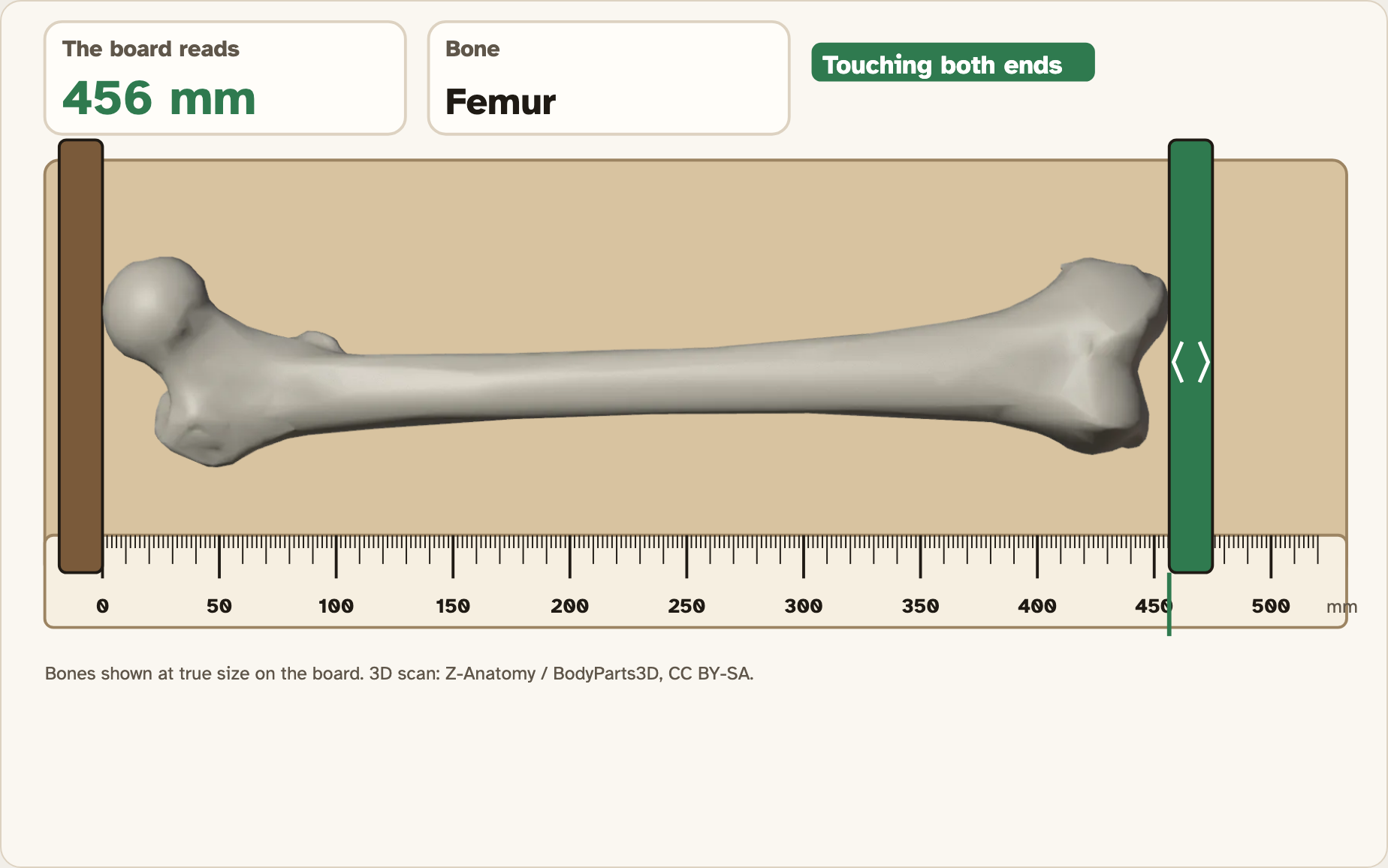
Screenshot: mrsajdak.com/bonecase, Tab 2
PART 2 · LEARN IT · 2 OF 4
Maximum length
The board reads the maximum length: the longest straight line from one end to the other. Crooked, the femur read less. The bone did not shrink. It was not lined up.
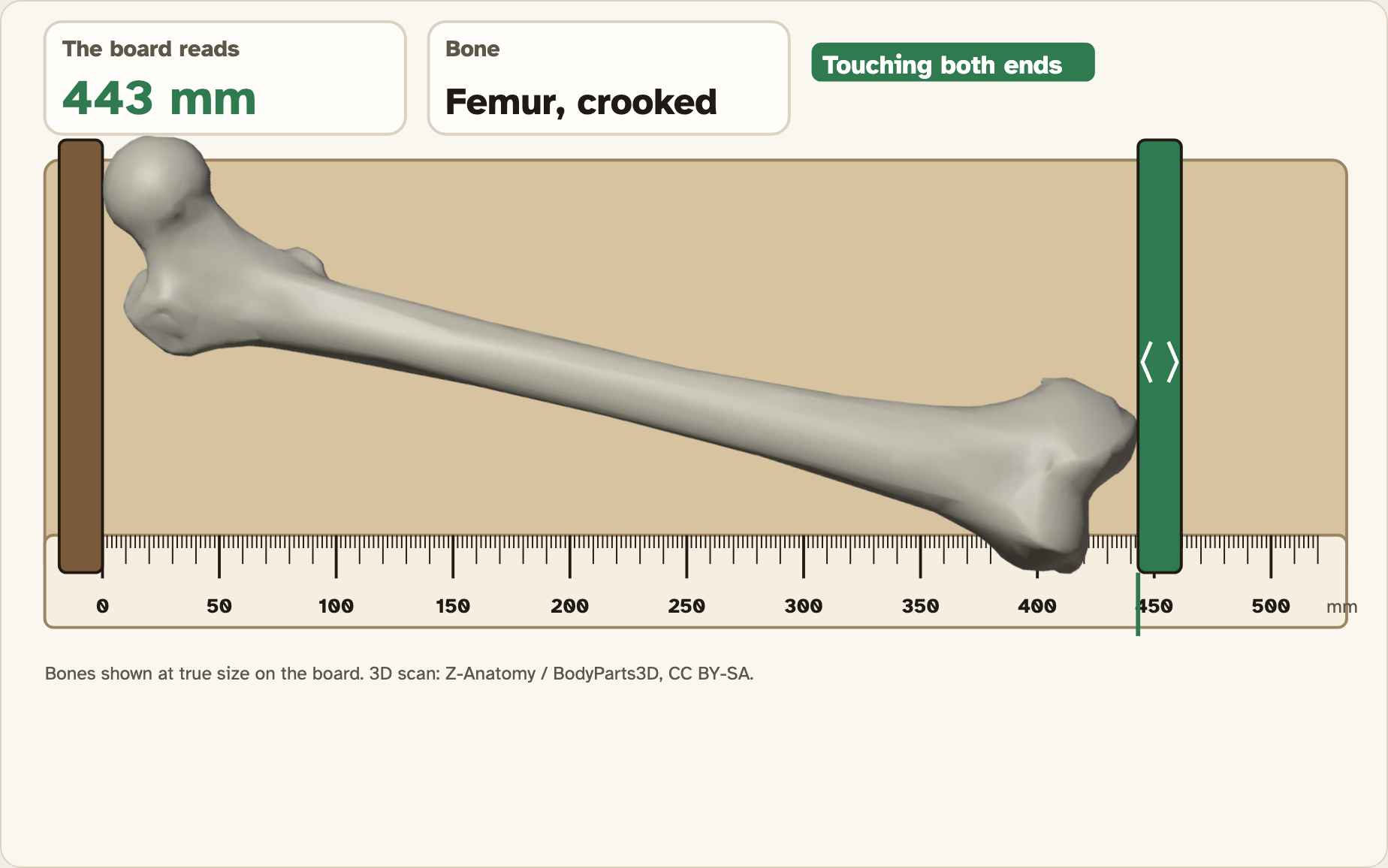
Screenshot: mrsajdak.com/bonecase, Tab 2
PART 2 · LEARN IT · 3 OF 4
The same way every time
The height formulas in Part 3 were built from bones measured this exact way. Measure a different way and the formula gives the wrong height. A crooked femur makes a person look about 3 cm shorter.
Photo: Z-Anatomy / BodyParts3D, CC BY-SA 4.0
PART 2 · LEARN IT · 4 OF 4
Millimeters to centimeters
The board reads in millimeters (mm). The formulas use centimeters (cm). There are 10 mm in 1 cm, so divide by 10. A reading of 512 mm is 51.2 cm.
Photo: Z-Anatomy / BodyParts3D, CC BY-SA 4.0
PART 2 · QUESTIONS 7 AND 8
Plan check
QUESTION 7
Trustworthy or not?
Four ways to measure. Tick one box in each row.
Think: longest line, lined up, block just touching.
QUESTION 8
Same way, every time
Why must a scientist measure the femur the same way the people who made the formula did?
PART 2 · THE BIG IDEA
A bone is measured as its maximum length, lined up on a bone board, the same way every time. Then its number can be compared and used.
IN YOUR WORDSWhy did the crooked femur give a smaller number?
TAB 3 · QUESTIONS 9 TO 12
Part 3. How tall?
You have four bones from one man.
Each one can give an estimate of his height.
Do the four bones agree?
Image: Z-Anatomy / BodyParts3D, CC BY-SA 4.0
PART 3 · QUESTION 9
Use the formula
1
Pick a bone. The lab shows its length and its formula.
2
Multiply the number by the length.
3
Add the second number. Write it on your sheet.
4
Press Show the estimate to check. Copy the range.
5
Do all four. Then try the Women’s formula on the femur.
Example
A tibia 40.0 cm long:
2.52 × 40.0 = 100.8
100.8 + 78.62 = 179.4 cm
PART 3 · QUESTION 10
Do they agree?
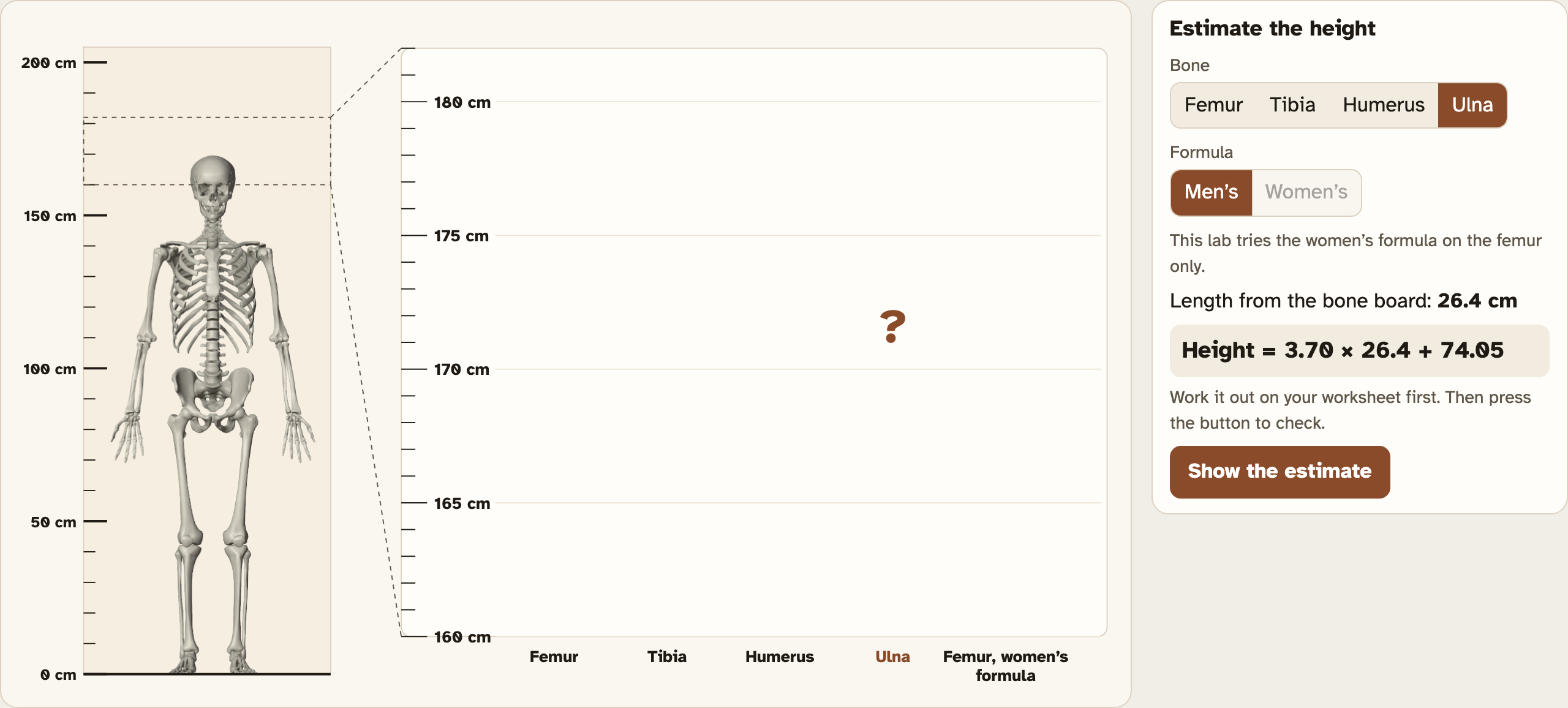
The ulna, before the estimate is shown.
QUESTION 10
Look at all four
What is the lowest estimate? The highest?
The dashed line is the scan’s skeleton. How many ranges include it?
Screenshot: mrsajdak.com/bonecase, Tab 3
PART 3 · LEARN IT · 1 OF 4
A formula from many skeletons
Mildred Trotter and Goldine Gleser measured the long bones of hundreds of people whose heights were known. Longer bones went with taller people, in proportion. They made a formula for each bone.
Photo: Z-Anatomy / BodyParts3D, CC BY-SA 4.0
PART 3 · LEARN IT · 2 OF 4
The plus or minus
People are not all built the same. So each formula gives a range, not one exact number. The true height usually falls inside it.
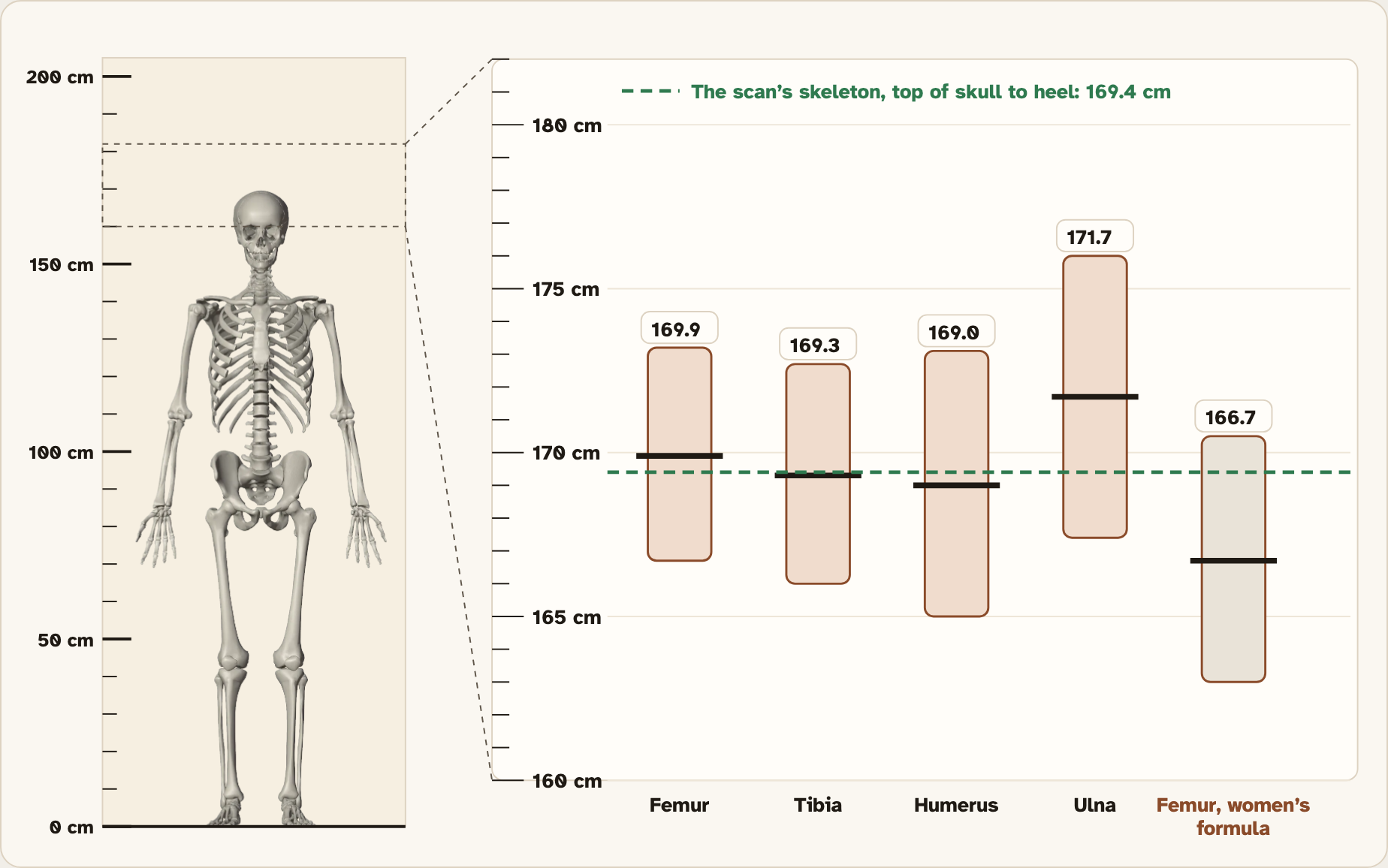
Screenshot: mrsajdak.com/bonecase, Tab 3
PART 3 · LEARN IT · 3 OF 4
Leg bones work best
The leg bones have the smallest ranges: femur ±3.27 cm, tibia ±3.37. The arm bones are wider: humerus ±4.05, ulna ±4.32. The legs make up a big part of your height.
Photo: Z-Anatomy / BodyParts3D, CC BY-SA 4.0
PART 3 · LEARN IT · 4 OF 4
Men and women get different formulas
Men’s and women’s bodies are built in slightly different proportions. So the same femur gives a different height with each formula. Scientists first look at the hip bones to decide which to use.
Photo: Z-Anatomy / BodyParts3D, CC BY-SA 4.0
PART 3 · QUESTIONS 11 AND 12
Which bone, which formula?
QUESTION 11
The narrowest range
Which bone gives the narrowest range?
Why do leg bones predict height best?
QUESTION 12
Man or woman first
Copy the femur estimate with each formula.
Why must a scientist decide man or woman first?
PART 3 · THE BIG IDEA
Long bones grow in proportion to height. A formula built from many skeletons turns one bone into a height, with a range. Leg bones give the closest answer.
IN YOUR WORDSWhy does a scientist give a height as a range and not one number?
TAB 4 · QUESTIONS 13 TO 15
Part 4. The king
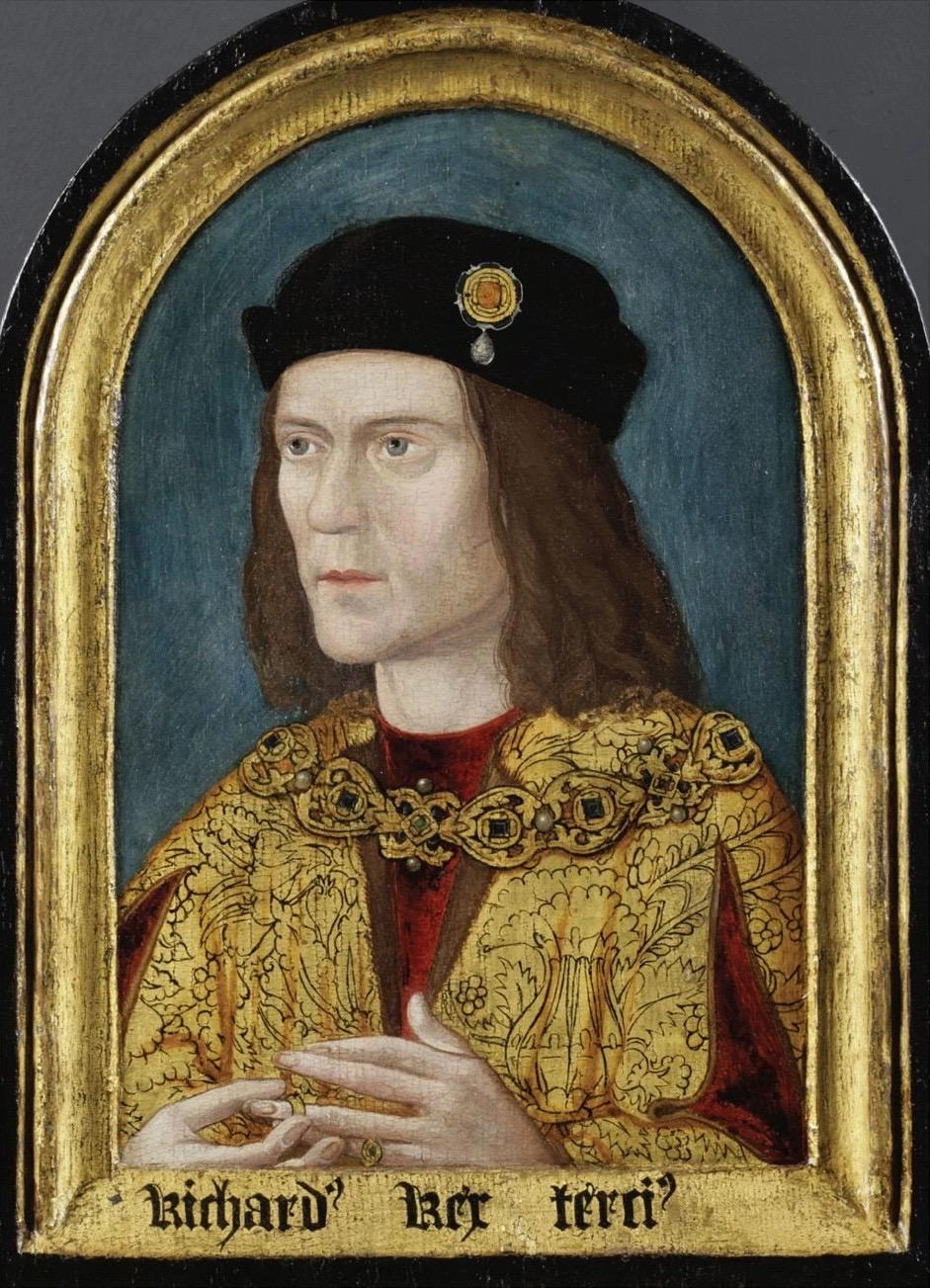
You met this king last lesson: the skeleton under the parking lot.
Now two new questions. How tall was he?
His spine was strongly curved. Could his bones still tell his height?
Painting: Society of Antiquaries of London, public domain
PART 4 · QUESTIONS 13 AND 14
Judge the bones, then work backward
1
Read the case file.
2
Click a dashed box on the skeleton.
3
Pick: still gives his true height, or thrown off by the curve.
4
Do all four parts.
5
Work backward to his femur. Type it and press Check.
PART 4 · QUESTION 14
Work it backward
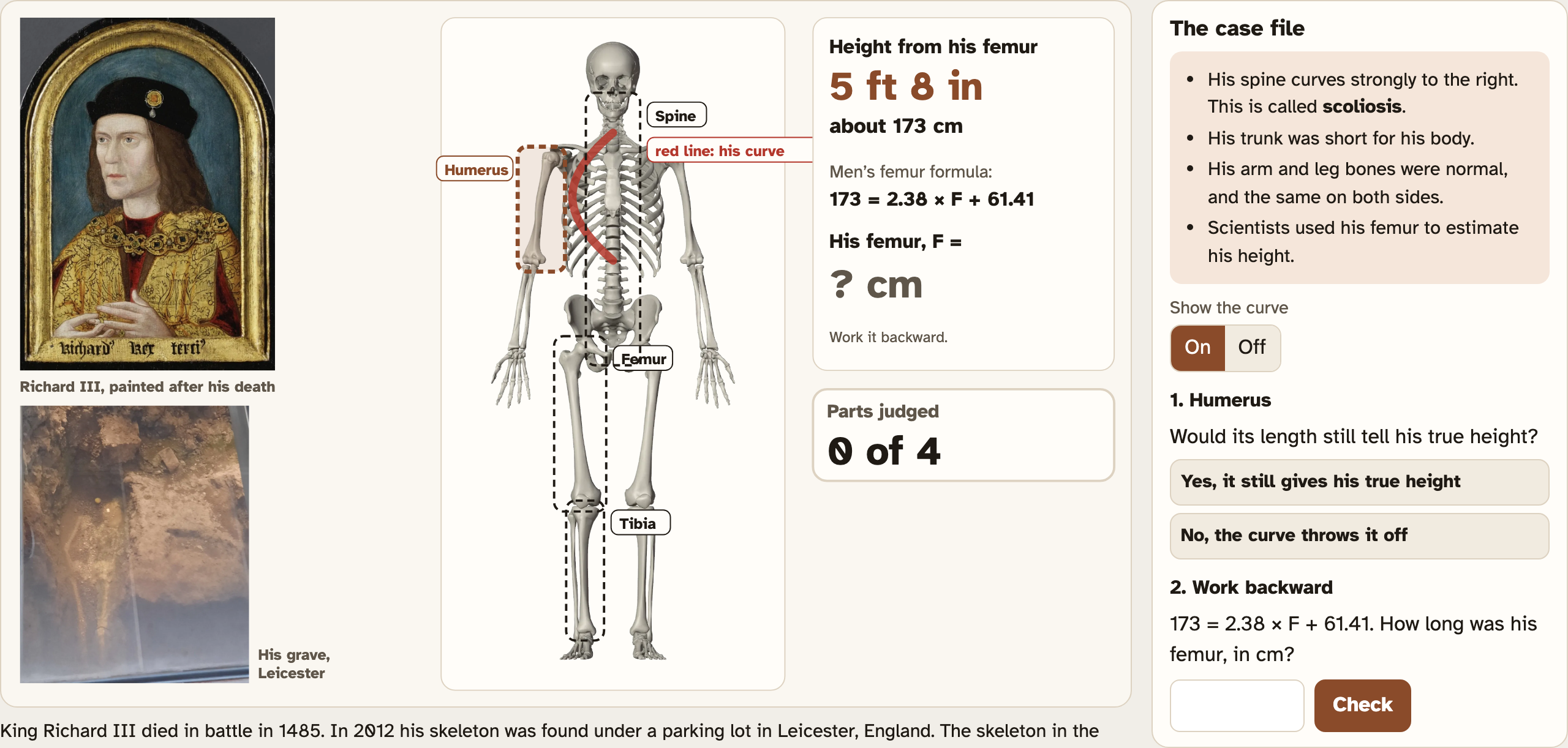
The humerus picked, not judged yet.
QUESTION 14
Undo the formula
173 = 2.38 × F + 61.41
First take away 61.41. Then divide by 2.38.
Screenshot: mrsajdak.com/bonecase, Tab 4
PART 4 · LEARN IT · 1 OF 4
Scoliosis
Scoliosis means the spine curves to the side. Richard’s spine curved strongly to the right, with a twist. It started in his teens, near the end of his growing years.
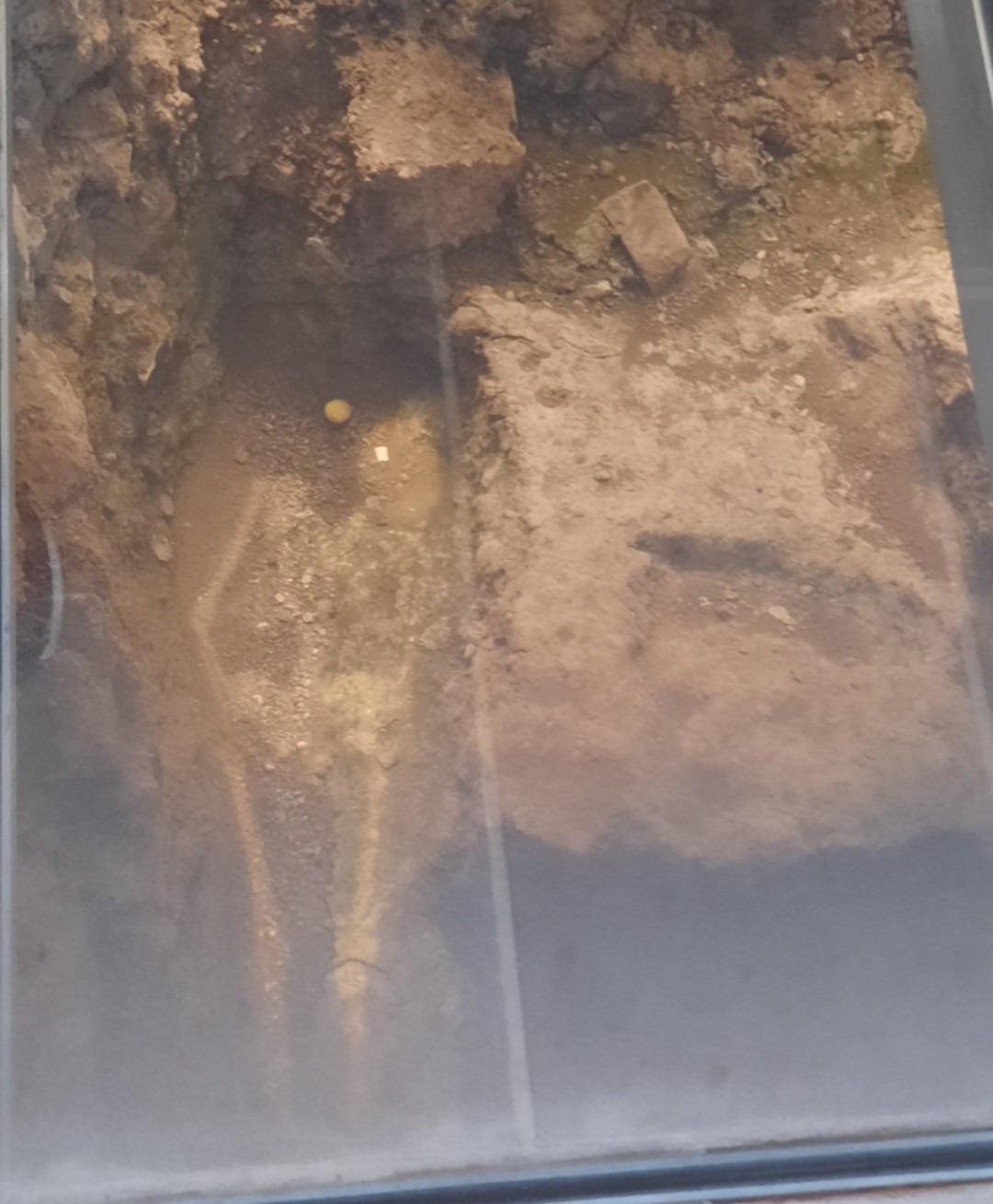
Photo: Harold9595959, CC BY-SA 4.0
PART 4 · LEARN IT · 2 OF 4
Short trunk, normal arms and legs
The vertebrae stack up to make part of your height. His curve bent that stack, so his trunk was short for his body. But his arm and leg bones were normal, and the same on both sides.
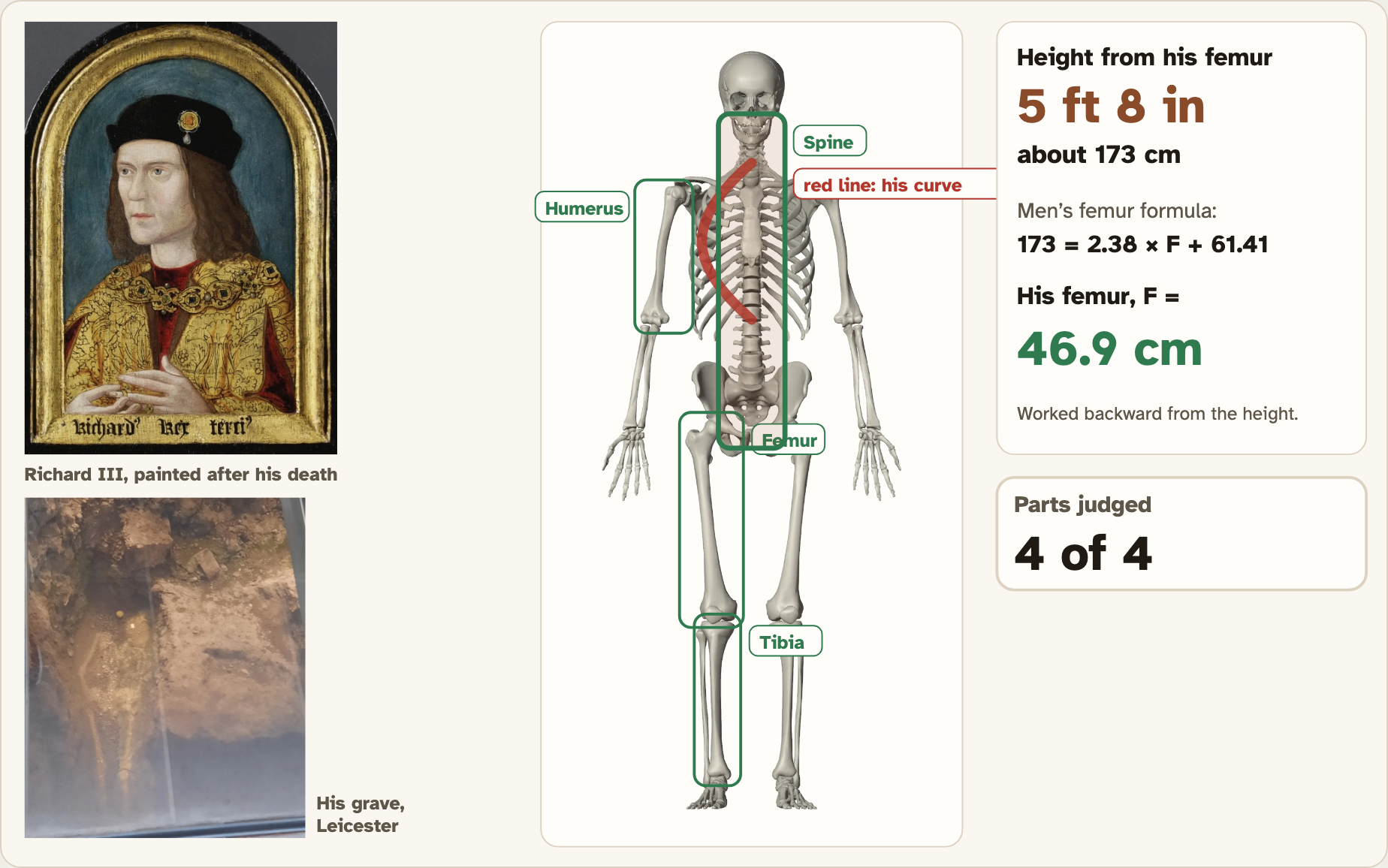
Screenshot: mrsajdak.com/bonecase, Tab 4
PART 4 · LEARN IT · 3 OF 4
Structure tells you what to measure
The femur is long and straight and not part of the spine. Its length still matches the height he would have had with a straight back: about 5 feet 8 inches. With the curve, he looked several inches shorter.
Photo: Society of Antiquaries of London, public domain
PART 4 · LEARN IT · 4 OF 4
What a forensic scientist does
Find the bone. Name it from its shape and place. Measure it the standard way. Use a formula from many skeletons. Give a range. You did all five.
Photo: RobinLeicester, CC BY-SA 4.0
PART 4 · QUESTION 15
Explain it
Question 15
Why did scientists use Richard III’s femur, not his spine, to estimate his height?
What happened
His spine, his limbs, his height.
The science idea
How the femur is built, and why that matters.
How the evidence shows it
Connect the facts to the idea.
PART 4 · THE BIG IDEA
Pick the bone whose structure was not changed. A straight, normal femur still tells the height a curved spine hides.
IN YOUR WORDSIf a skeleton had a broken, badly healed femur, which bone would you measure instead?
WRAP IT UP · BACK TO THE START
Revisiting the Phenomenon
Nobody wrote down how tall they were. How can a few bones tell us who a person was and how tall they stood?
1Go back to Photo A. Name three bones you can see now, and the region of each.
2Which bone in Photo A would you measure to find the person’s height? Why that one?
3Your answer to the PREDICT question at the start. Were you right? What would you change?
4A scientist says, "This person was exactly 168 cm tall." What is wrong with saying it that way?
Photos: A, Oxfordshire County Council, Anni Byard, CC BY-SA 4.0; B, Harold9595959, CC BY-SA 4.0
LAST CHECK
Before you hand it in
Name, date and period are on top.
Both sides are done.
Every table is full.
Your explanation uses facts from the case.
Next lesson: inside a bone. Compact and spongy bone tissue.
Photo: RobinLeicester, CC BY-SA 4.0