ANATOMY AND PHYSIOLOGY · CHAPTER 6
Burns and Wounds Lab
Follow along with your worksheet, one question at a time.
mrsajdak.com/burns
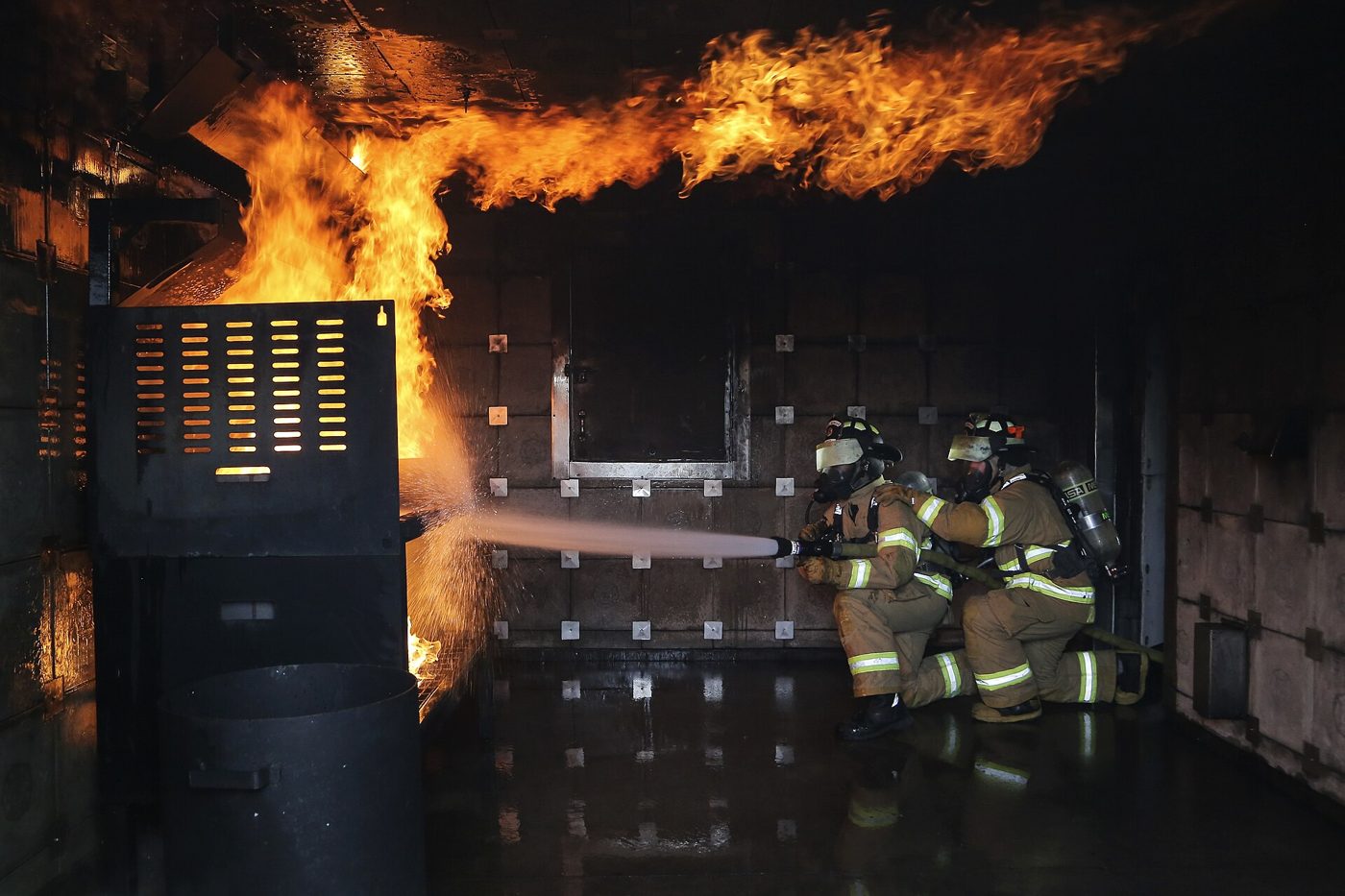
Photo: Alejandro Pena, U.S. Air Force, public domain
START HERE
Phenomenon: One Hand, Two Photos
Photos: Vera de Kok (1Veertje), CC BY-SA 3.0
START HERE
Observe, wonder, predict
These photographs show the same hand. Something hot hurt the skin before Photo A was taken. Photo B was taken some time later. How can skin that looks this hurt look almost normal again?
OBSERVEWhat differences do you notice between the photographs?
WONDERWhere might the new skin in Photo B have come from?
PREDICTWill every burn heal this well? Explain your reasoning.
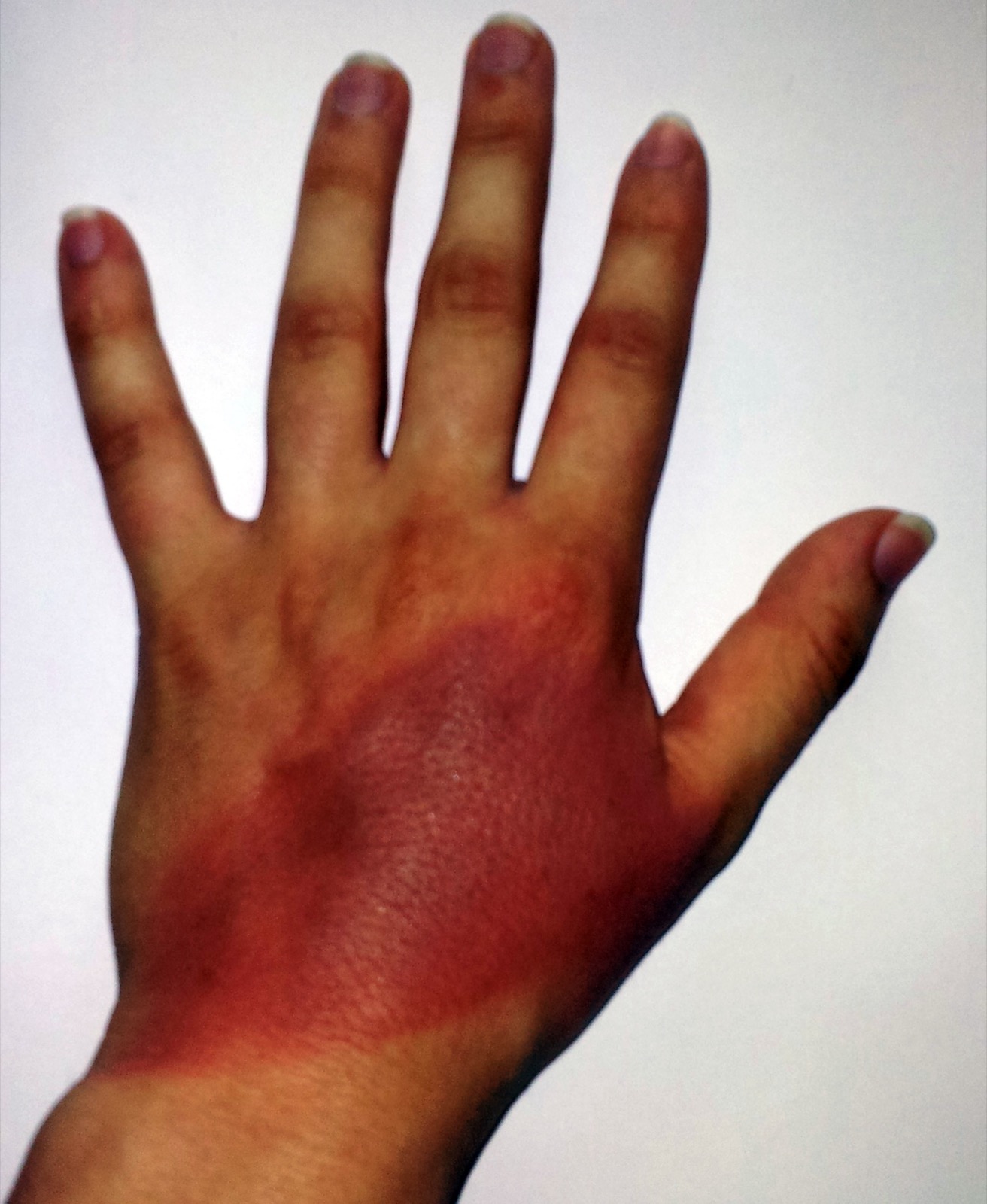
Photo A, up close.
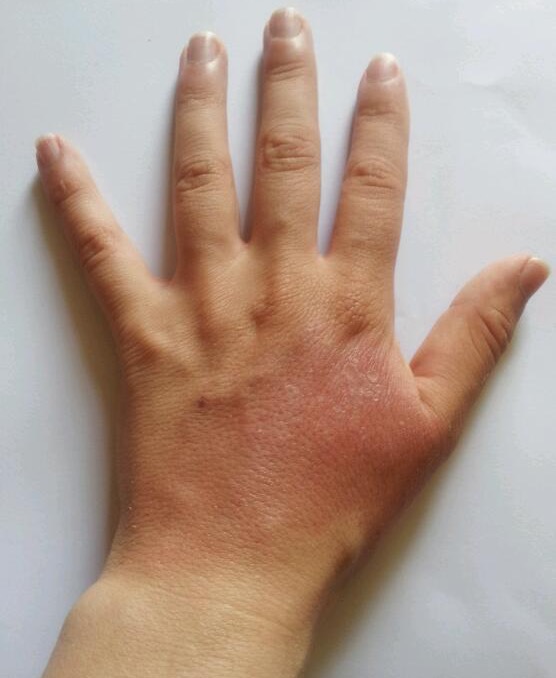
Photo B, up close.
Photos: Vera de Kok (1Veertje), CC BY-SA 3.0
DRIVING QUESTION
Why do some burns heal clean and others scar?
START HERE
What Happened Here?
Finished observing? Click here to find out.
In May 2012, boiling water burned the back of this person's left hand. Photo A was taken 2 days later. Photo B was taken about 10 days after Photo A. Water does not have to boil to do this. Hot tap water at 140°F (60°C) can cause a serious burn in about 5 seconds.
Today, you will investigate how heat and time burn the skin, how nurses read a burn, and how the body closes a wound. At the end of the investigation, you will compare how a scrape and a severe burn heal and return to the original driving question.
BEFORE YOU START
Your skin is a wall
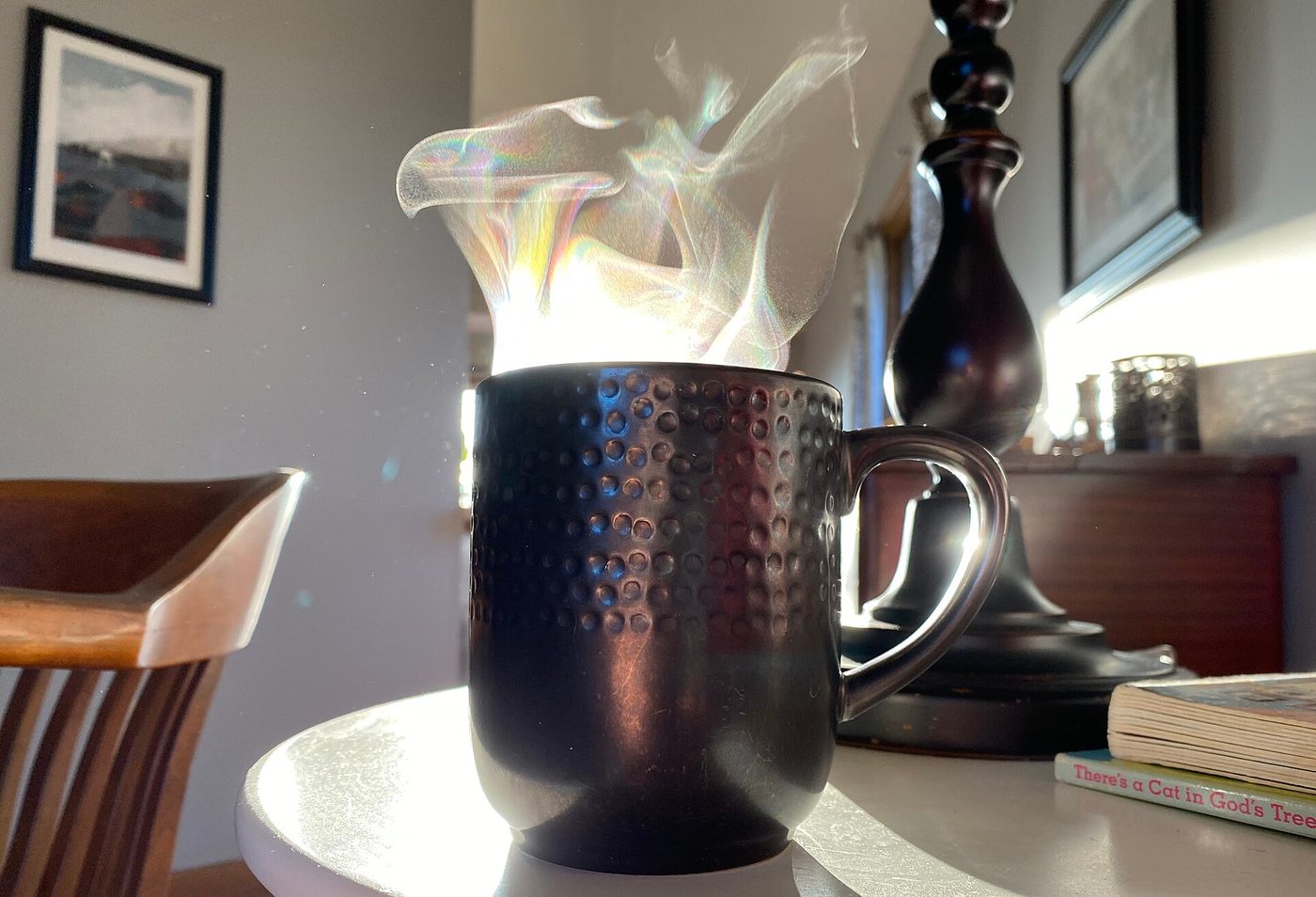
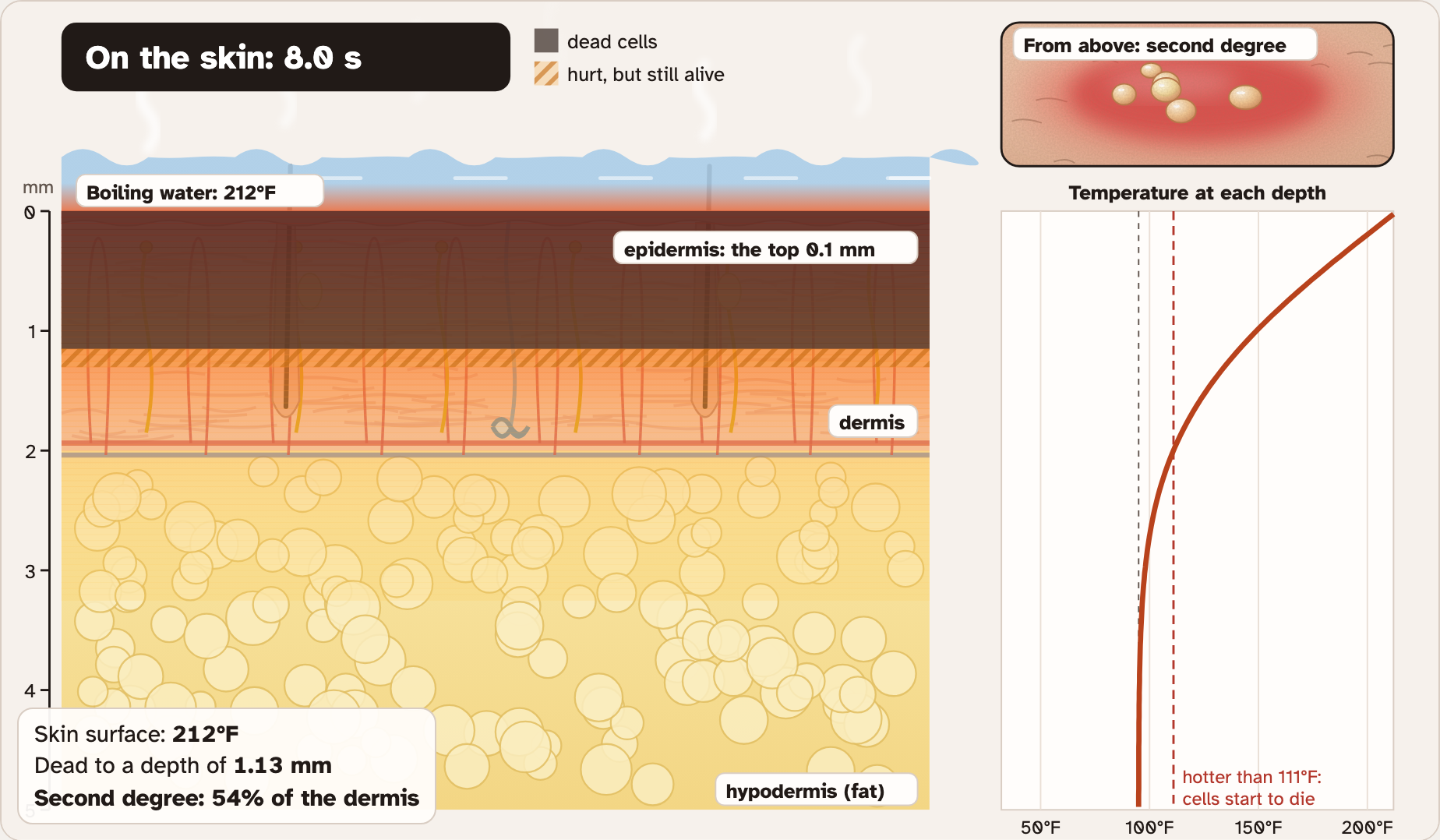
Coffee is served at about 180°F. Is that hot enough to hurt you?
Words for this lab
A burn is skin killed by heat.
A wound is a break in the skin, or under it.
The epidermis is the thin top layer of the skin.
The dermis is the thick layer under it. It holds the blood vessels, nerve endings and hair roots.
Which is worse: boiling water for one second, or hot tap water for one minute?
Photo: PedanticNarrativeController, CC0
BEFORE YOU START
What you will learn
BURNS
I can use data to explain how the temperature and the time of contact decide how deep a burn goes.
I can tell a first-, second- and third-degree burn apart from its signs, and measure a burn with the rule of nines.
WOUNDS
I can name six kinds of wounds from how they were made and how they look.
I can put the four stages of healing in order and tell what the cells do in each one.
BEFORE YOU START
Get set up
1
Open mrsajdak.com/burns on your device.
2
Write your name, the date and your period on the worksheet.
3
Find the tabs at the top of the lab. Each tab goes with one part of the worksheet.
4
Burns are the front of the worksheet. Wounds are the back.
5
Start on Tab 1. Do not skip ahead.

| Tab in the lab | Worksheet | Questions |
|---|---|---|
| 1. Heat and time | Part 1 | 1 to 6 |
| 2. Read the burn | Part 2 | 7 to 9 |
| 3. Rule of nines | Part 3 | 10 to 13 |
| 4. Six wounds | Part 4 | 14 to 17 |
| 5. Heal it | Part 5 and Wrap it up | 18 to 23 |
Screenshot: mrsajdak.com/burns
BURNS · TAB 1 · QUESTIONS 1 TO 6
Part 1. Heat and time
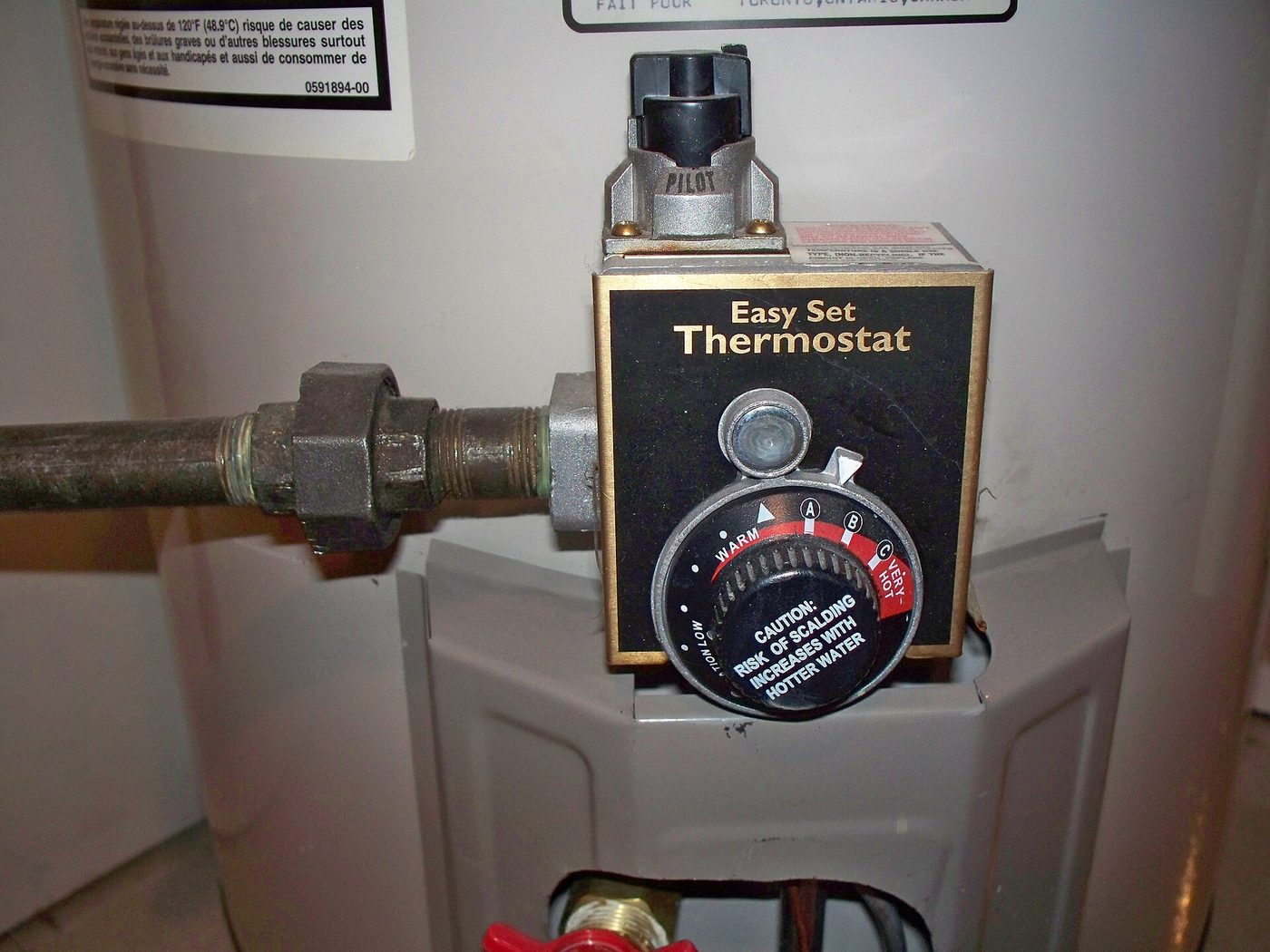
Every home water heater has a dial. Turn it up and the showers are hotter. Read the red label.
You will run water of six temperatures over skin. You will time how long each one takes to burn.
Photo: Jason Woodhead, CC BY 2.0
PART 1 · QUESTION 1
Run six waters
1
Under Time on the skin, pick 10 min. Keep Adult and Nothing.
2
Under Hot water, pick 104°F. Press Run.
3
Watch the orange glow sink in. The dark band is dead cells.
4
A row is added to Your runs. Copy 2nd degree after and 3rd degree after.
5
Do the other five waters. Change nothing else.
PART 1 · QUESTIONS 2 TO 4
Read your table
QUESTION 2
How many times as long?
Find your 120°F time. It is in minutes. Change it to seconds.
Divide it by your 140°F time.
QUESTION 3
The water that never burned
One column of your table says never.
Find the dashed red line on the graph in the lab. Read its label.
QUESTION 4
Whose skin?
Run 140°F for 10 min with Adult, then with Small child.
Read the ruler. Find where the dermis ends in each skin.
Example
2.0 min × 60 = 120 s
One minute is 60 seconds. These are not your numbers.
Example
120 s ÷ 4 s = 30
One burn takes 120 s. Another takes 4 s. The first takes 30 times as long. These are not your numbers.
PART 1 · QUESTION 5
A fair test of first aid
The question
What should you do in the first minutes after a burn?
Set up
212°F Boiling water, 10 s, Adult.
Change one thing
Only First aid, right after. Run all four.
What to read
Dead after 2 min, Dead 2 days later and Burn, 2 days later.
Then
Copy all four rows into the Question 5 table.
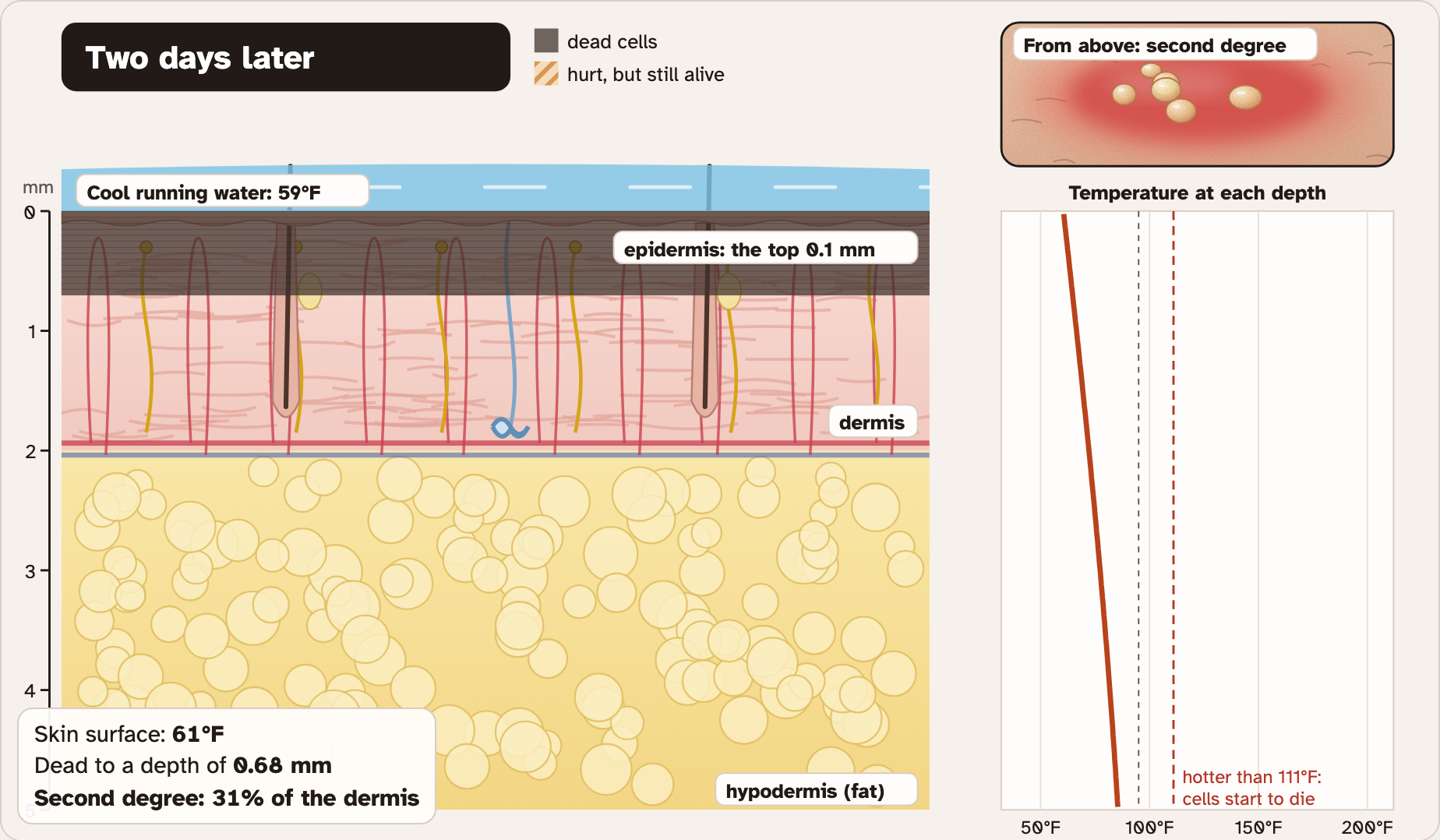
Striped cells are hurt but alive. In the next two days they heal, or they die.
This is coffee for 5 seconds, cooled with water. It is not in your table.
Screenshots: mrsajdak.com/burns, Tab 1
PART 1 · LEARN IT · 1 OF 4
Heat moves in by conduction
Hot water heats the surface first. Each layer warms the layer under it. It takes time for the heat to reach deep down.
Screenshot: mrsajdak.com/burns, Tab 1
PART 1 · LEARN IT · 2 OF 4
Temperature and time
Skin cells start to die above about 111°F. The hotter they get, the faster they die. A few degrees can change the time a lot.
Photo: Jason Woodhead, CC BY 2.0
PART 1 · LEARN IT · 3 OF 4
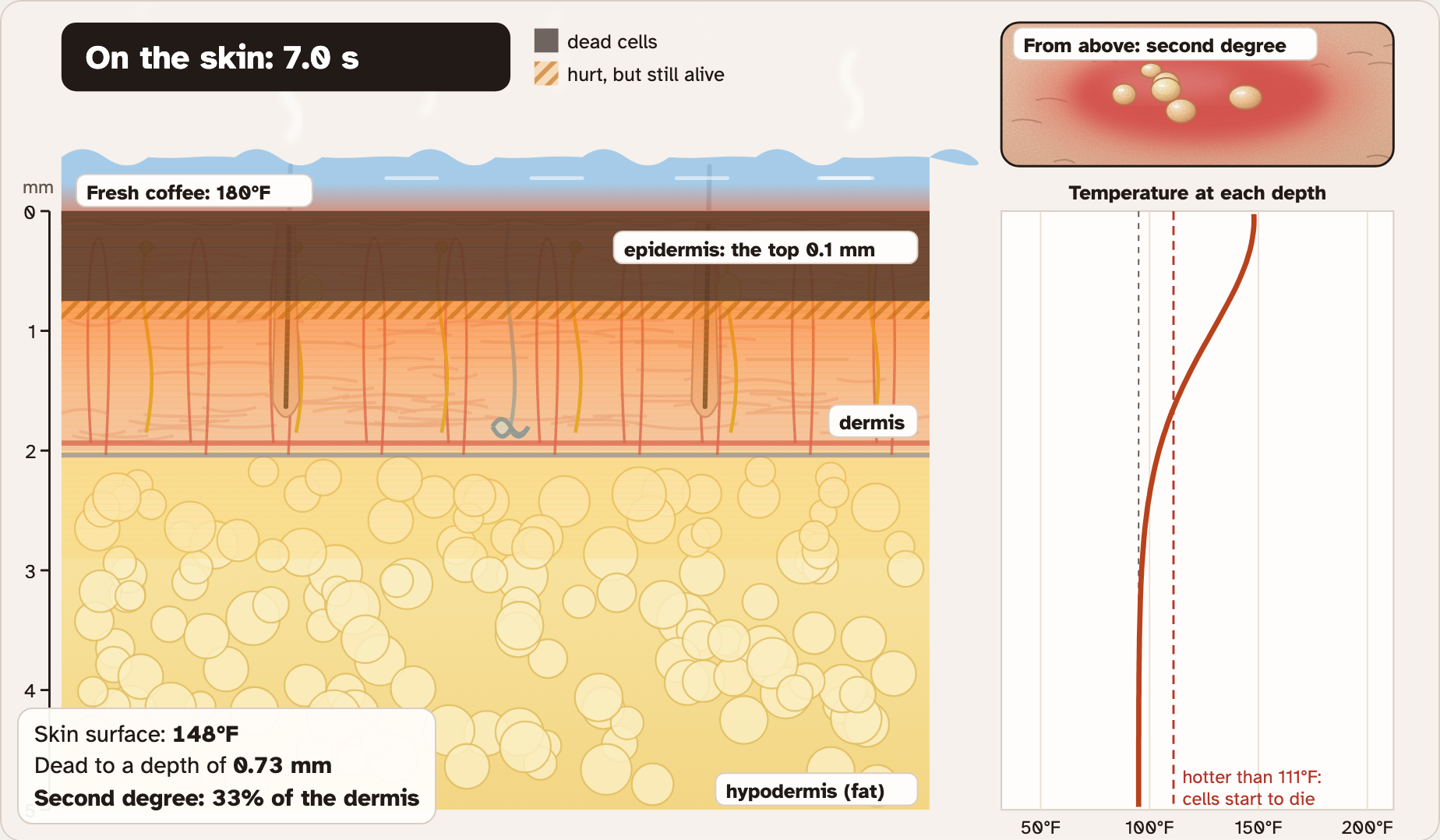
How deep the dead cells reach
3rd degree after is when the dead cells reach the bottom of the dermis. The heat has to cross all the skin above that line first.
Screenshot: mrsajdak.com/burns, Tab 1
PART 1 · LEARN IT · 4 OF 4
The burn keeps going
The skin stays hot after the water stops. The hurt cells under the burn heal or die. Cool running water pulls the heat out. Ice hurts skin too.
Screenshot: mrsajdak.com/burns, Tab 1
PART 1 · QUESTION 6
Explain what you saw
QUESTION 6a
Whose skin burns through sooner?
Use your Question 4 ruler numbers.
Use conduction to explain why the child's skin burns through sooner.
QUESTION 6b
The best first aid, and the worst
Pick the best first aid. Back it up with two numbers from your Question 5 table.
Use what happens after the water stops to explain why butter is the worst.
PART 1 · THE BIG IDEA
Heat kills skin cells one layer at a time. Hotter water, more time or thinner skin makes a deeper burn. Cool running water stops it. Ice and butter do not.
IN YOUR WORDSWhy should you run cool water over a burn for 20 minutes?
BURNS · TAB 2 · QUESTIONS 7 TO 9
Part 2. Read the burn
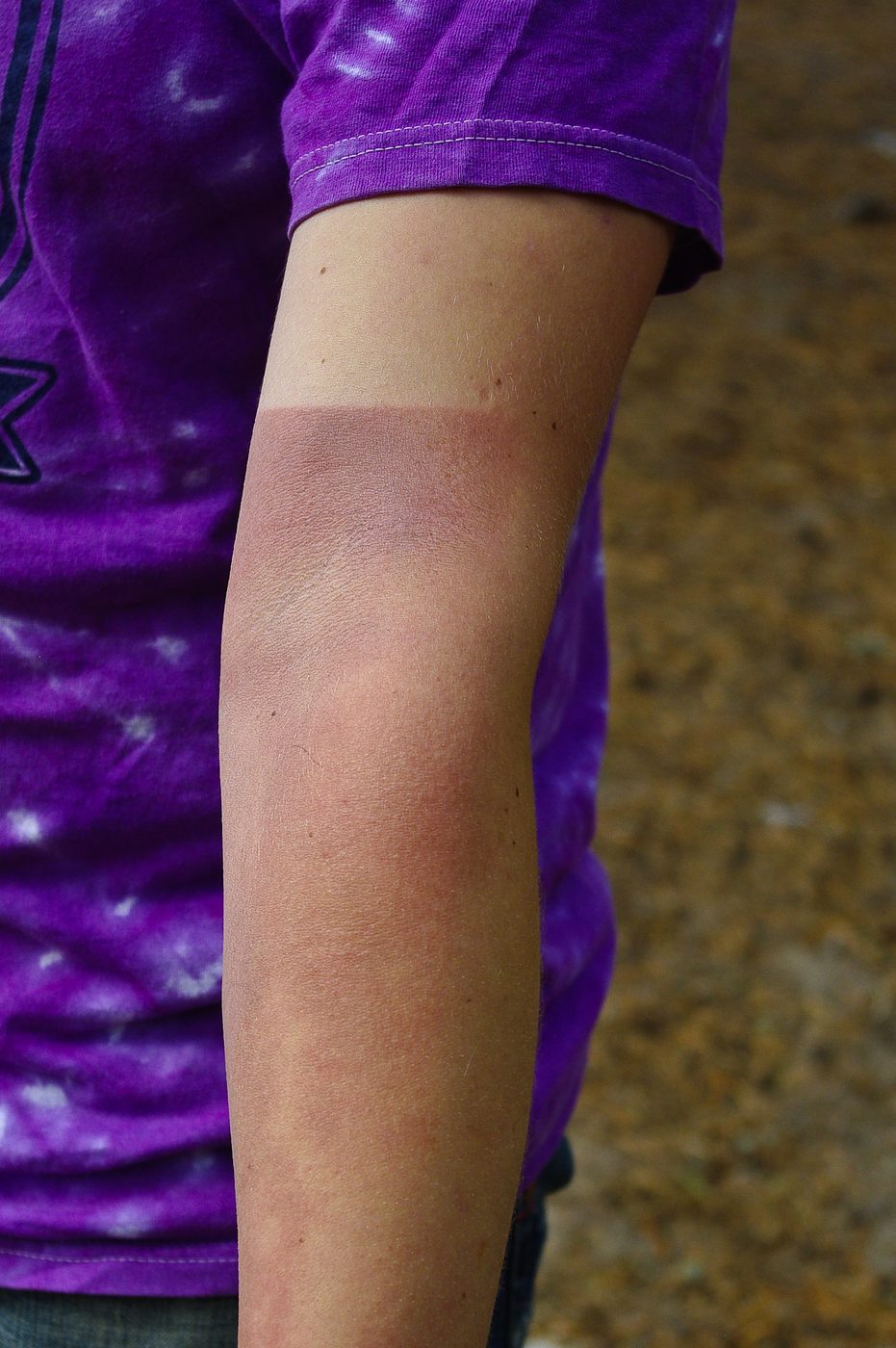
A sunburn is a burn. It is the mildest kind.
A nurse cannot cut a burn open to see how deep it goes. She reads the signs on top.
You will examine six burns with four tools.
Photo: Taavi Adamberg, CC BY-SA 3.0
PART 2 · QUESTION 7
Four tools, six burns
1
Under Six burns, press 1. Read the story.
2
Pick Look. Click the burn.
3
Pick Press. Click the burn. Watch the color, and read the stopwatch.
4
Pick Pin, then Hair. Click the burn each time.
5
Now classify the burn. A wrong pick gets crossed out.
6
Copy the row from Burns you classified. Do all six.
PART 2 · QUESTION 8
Three depths of burn
QUESTION 8
How deep does each one go?
Solve a case in the lab. Then look at Inside the skin. It shows which layers the burn reached.
Photos: Taavi Adamberg, CC BY-SA 3.0 · Themidget17, CC BY-SA 4.0 · Craig0927, public domain
PART 2 · QUESTION 9
The worst burn hurts the least
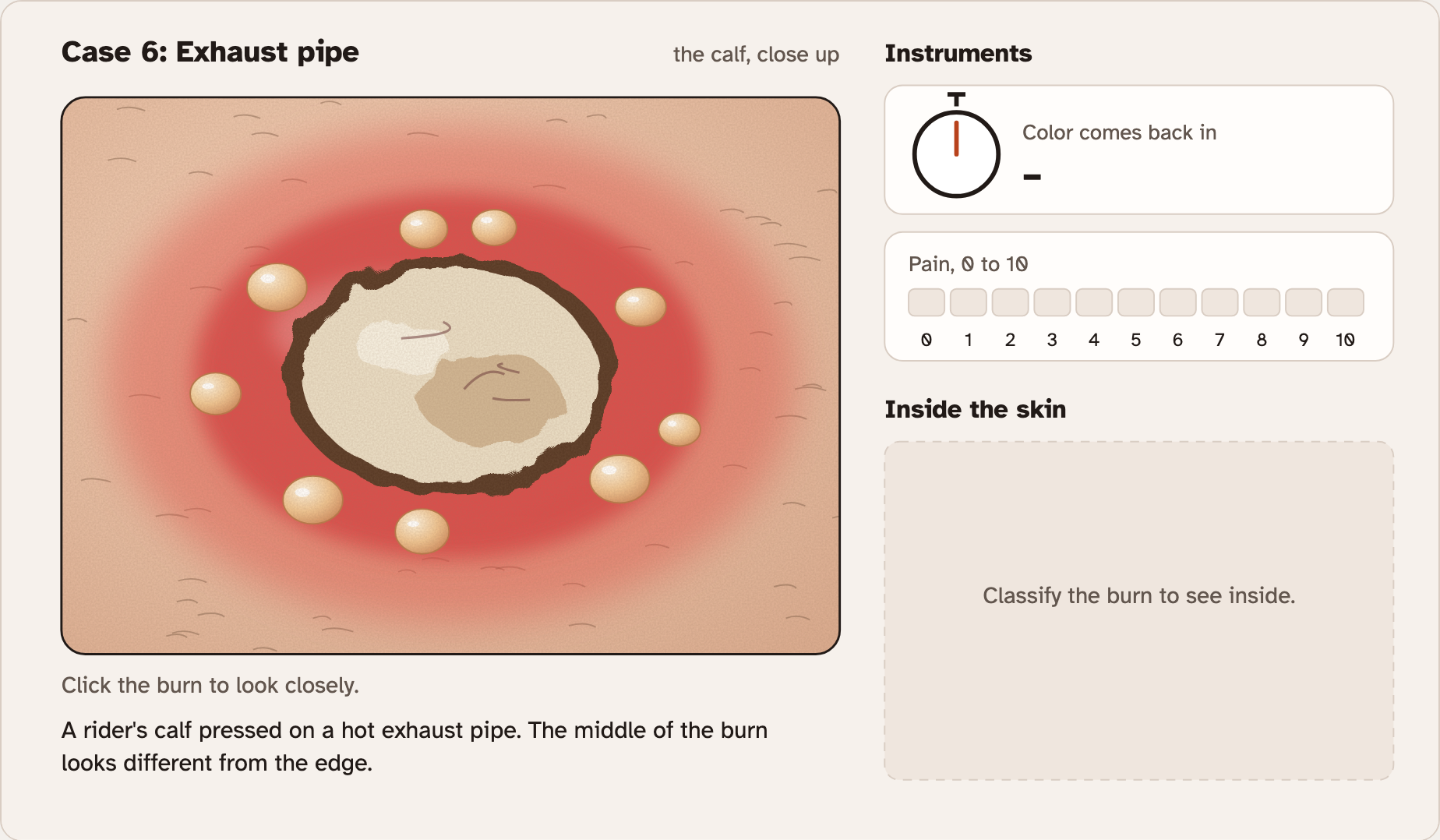
Case 6. Test the middle. Then test the edge.
LOOK AT YOUR TABLE
Which burns scored 0 for pain?
Find them in the Pain column. Read their Degree.
THINK ABOUT IT
What feels pain?
Nerve endings feel pain. Think back to the Skin Lab. Which layer are they in?
What has happened to that layer in these burns?
Screenshots: mrsajdak.com/burns, Tab 2
PART 2 · THE BIG IDEA
A burn shows its depth on top. Red and dry: first degree, the epidermis only. Wet blisters: second degree, into the dermis. White or leathery with no pain: third degree, through the dermis.
IN YOUR WORDSWhy can the deepest burn hurt the least?
BURNS · TAB 3 · QUESTIONS 10 TO 13
Part 3. Rule of nines
How deep is only half the story. The other half is how much skin is burned.
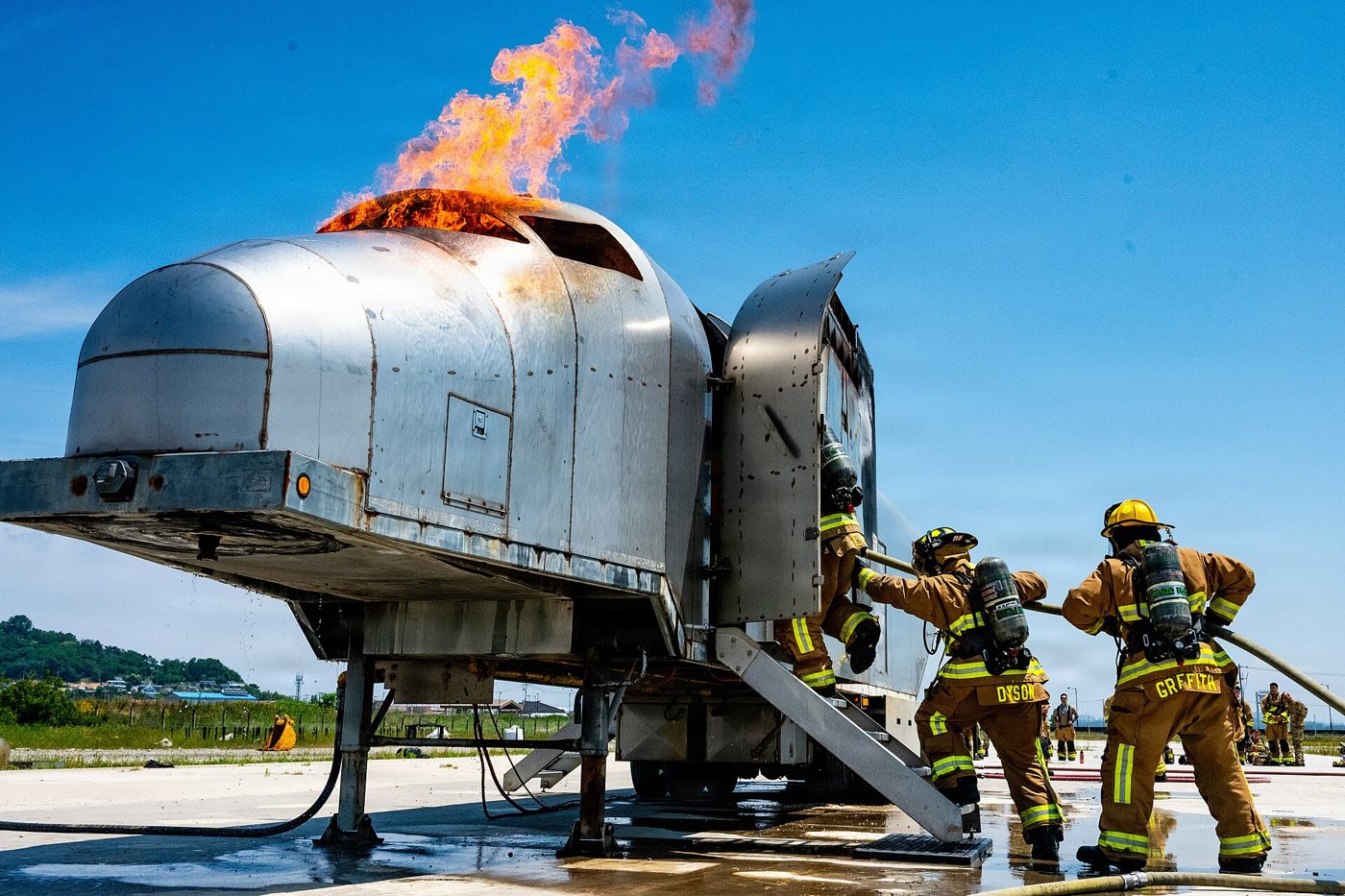
A fire crew or a burn team needs that number in the first minutes. So they use a shortcut: the body, cut into pieces of 9%.
You will paint four patients and work out the fluid each one needs.
Photo: Staff Sgt. Brandon Keys, U.S. Air Force, public domain
PART 3 · QUESTION 10
The body in nines
1
Open Tab 3. Find the numbers on the two bodies.
2
Each number is the percent of the whole skin in that part.
3
One body is the front. The other is the back.
4
Question 10: add the front and the back of each part.
5
Check: all the parts of the body should add up to 100%.
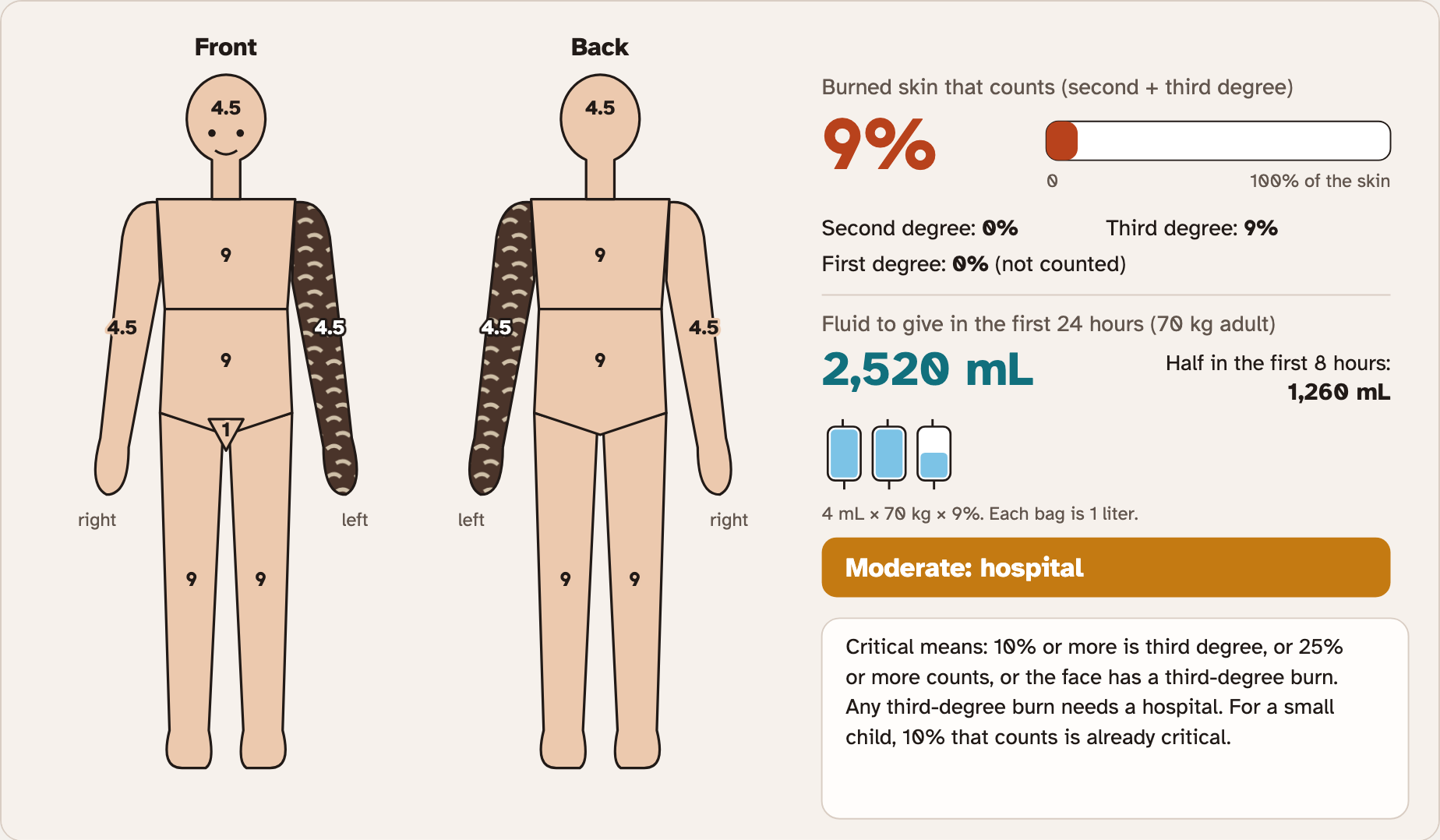
This patient is not on your worksheet.
Screenshots: mrsajdak.com/burns, Tab 3
PART 3 · QUESTION 11
Paint four patients
1
Under Four patients, press 1. Read the story.
2
Pick a Brush: First, Second or Third degree.
3
Click each burned part. Check: is it the front or the back?
4
Press Check my painting. If it does not match, read the story again.
5
Copy the row from Your patients. Do all four.
PART 3 · QUESTION 12
Fluid, and a smaller body
QUESTION 12
Show the math
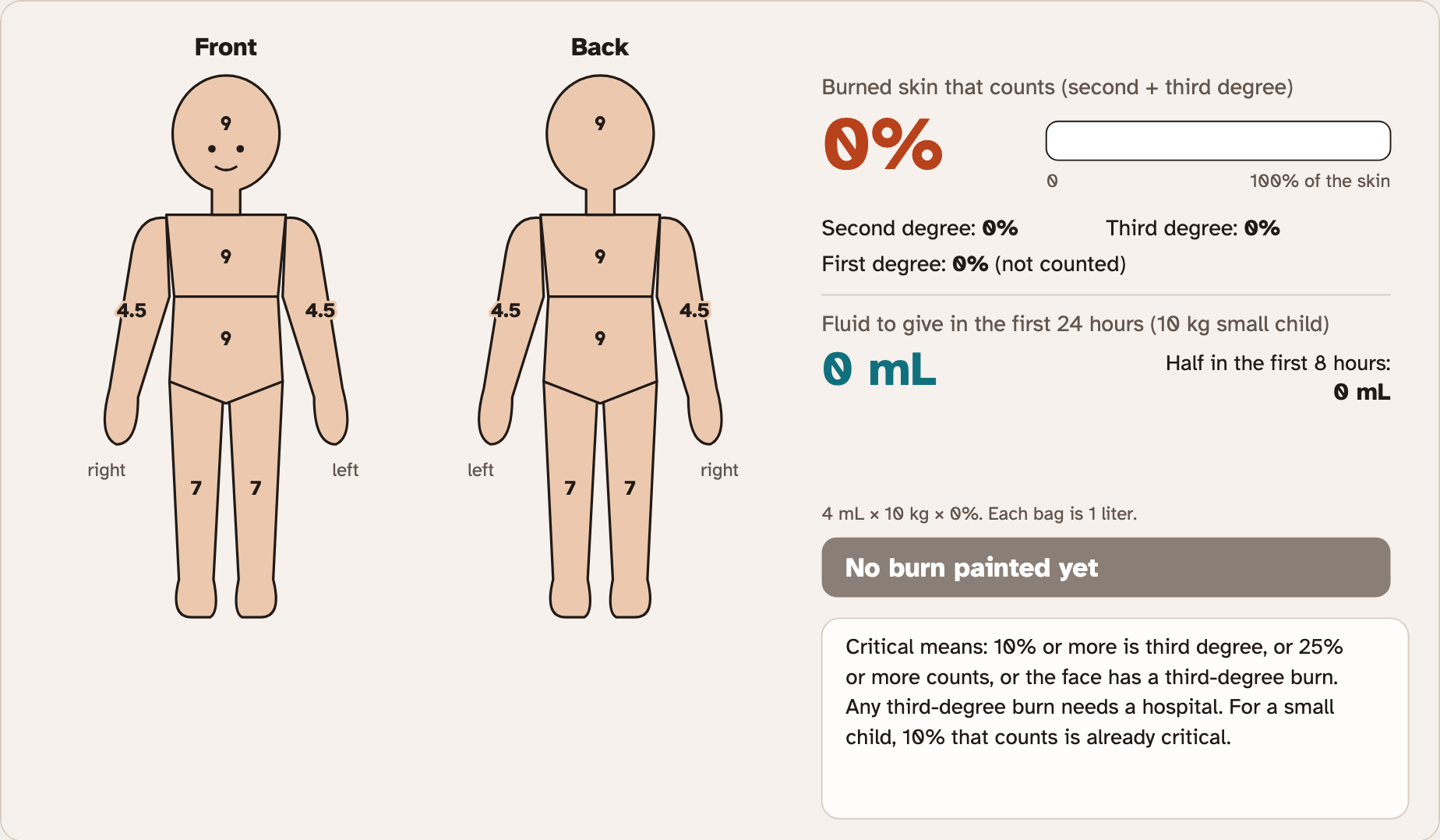
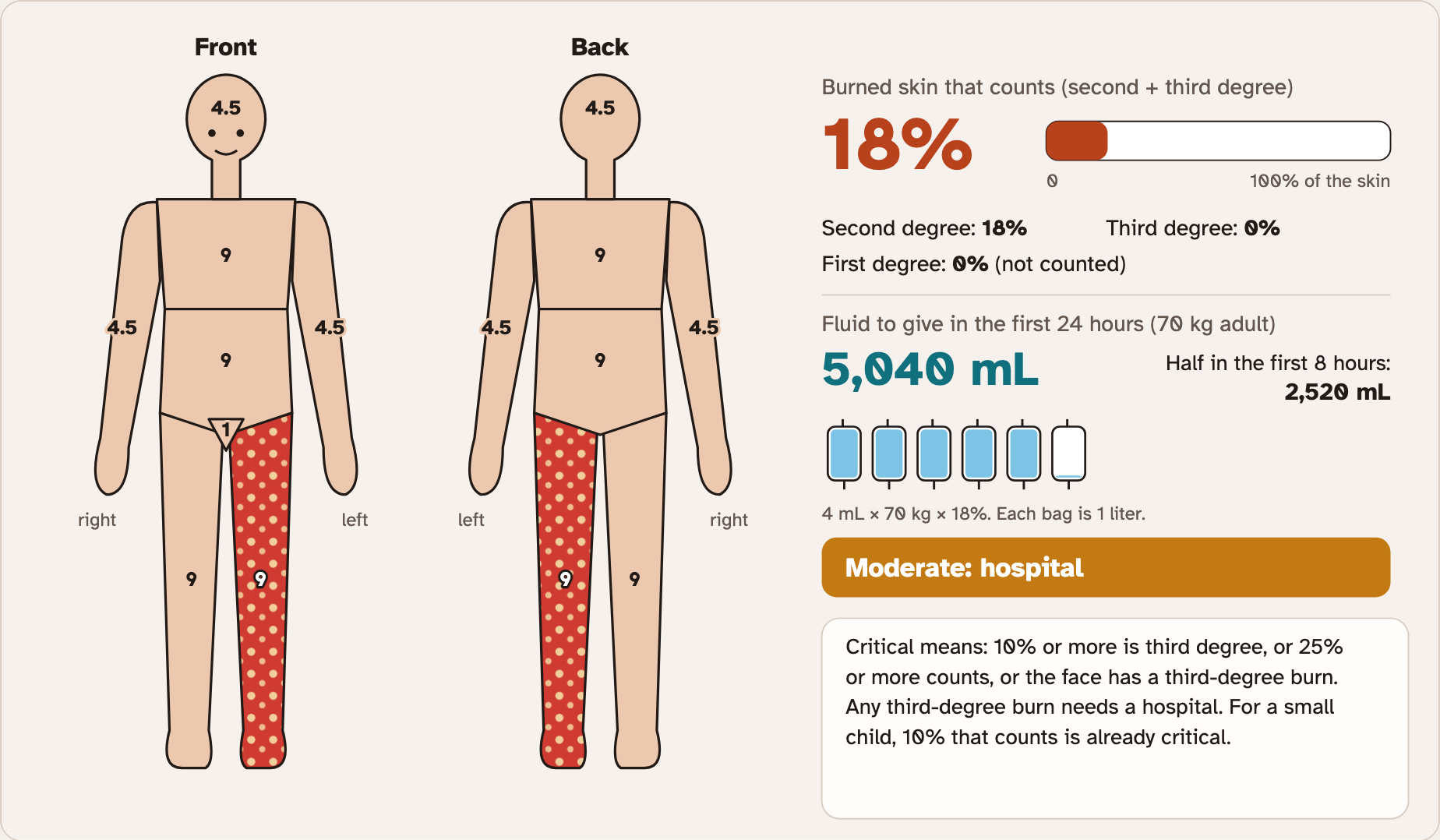
The fluid for the first day is 4 mL × kilograms × percent burned.
Example: 60 kg and 10% burned is 4 × 60 × 10 = 2,400 mL. These are not your numbers.
QUESTION 12
Switch to Small child
Read the numbers on the head and the legs. Write the adult and the child numbers.
Screenshots: mrsajdak.com/burns, Tab 3
PART 3 · LEARN IT · 1 OF 4
Skin keeps water in
Your skin is a wall. It keeps the water in your body from leaking out. The dermis is full of tiny blood vessels.
Screenshot: mrsajdak.com/burns, Tab 4
PART 3 · LEARN IT · 2 OF 4
A deep burn leaks
A burn that reaches the dermis hurts its vessels. Fluid leaks out through the burn. A big burn can lose liters of fluid in a few hours.
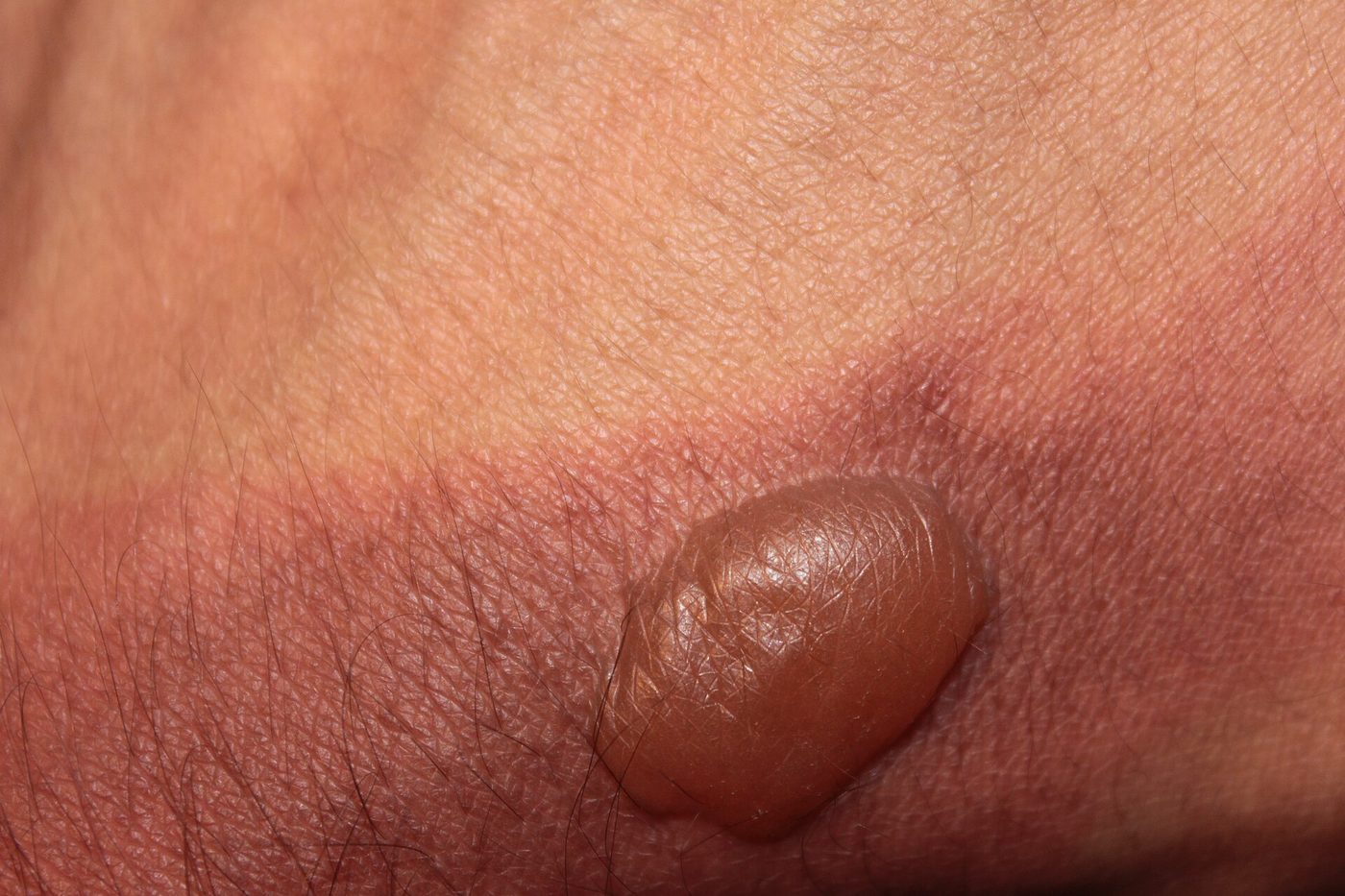
Photo: Themidget17, CC BY-SA 4.0
PART 3 · LEARN IT · 3 OF 4
Count the burns that leak
Doctors add up the percent of skin with burns that reach the dermis. Then they give that much fluid back through a vein.
Screenshot: mrsajdak.com/burns, Tab 3
PART 3 · LEARN IT · 4 OF 4
Bodies grow unevenly
From baby to adult, the legs grow a lot. The head grows much less. So a small child gets a different set of numbers.
Screenshot: mrsajdak.com/burns, Tab 3
PART 3 · QUESTION 13
Explain the numbers
QUESTION 13a
Burned, but not counted
Patient 3 is burned over 27% of his skin, but 0% counts.
Use the word dermis to explain why.
QUESTION 13b
A smaller body
Use your Question 12 numbers for the head and the legs.
Use how bodies grow to explain why the rule of nines changes for a small child.
PART 3 · THE BIG IDEA
Burns that reach the dermis leak fluid. Doctors use the rule of nines to find the percent of skin burned, then give that fluid back. A small child gets different numbers.
IN YOUR WORDSWhy does a big sunburn not need fluid in a hospital?
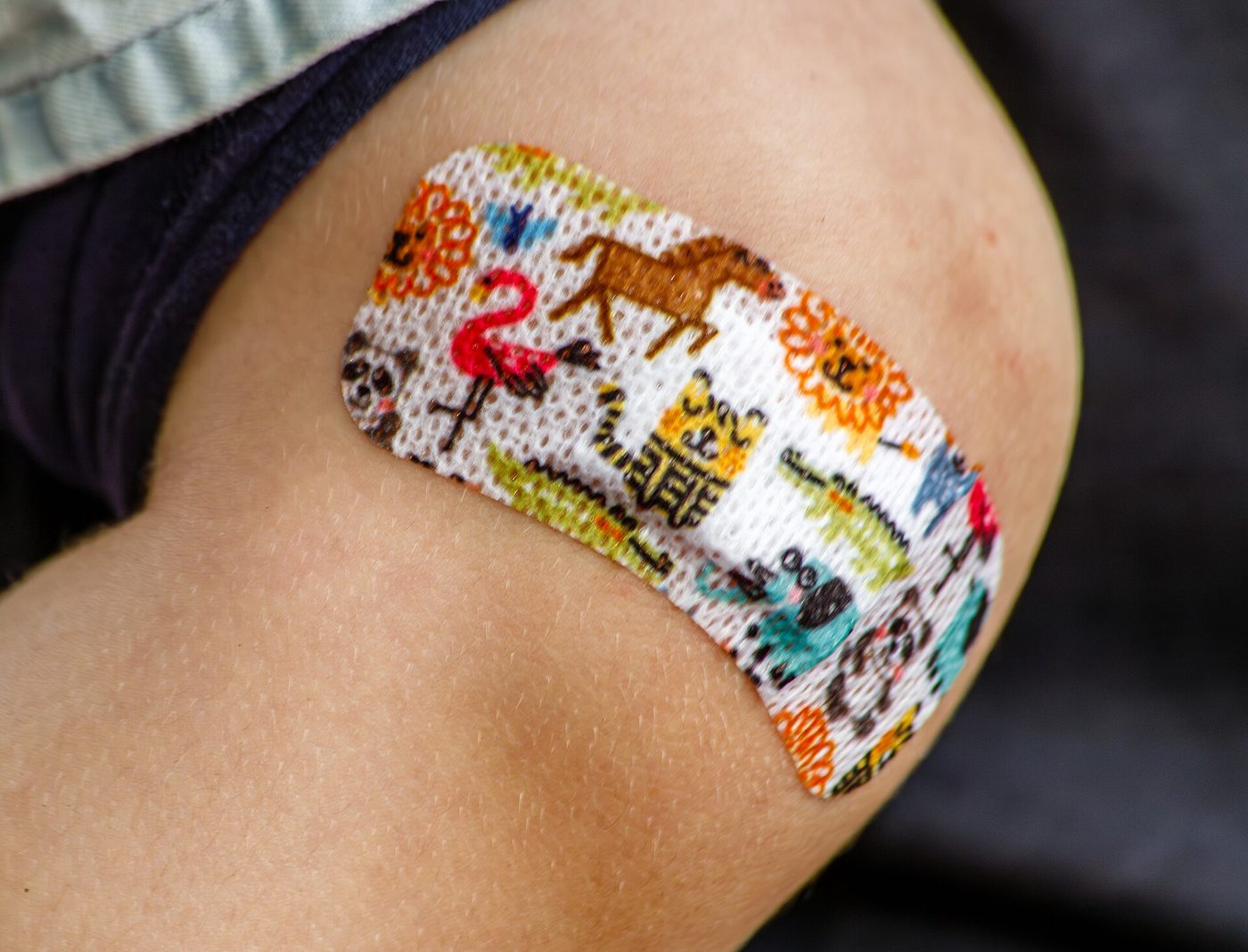
WOUNDS · TAB 4 · QUESTIONS 14 TO 17
Part 4. Six wounds
A wound is a break in the skin, or under it. There is one under this bandage.
The same skin can be opened six ways. Each way leaves a different shape.
You will make all six, then solve six mystery wounds.
Photo: Friedrich Haag, CC BY-SA 4.0
PART 4 · QUESTION 14
Make six wounds
1
Under How did it happen?, pick Slid on pavement.
2
Press Make the wound. Watch the slice of skin.
3
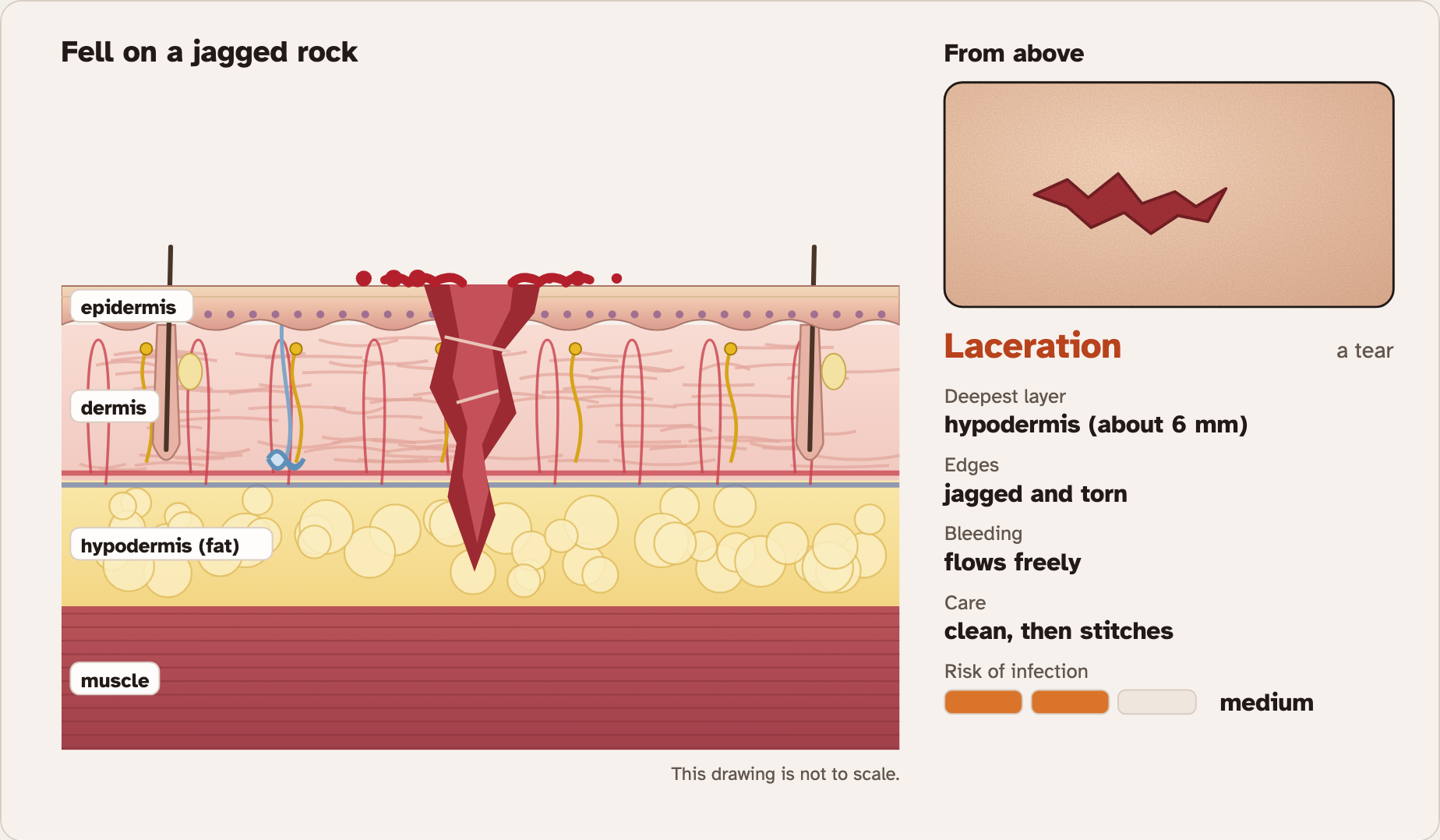
Read the card: the wound, its deepest layer, its edges, its bleeding and its risk of infection.
4
Press Record. Copy the row from Wounds you made.
5
Make the other five.
PART 4 · LEARN IT · 1 OF 4
Sharp or blunt
A sharp edge slices. It leaves straight, smooth edges. A blunt hit tears, with jagged edges. A blunt hit can break vessels without breaking the skin.
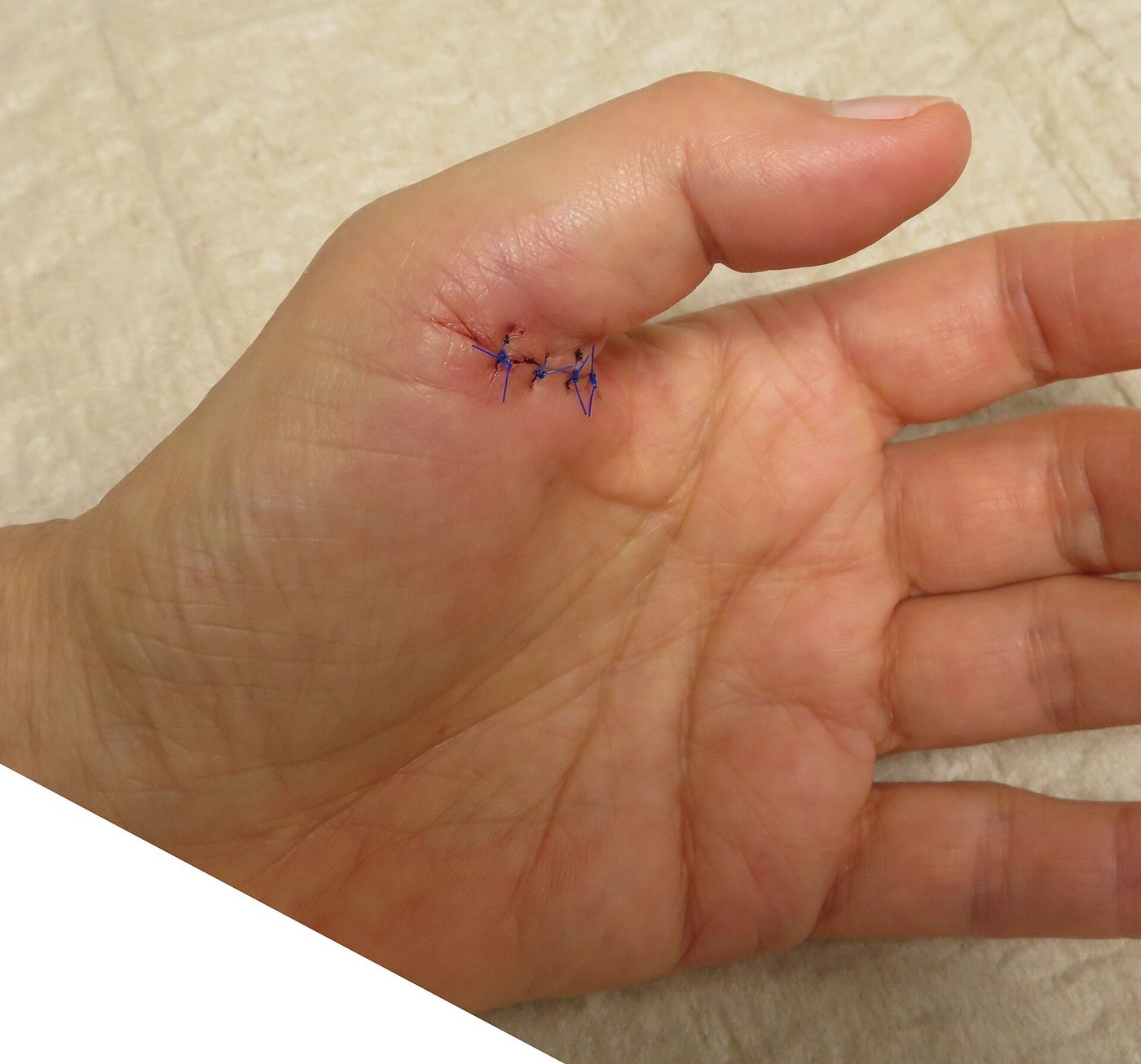
Photo: Sciencia58, CC0
PART 4 · LEARN IT · 2 OF 4
Rubbing and pulling
Rubbing on a rough surface scrapes off the top of the skin over a wide patch. A strong pull can tear a whole flap of skin loose.
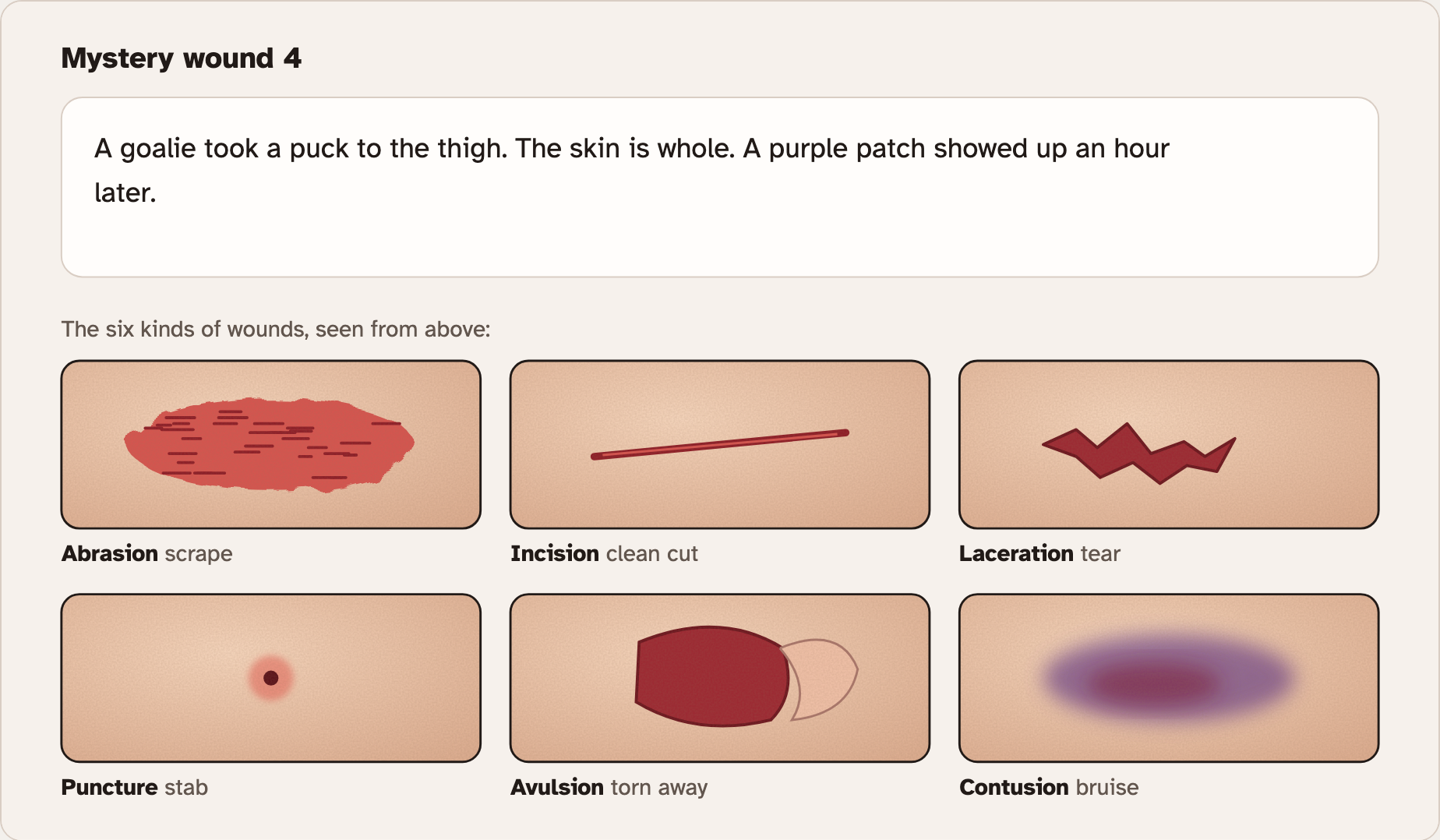
Screenshot: mrsajdak.com/burns, Tab 4
PART 4 · LEARN IT · 3 OF 4
Bleeding washes a wound
Blood flowing out of a wound carries dirt and germs out with it. A wide, open wound is also easy to clean.
Screenshot: mrsajdak.com/burns, Tab 5
PART 4 · LEARN IT · 4 OF 4
Deep and narrow is a trap
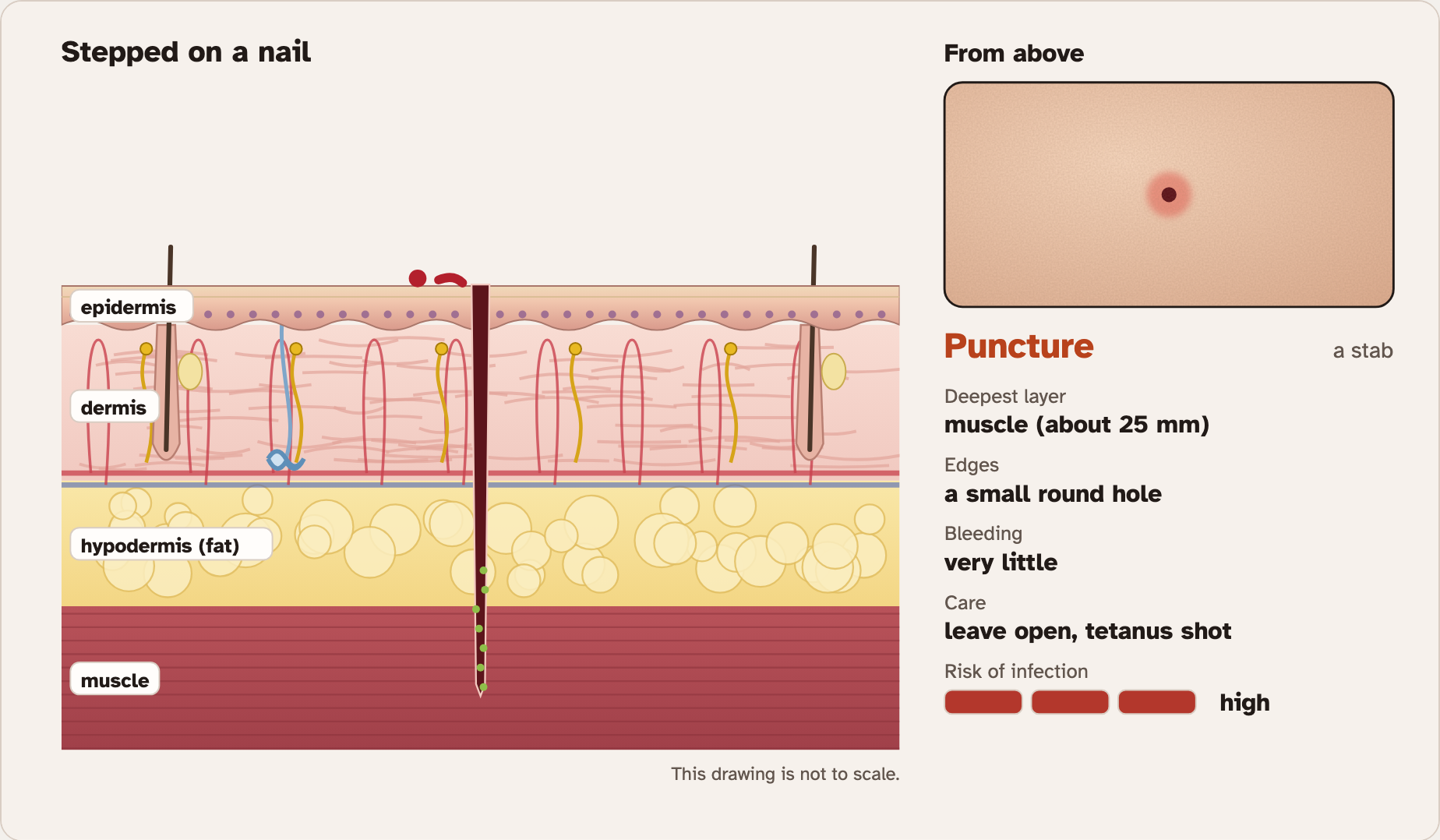
A sharp point pushes germs deep in. A narrow hole is hard to wash and soon closes on top. Tetanus germs grow best where there is no air.
Screenshot: mrsajdak.com/burns, Tab 4
PART 4 · QUESTIONS 15 AND 16
Clues in the story
QUESTION 15
Least blood, most risk
Look at the shape of the puncture in the slice, and its Bleeding in your table.
Use what bleeding does to a wound to explain how both can be true.
QUESTION 16
Six mysteries
Press Mystery wounds.
Read for three clues: what made it, what the edges look like, and how it bled.
Screenshot: mrsajdak.com/burns, Tab 4
PART 4 · QUESTION 17
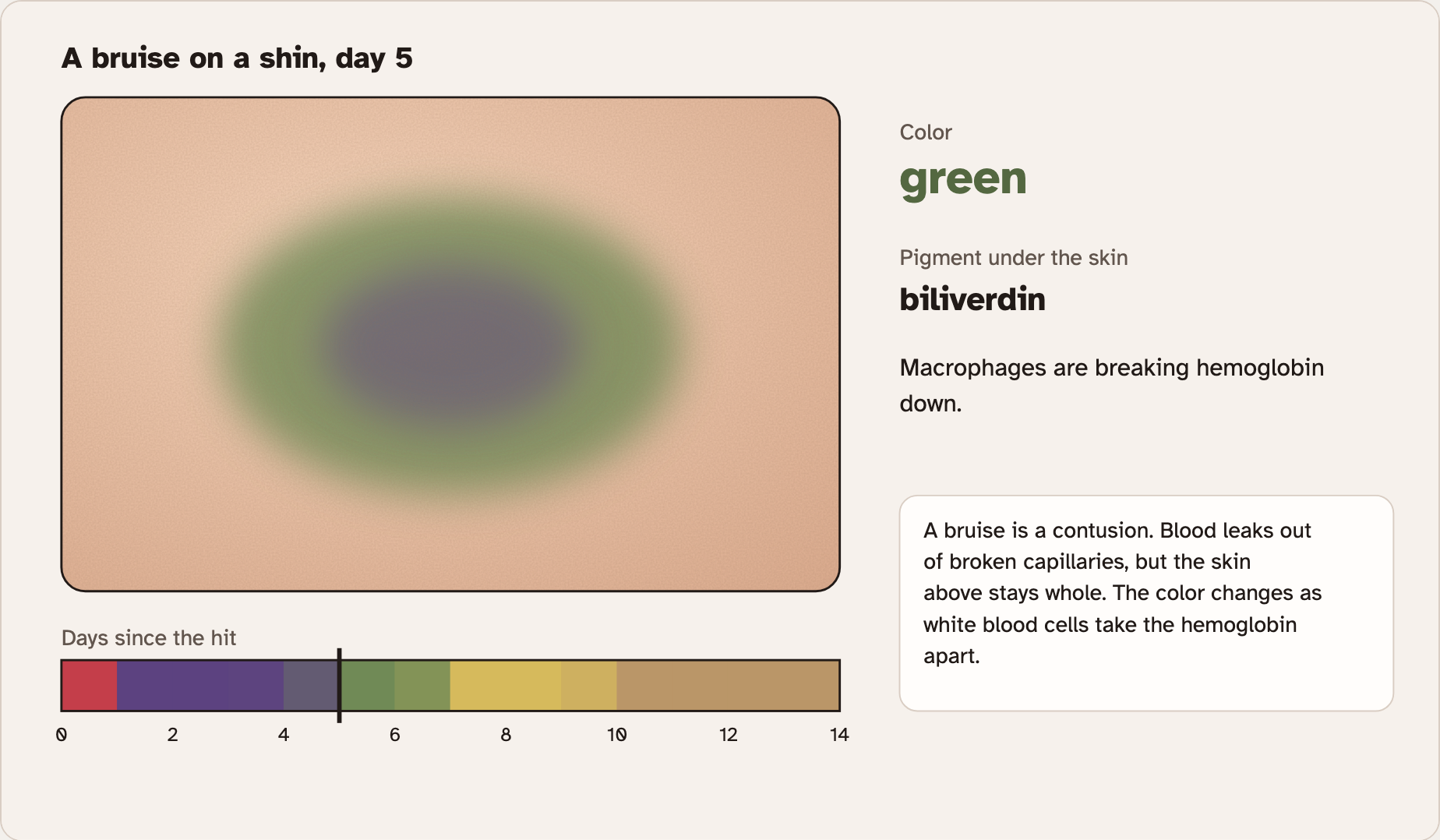
How old is that bruise?
1
Press Bruise clock.
2
Drag Day to 0. Press Record this day.
3
Do the same for days 3, 6, 8 and 12.
4
Copy the color and the pigment for each day.
5
A patient has a green bruise. Use your table to say how old it is.
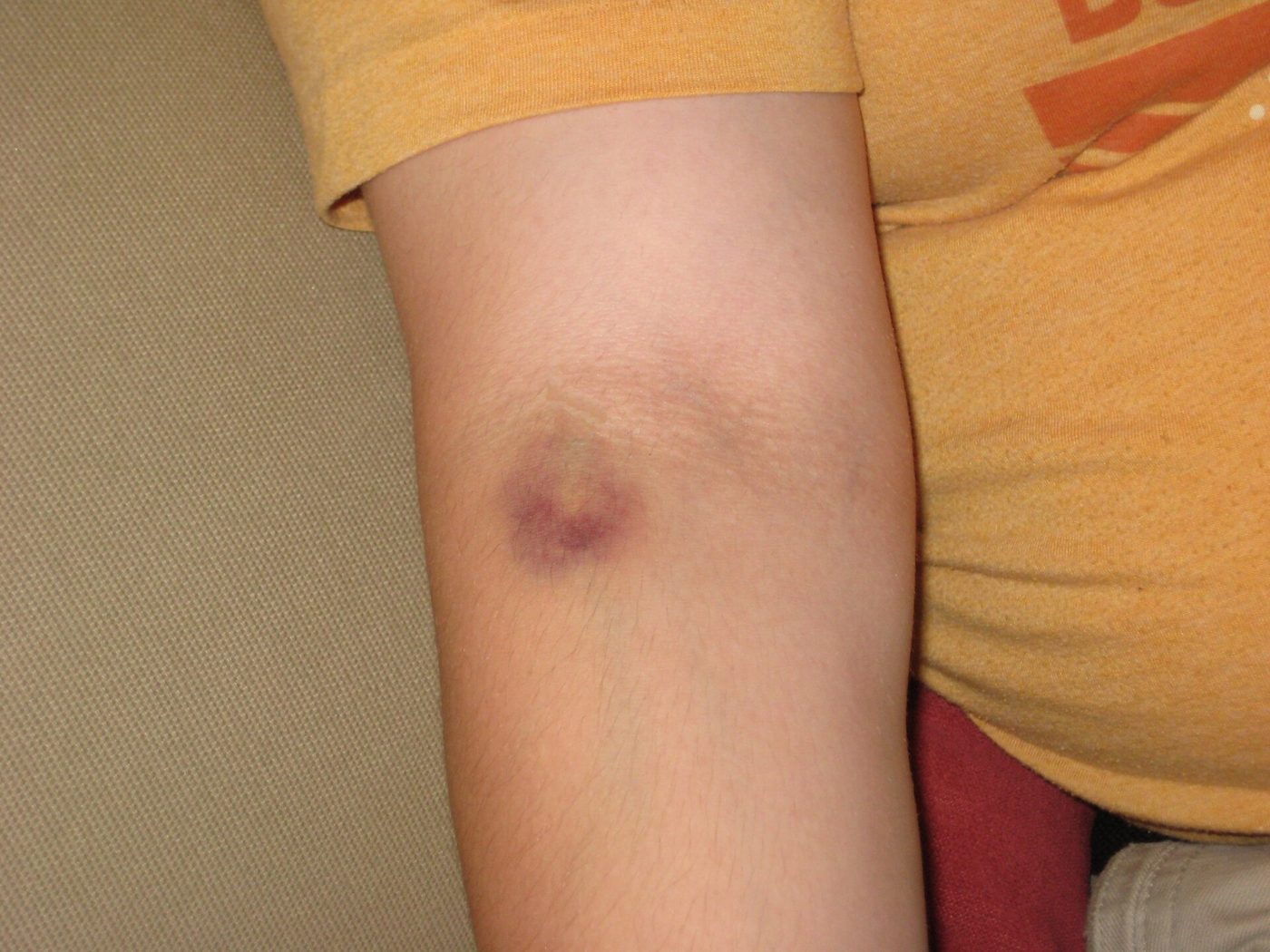
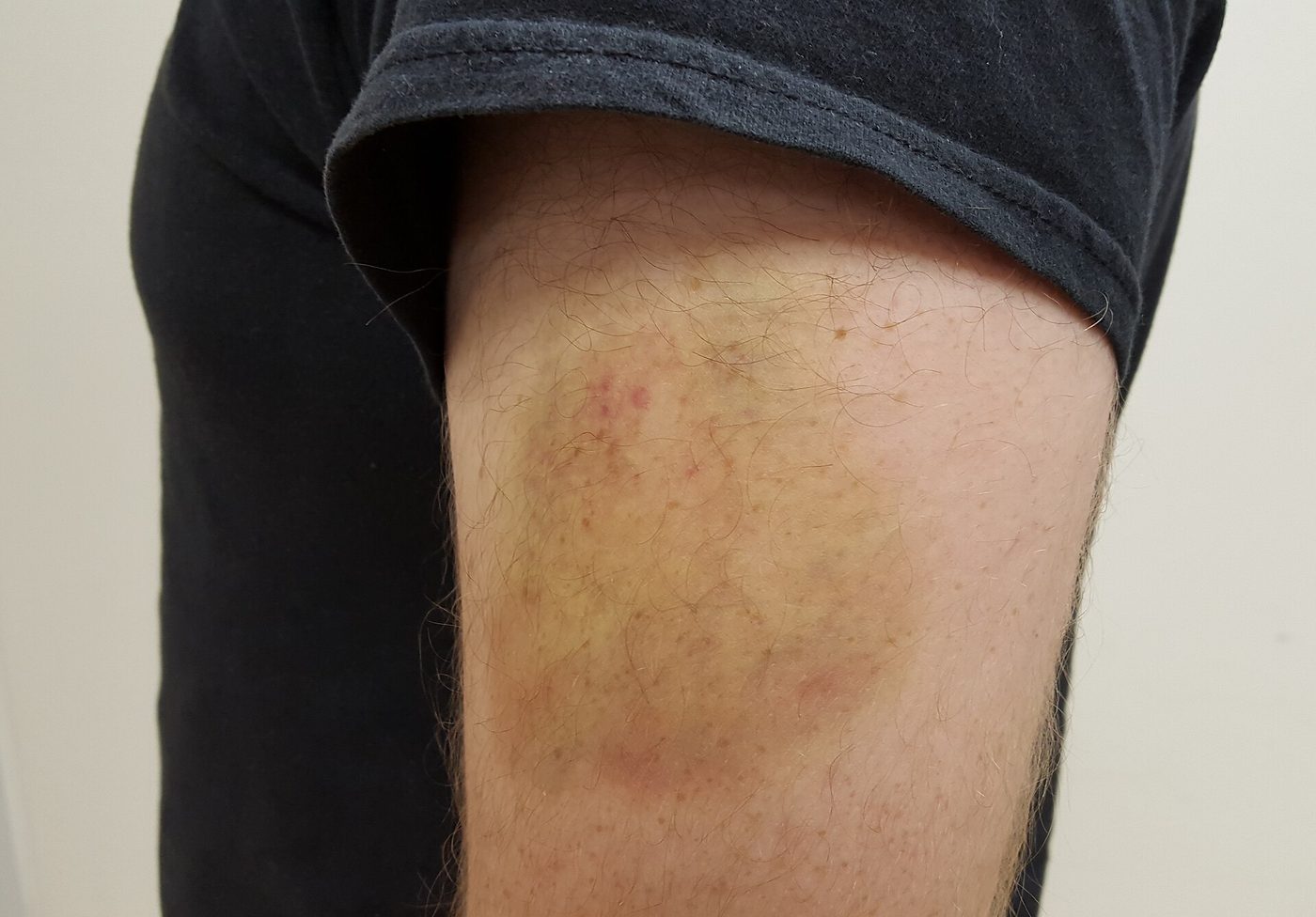
Two real bruises. Which one is older?
Screenshot: mrsajdak.com/burns, Tab 4 · Photos: crayolarabbit, CC BY-SA 2.0 · Whoisjohngalt, CC BY-SA 3.0
PART 4 · THE BIG IDEA
How a wound happens decides its shape, its edges and how it bleeds. A deep, narrow puncture bleeds the least but is the most likely to get infected.
IN YOUR WORDSWhy do people get a tetanus shot after stepping on a nail?
WOUNDS · TAB 5 · QUESTIONS 18 TO 23
Part 5. Heal it
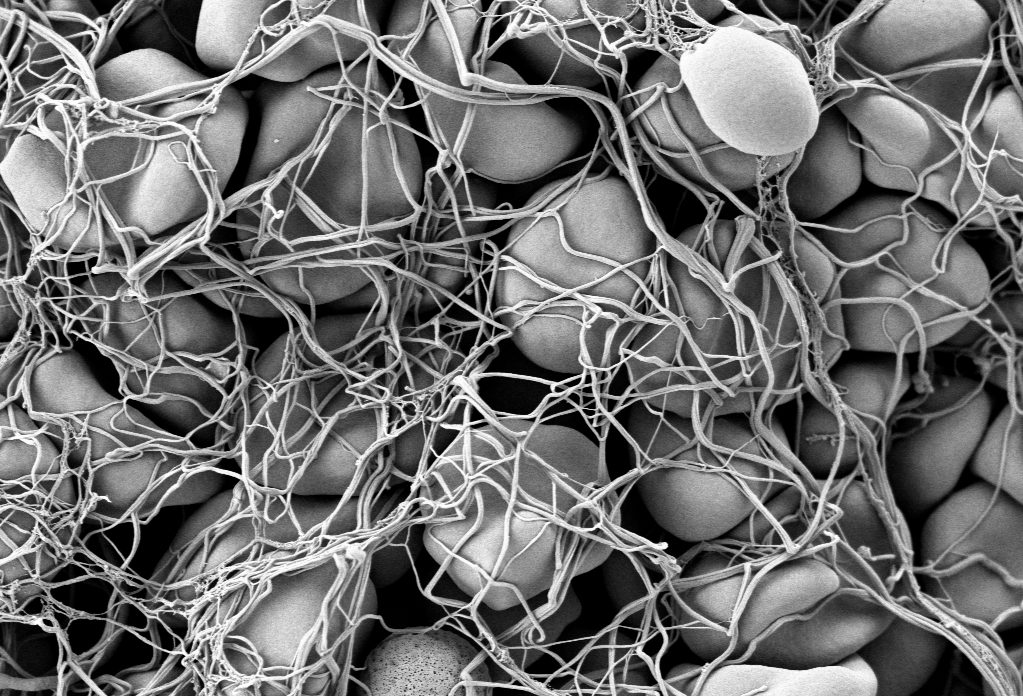
This is a blood clot, seen with an electron microscope. Red blood cells are caught in a net of threads.
A clot is only the first of four stages. Then white blood cells clean up, and other cells rebuild.
You will watch a cut heal for six weeks.
Photo: Fuzis, CC BY-SA 4.0
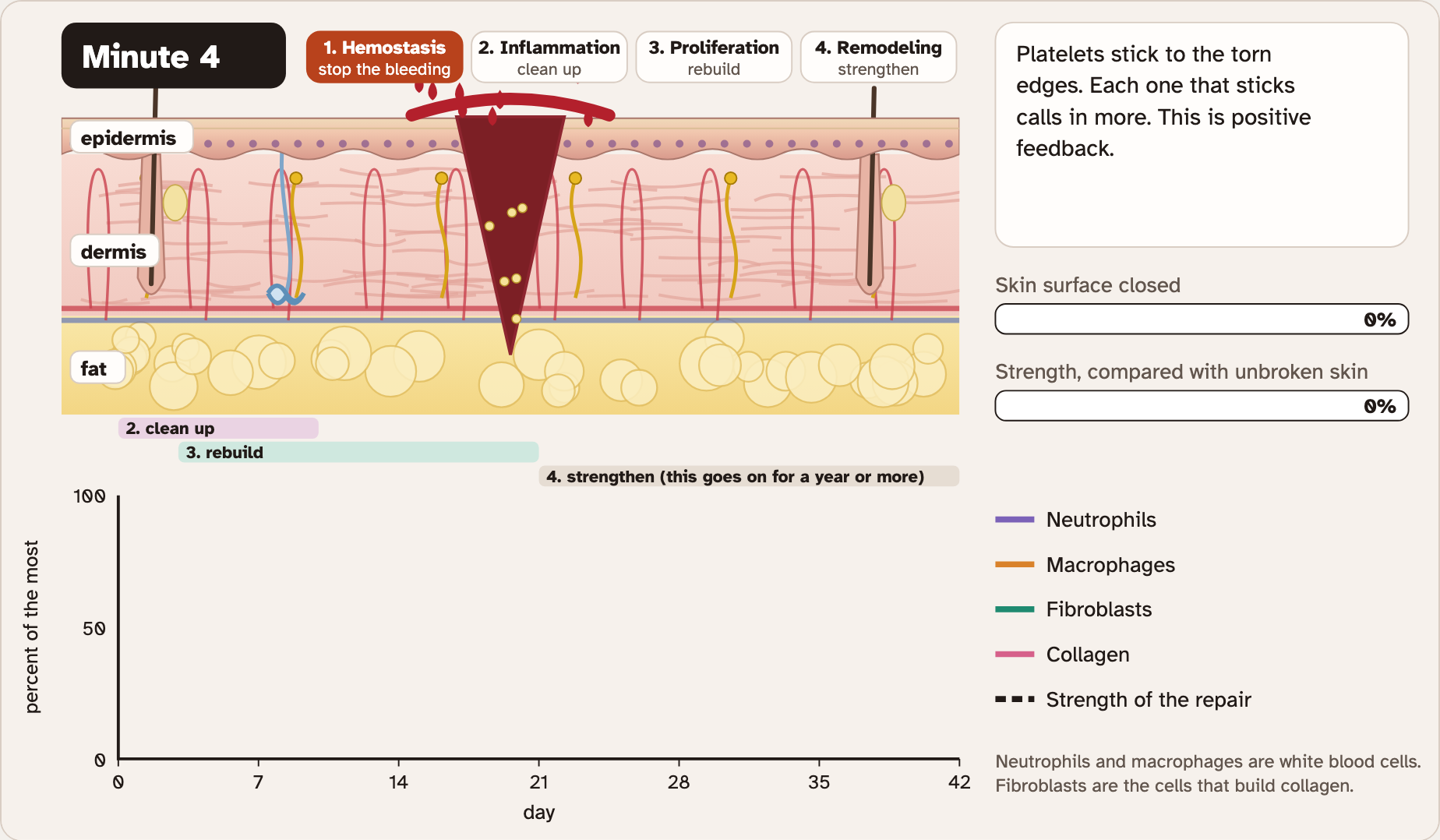
PART 5 · QUESTION 18
Four stages, four crews
1
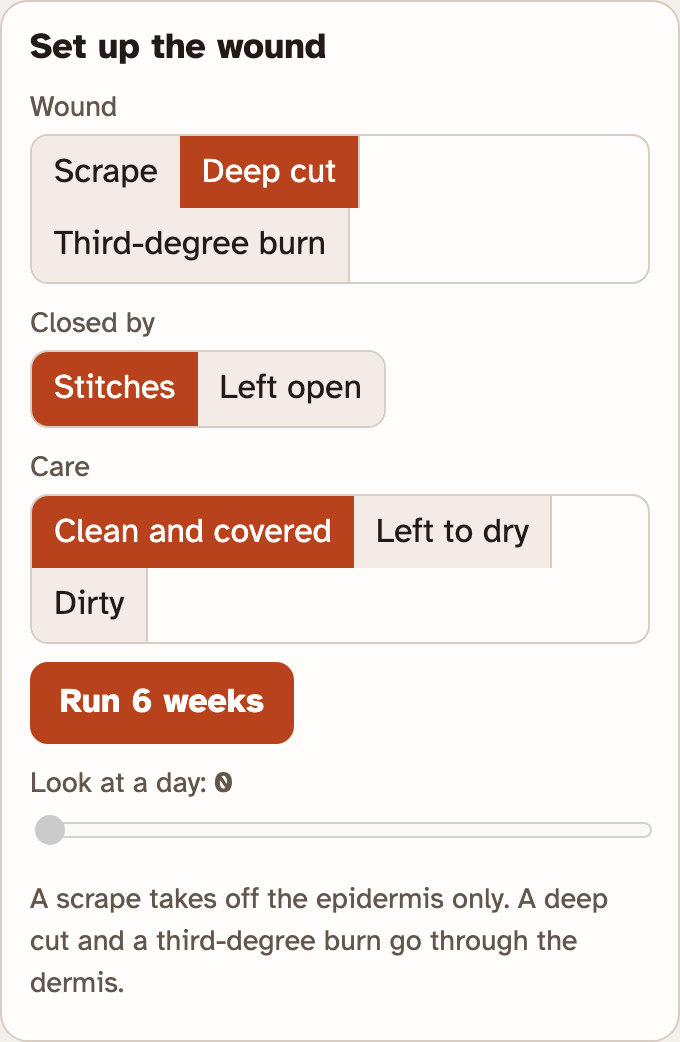
Pick Deep cut, Stitches, Clean and covered.
2
Press Run 6 weeks. First come ten minutes, then the days.
3
Watch the four stage boxes at the top. Two can be lit at once.
4
Read the box on the right. It says what the cells are doing.
5
Fill in the table: each job, and the cells doing it.
The days, cell counts and scar widths are from a model made to show the pattern.
PART 5 · QUESTIONS 19 AND 20
A fair test of care
The question
Does it matter how you look after a cut?
Set up
Deep cut, Left open.
Change one thing
Only the Care: clean and covered, left to dry, dirty.
What to read
A row is added to Your runs when each run ends.
Question 20
A friend says a cut should air out and scab over. Check your table. Use two numbers.
Screenshots: mrsajdak.com/burns, Tab 5 · The days, cell counts and scar widths are from a model made to show the pattern.
PART 5 · QUESTIONS 21 AND 22
How strong? How deep?
QUESTION 21
Strength over a year
Run Deep cut, Stitches, Clean and covered. Read Day 7, Day 21, Day 90 and 1 year in Your runs.
QUESTION 22
Scrape or burn
Run a Scrape. Then a Third-degree burn, left open and with a graft. Keep the care the same.
Photos: Sciencia58, CC0 · Dave Haygarth, CC BY 2.0 · Bezbozhnik, public domain
PART 5 · LEARN IT · 1 OF 4
Only living cells make skin
New skin cells come from living cells that divide. The bottom layer of the epidermis makes new cells all the time.
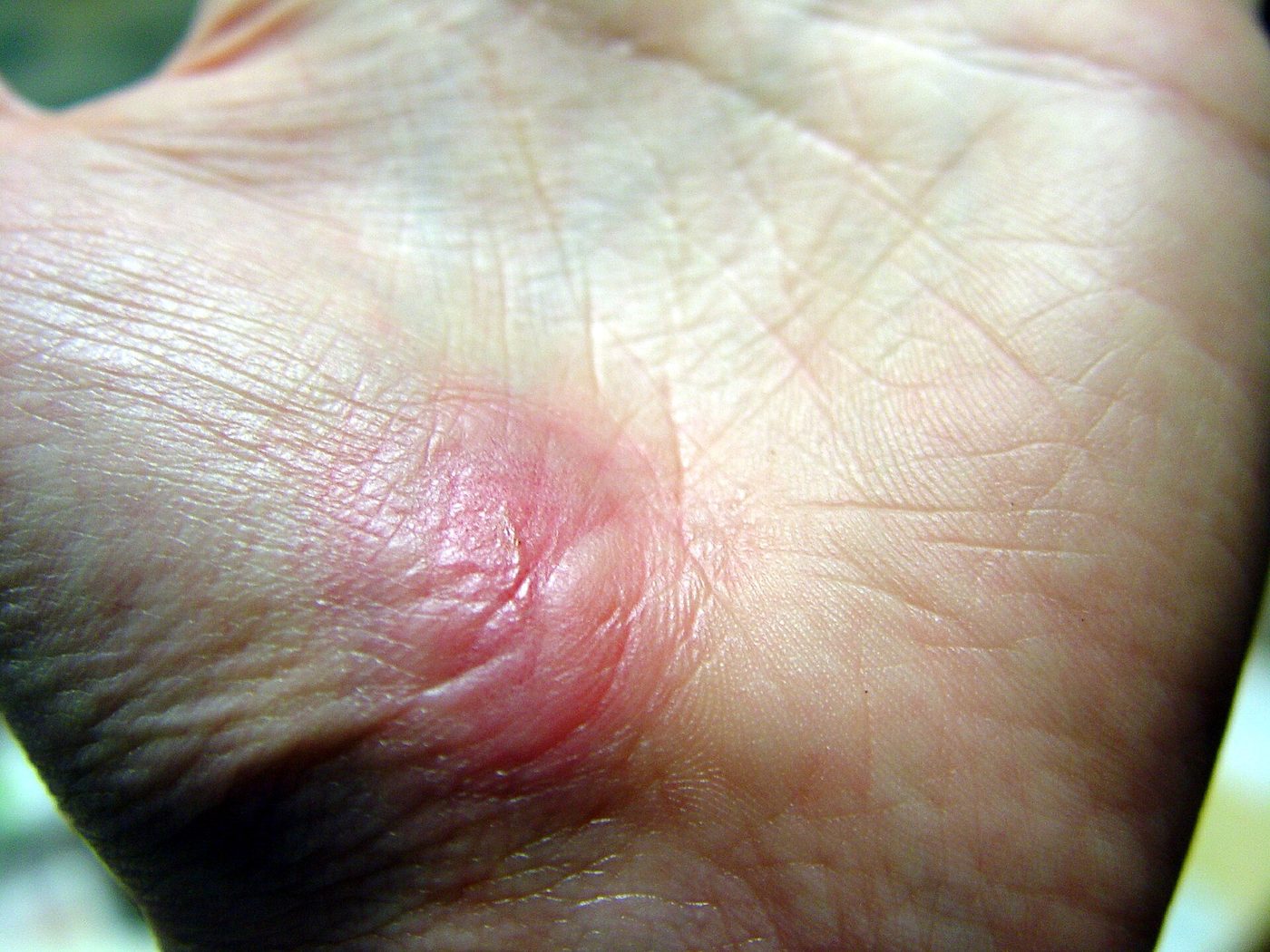
Photo: Jpbarrass, public domain
PART 5 · LEARN IT · 2 OF 4
Skin cells hide in the dermis
Hair follicles and sweat glands reach deep into the dermis. They are lined with the same kind of cells. New skin can grow up out of them.
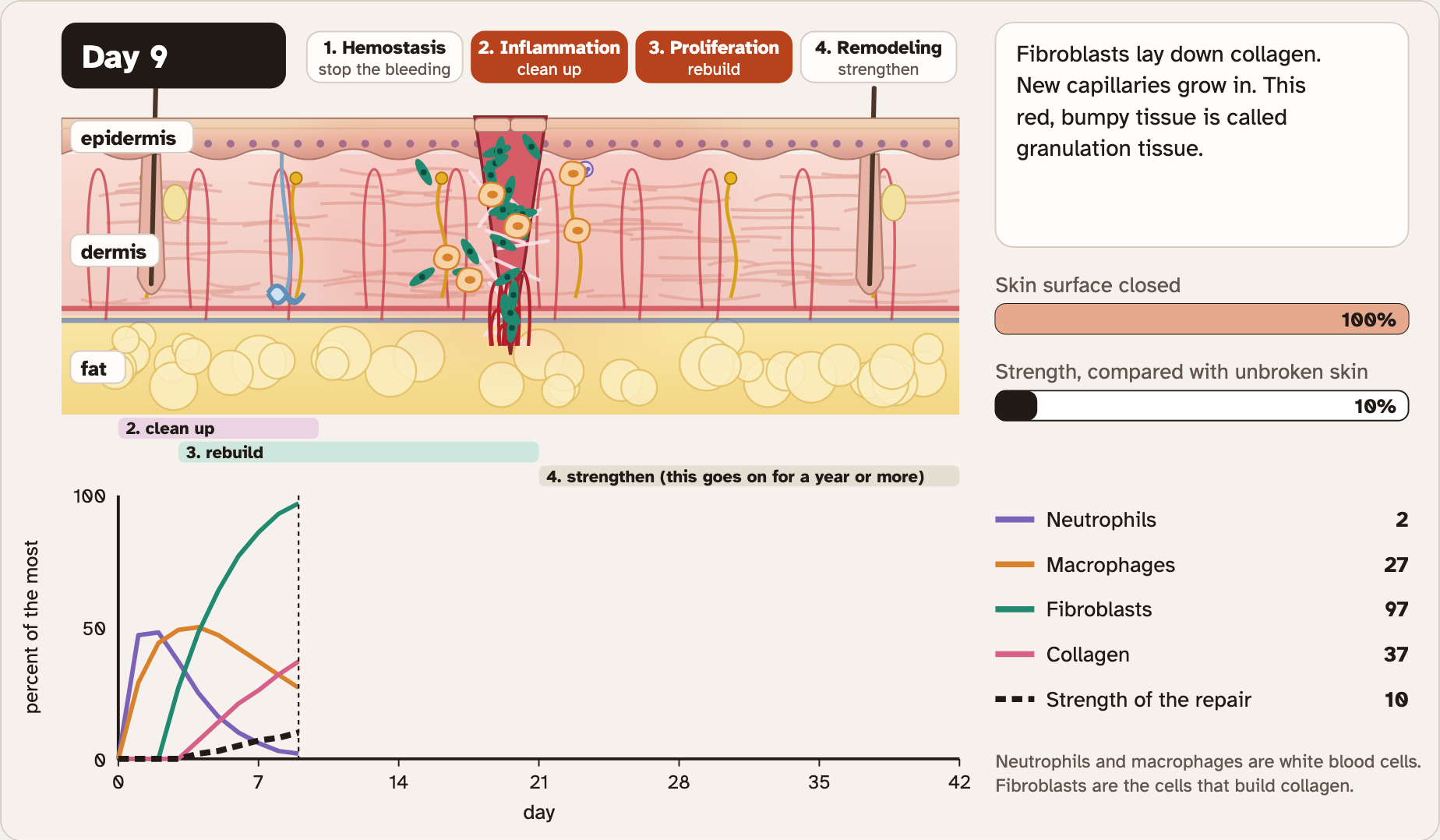
Screenshot: mrsajdak.com/burns, Tab 5
PART 5 · LEARN IT · 3 OF 4
Many starts, or only the edges
With the dermis left, new skin grows out of every follicle at once. With the dermis gone, new skin can only creep in from the edges. That is slow.
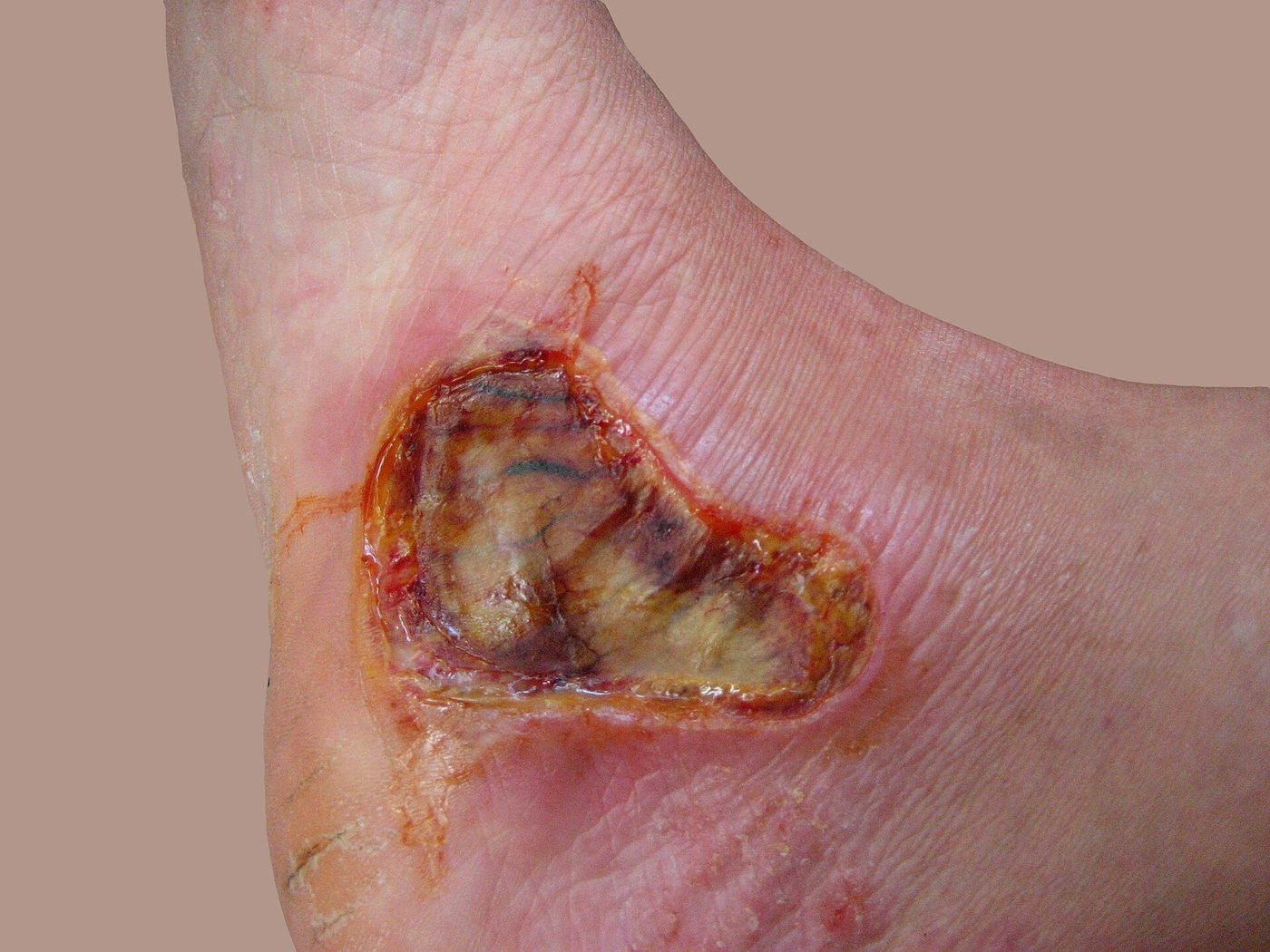
Photo: Craig0927, public domain
PART 5 · LEARN IT · 4 OF 4
Scar tissue fills the gap
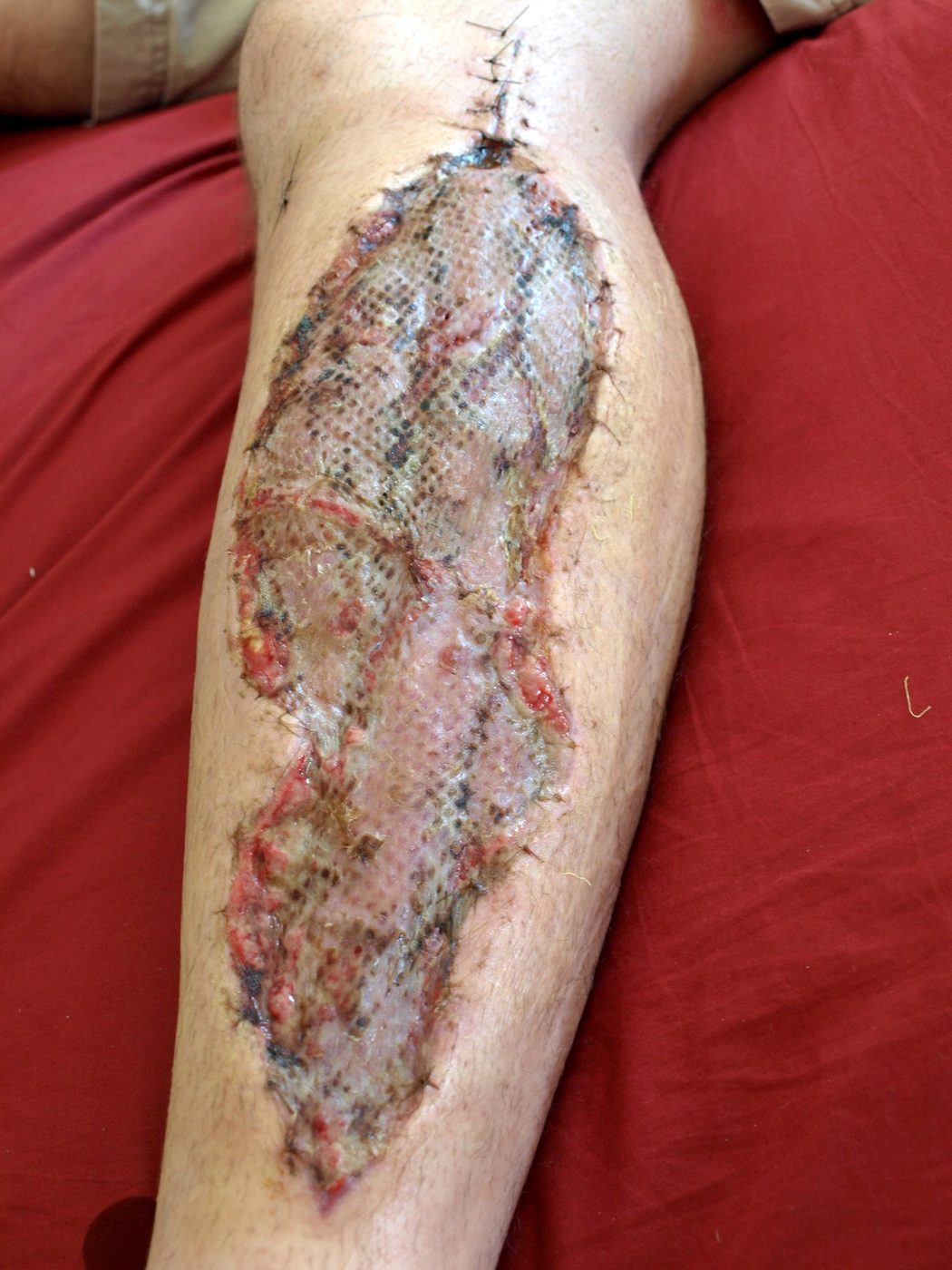
In a deep wound, fibroblasts fill the gap with collagen. That is a scar. It has no hair follicles and no sweat glands.
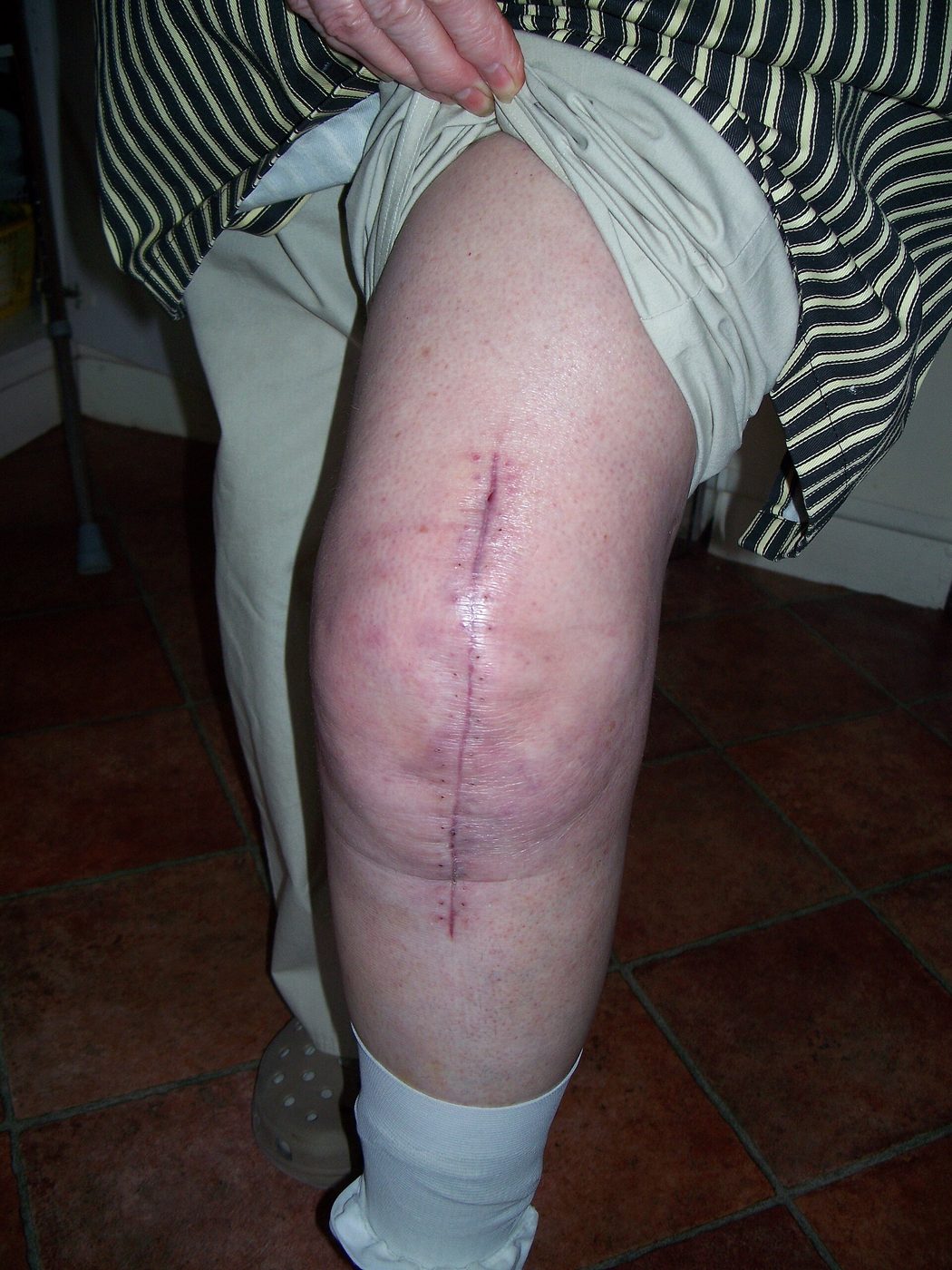
Photo: Dave Haygarth, CC BY 2.0
PART 5 · THE BIG IDEA
Every wound heals in four stages: stop the bleeding, clean up, rebuild, strengthen. New skin grows only from living cells, so the deeper the damage, the slower it heals and the bigger the scar.
IN YOUR WORDSWhy does a scrape heal without a scar, but a third-degree burn does not?
WRAP IT UP · QUESTION 23
Depth decides
The claim
“How deep a burn or a wound goes decides how it heals.”
Evidence, Part 2
Use the Heals in column of your burns table. Compare the three degrees.
Evidence, Q22
Compare the scrape with the third-degree burn. Use the day and the scar.
Reasoning
Use where new skin grows from. What is left alive under a scrape? What is left under a third-degree burn?
WRAP IT UP · BACK TO THE START
Revisiting the Phenomenon
Why do some burns heal clean and others scar?
1The burn in the photos was red. Blisters showed up by day 3. What degree of burn was it? Which layers of the skin did it reach?
2Photo B was taken 12 days after the burn. Does that fit the Heals in column of your burns table? Explain.
3Where did the new epidermis on this hand grow from? Use what is still alive in the dermis after a burn like this one.
4Why would a third-degree burn in the same place leave a scar or need a skin graft? Use evidence from Question 22.
LAST CHECK
Before you hand it in
Name, date and period are on top.
Both sides are done: burns and wounds.
Every table is full.
Your explanations use numbers from your own tables.
Done early? Open the Burn unit shift tab. Eight patients are waiting.
Photo: Jpbarrass, public domain