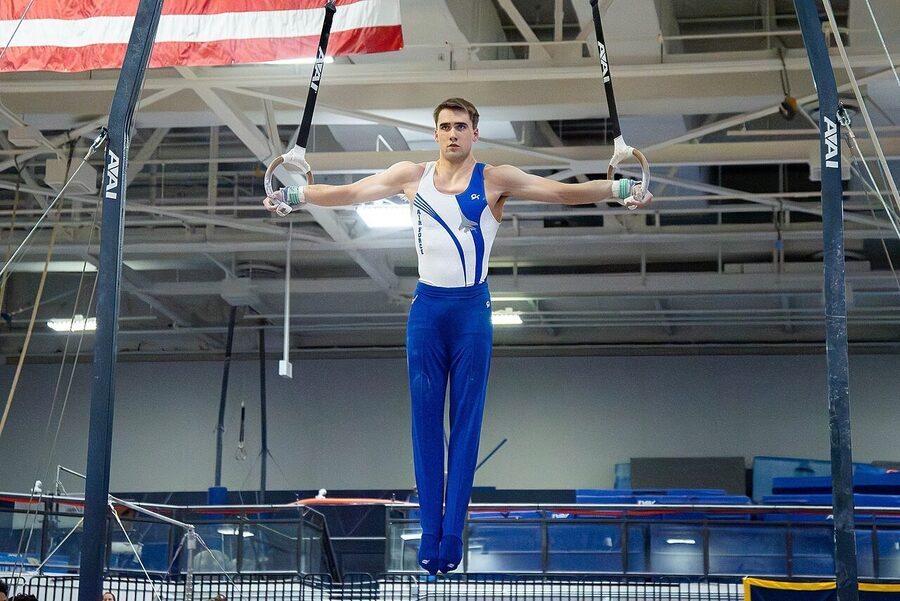
ANATOMY & PHYSIOLOGY · SECTION 7.13
How Joints Move
Follow along with your worksheet, one question at a time.
mrsajdak.com/joints
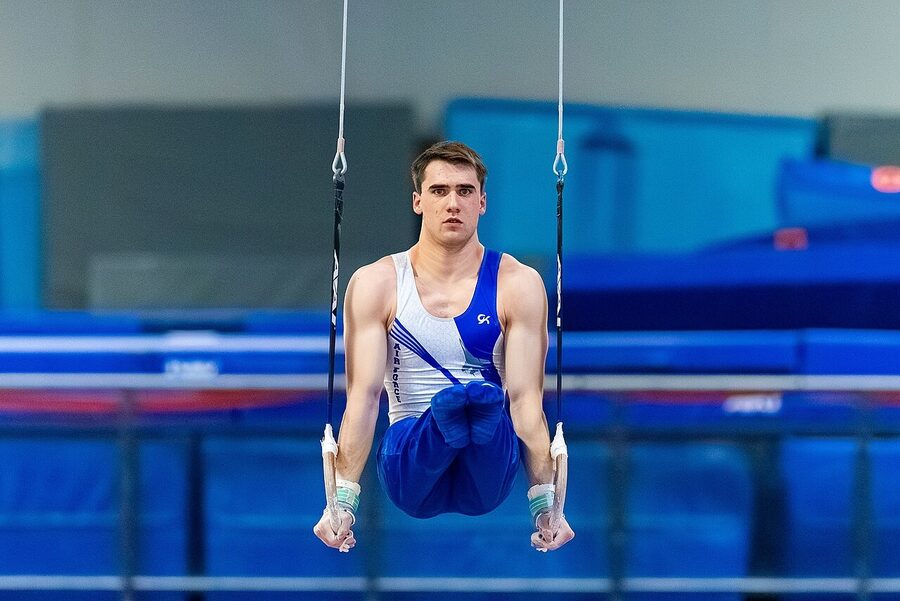
Photo: U.S. Air Force, Ray Bahner and Ada, public domain
START HERE · PICK AN OPENER
Choose how to open the lesson
Click a card to jump to it. Every option ends at the same Observe, Wonder, Predict slide and the same driving question.
OPTION A · VIDEO
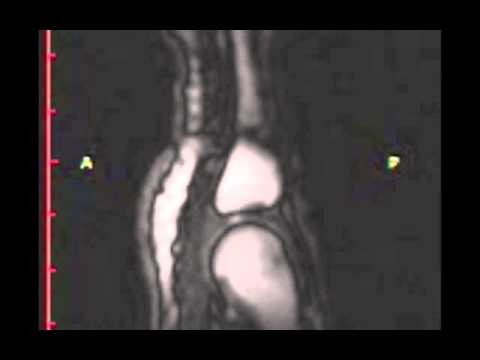
Inside a Cracking Knuckle
Clip 1 is the University of Alberta team that filmed a knuckle cracking inside an MRI scanner. Clip 2 is a short news explainer of the same study.
Watch for
What is inside the knuckle before the pop?
What shows up in the joint when it pops?
Do the two bones ever touch?
Videos on YouTube: RehabMedicineUofA (University of Alberta); SciNews.
OPTION B · TRY IT · 3 MINUTES
Tape the Thumb
1
Tape your thumb flat against the side of your hand. Not tight.
2
Write your name.
3
Pick up a pencil from the desk. Then a coin.
4
Take the tape off. Move your thumb in a circle. Which ways can it go?
You need
Masking tape, one short strip each
A pencil and a coin
Watch for
Writing and picking up a coin get hard fast.
The thumb base moves two ways: across the palm and away from it.
Why can your thumb do this when your finger joints cannot?
OPTION C · PHOTOS
Phenomenon: Same Arm, Two Joints
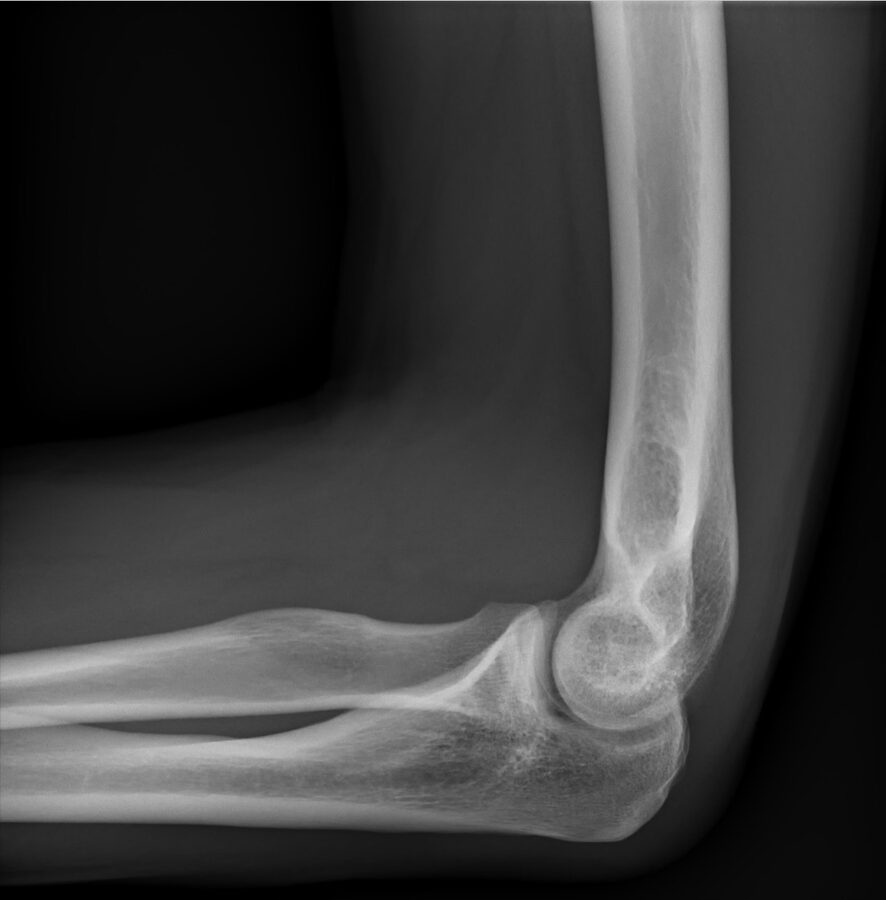
Photo: U.S. Air Force, Ray Bahner and Ada, public domain · X-ray: Mikael Häggström, CC0
START HERE
Observe, wonder, predict
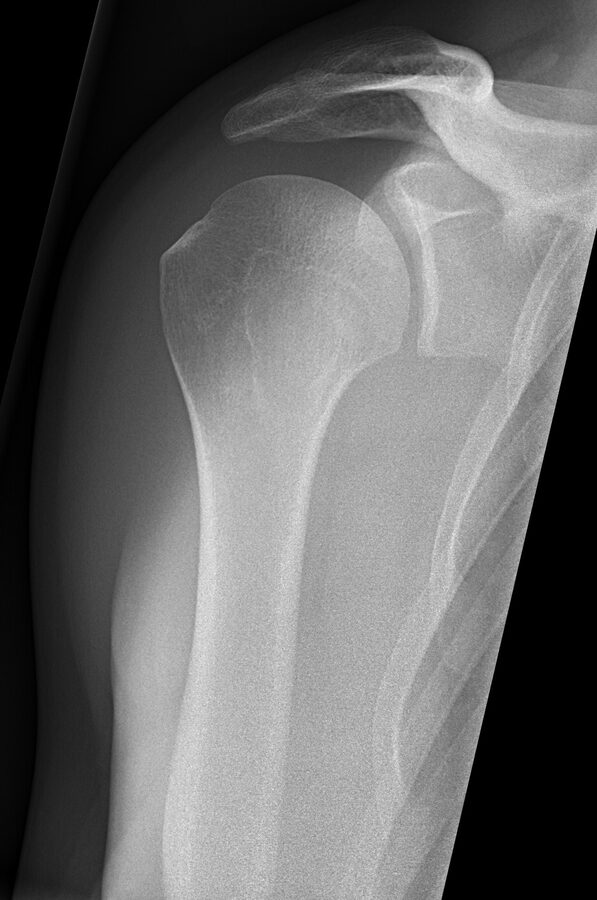
Your shoulder swings in a full circle. Your elbow bends one way, like a door.
OBSERVEMove your shoulder, elbow, wrist and neck. Which ones move the most ways?
WONDERWhat do you wonder about what is inside a joint?
PREDICTDo the bones rub right on each other?
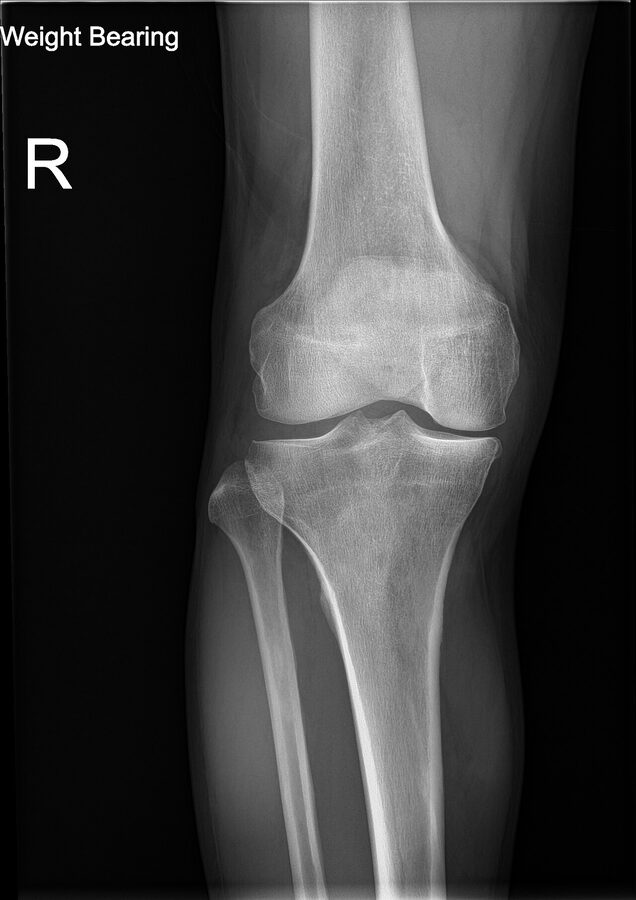
A real knee X-ray. Look between the two bones.
X-ray: Ptrump16, CC BY-SA 4.0
DRIVING QUESTION
Your shoulder swings in a full circle. Your elbow only bends one way. Why?
START HERE
What Happened Here?
Finished observing? Click here to find out.
Joints are not all built the same. The shape of the bone ends, and what is between them, decides how a joint can move.
Today, you will pull a joint apart and find its parts. You will test six real joints four ways. Then you will see how one muscle moves your arm.
TAB 1 · QUESTIONS 1 TO 6
Part 1. Inside a joint
Pull the bones apart. What is between them?
Photo: Ptrump16, CC BY-SA 4.0
PART 1 · QUESTIONS 1 TO 3
Find every part, then push
1
Slide to pull the bones apart.
2
Click all six parts. Read each job.
3
Push all four blocks.
4
Answer Questions 1 to 3.
PART 1 · LEARN IT · 1 OF 3
Bone never touches bone
In a synovial joint, each bone end has a cap of articular cartilage. Synovial fluid fills the space between the caps.
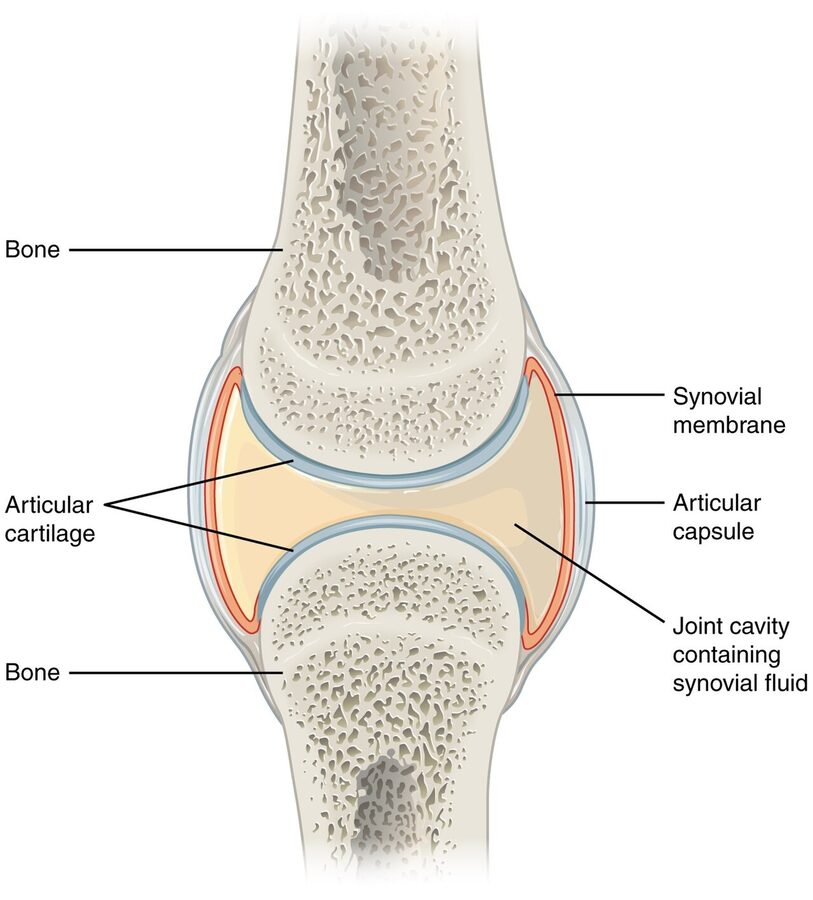
Photo: OpenStax College, CC BY 3.0
PART 1 · LEARN IT · 2 OF 3
What holds it together
The synovial membrane lines the joint and makes the fluid. The joint capsule seals it. Ligaments tie bone to bone.
Photo: OpenStax College, CC BY 3.0
PART 1 · LEARN IT · 3 OF 3
Three kinds of joints
Named by what holds the bones. Fibrous: tough fibers, barely move (skull seams). Cartilaginous: a cartilage pad, move a little (discs). Synovial: a capsule with fluid, move freely (knee, shoulder).
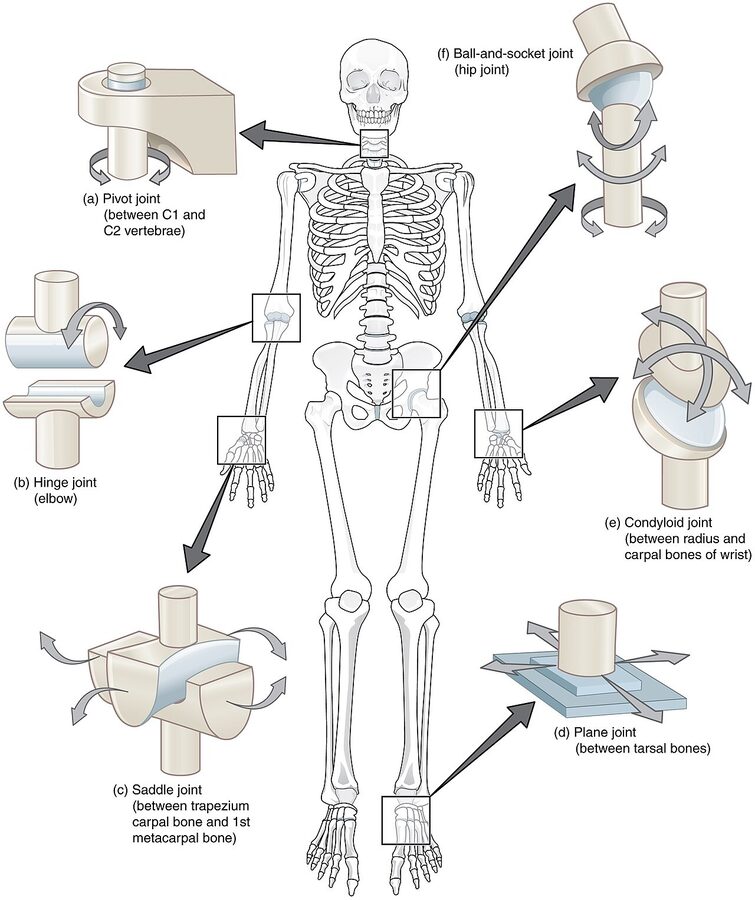
Photo: OpenStax College, CC BY 3.0
PART 1 · QUESTIONS 4 TO 6
Sort, read, argue
1
Sort the six joints in the lab.
2
Look at the real knee X-ray.
3
Answer Questions 4 to 6.
TAB 2 · QUESTIONS 7 TO 11
Part 2. Test six joints
Six real X-rays. Four tests each.
Photo: Mikael Häggström, CC0
PART 2 · QUESTIONS 7 AND 8
Test all six joints
1
Pick joint 1.
2
Press Bend, Side to side, Twist and Slide.
3
Fill in that row of the table.
4
Do all six joints.
PART 2 · LEARN IT · 1 OF 2
Count the ways it moves
Six kinds of synovial joints, named by the shape of the bone ends. Ball-and-socket moves 3 ways. Condylar and saddle move 2 ways. Hinge bends 1 way. Pivot twists only. Plane slides.
Photo: OpenStax College, CC BY 3.0
PART 2 · LEARN IT · 2 OF 2
The printed models
Each model copies one kind. The shape of the ends decides which tests it passes.
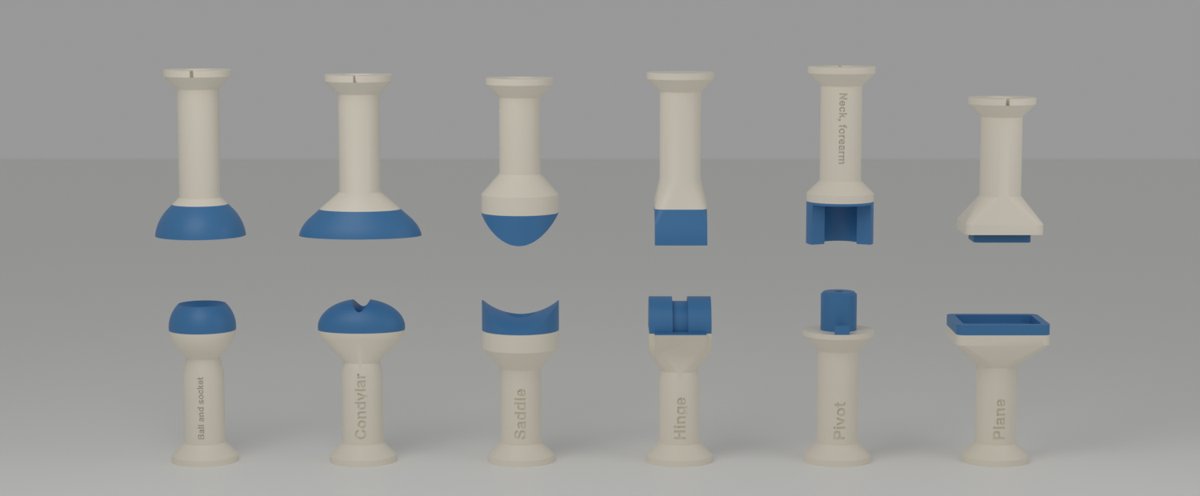
Image: Ryan Sajdak
PART 2 · QUESTIONS 9 TO 11
Use the idea
QUESTION 9
Name each kind
Use your table and the Learn It.
QUESTION 10
New joints
Each one was tested the same four ways.
QUESTION 11
Model check
SEP 2. How is a model joint different from a real one?
TAB 3 · QUESTIONS 12 TO 15
Part 3. Muscles make the move
One muscle. A whole forearm.
Photo: U.S. Air Force, Ray Bahner and Ada, public domain
PART 3 · QUESTIONS 12 AND 13
Shorten the biceps
1
Slide the biceps shorter.
2
Press Record at 34, 32, 30 and 28 cm.
3
Press Triceps pulls.
4
Answer Questions 12 and 13.
PART 3 · LEARN IT · 1 OF 2
Muscles only pull
A muscle crosses a joint. When it shortens, it pulls. Muscles cannot push, so they work in pairs: the biceps bends the elbow, the triceps straightens it.
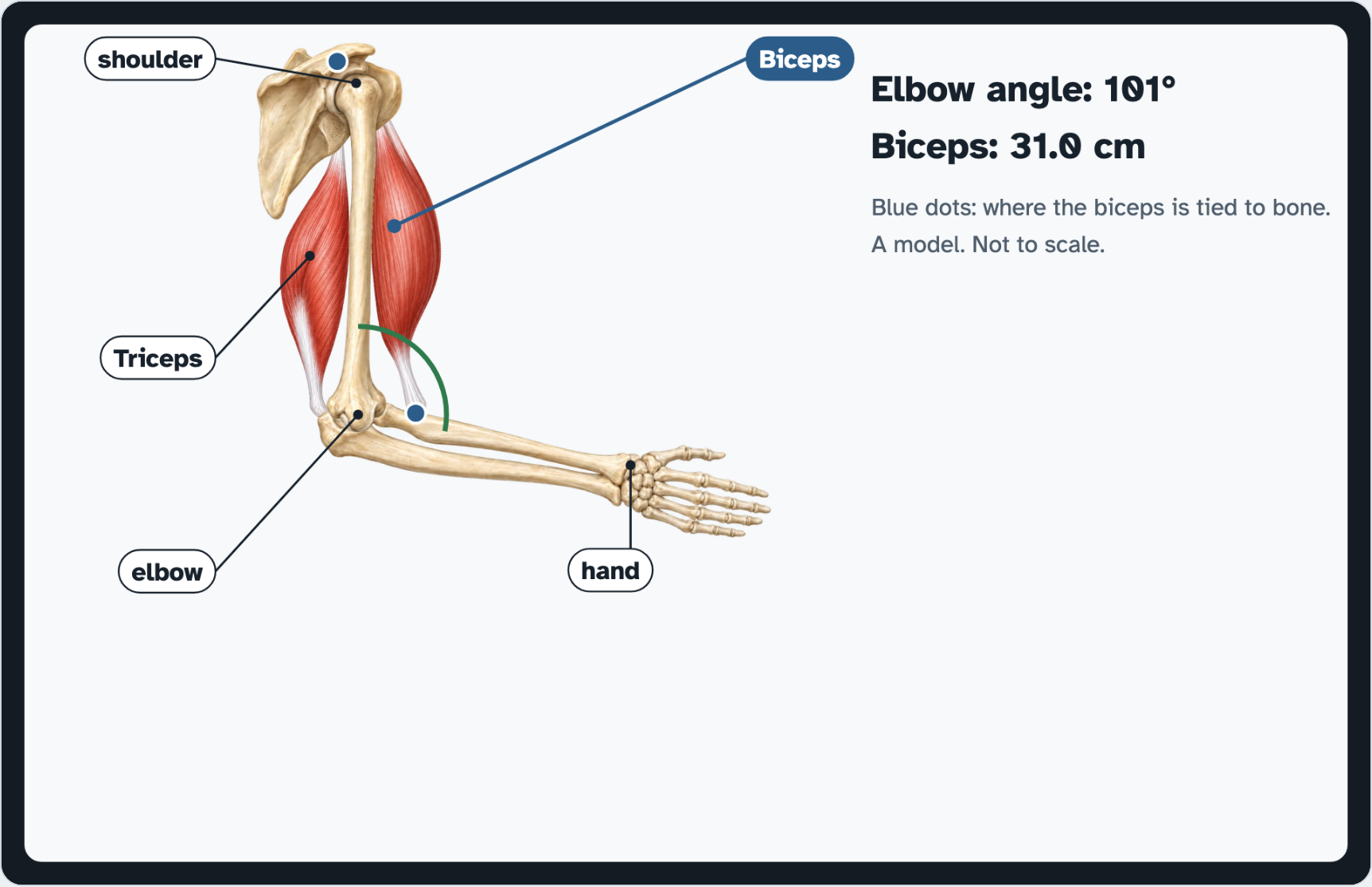
Image: Ryan Sajdak
PART 3 · LEARN IT · 2 OF 2
Names of the moves
Flexion bends. Extension straightens. Abduction moves away from the middle; adduction moves back. Rotation turns. Circumduction circles. Pronation turns the palm down; supination turns it up.
Photo: U.S. Air Force, Ray Bahner and Ada, public domain
PART 3 · QUESTION 14
Do it, then name it
STAND UP
Try each move
Arms out to the sides. Palm up. Shake your head no.
Straighten your knee. Arm circle. Bend your elbow.
Example
Bend your knee to sit down.
The angle at the knee gets smaller.
Flexion
These are not your numbers. Use your own.
EXPLAIN IT · QUESTION 15
Why does the shoulder move more?
What I saw
The shoulder passed more tests in Tab 2 than the elbow.
Science idea
What decides how a joint can move?
Explains it
Name both kinds of joint and say how their shapes differ.
WRAP IT UP · BACK TO THE START
Revisiting the Phenomenon
Your shoulder swings in a full circle. Your elbow only bends one way. Why?
EVIDENCEWhat keeps the bones from rubbing?
EVIDENCEHow many ways did each joint move?
EVIDENCEWhat made the elbow bend in Tab 3?
Hand in your worksheet.
Next lesson: how the skeleton changes as we age.