ENVIRONMENTAL SCIENCE · WATER QUALITY
Combined Sewer Overflow Lab
Follow along with your worksheet, one question at a time.
mrsajdak.com/sewer-overflow
Photo: Andre Carrotflower, CC BY-SA 4.0
START HERE
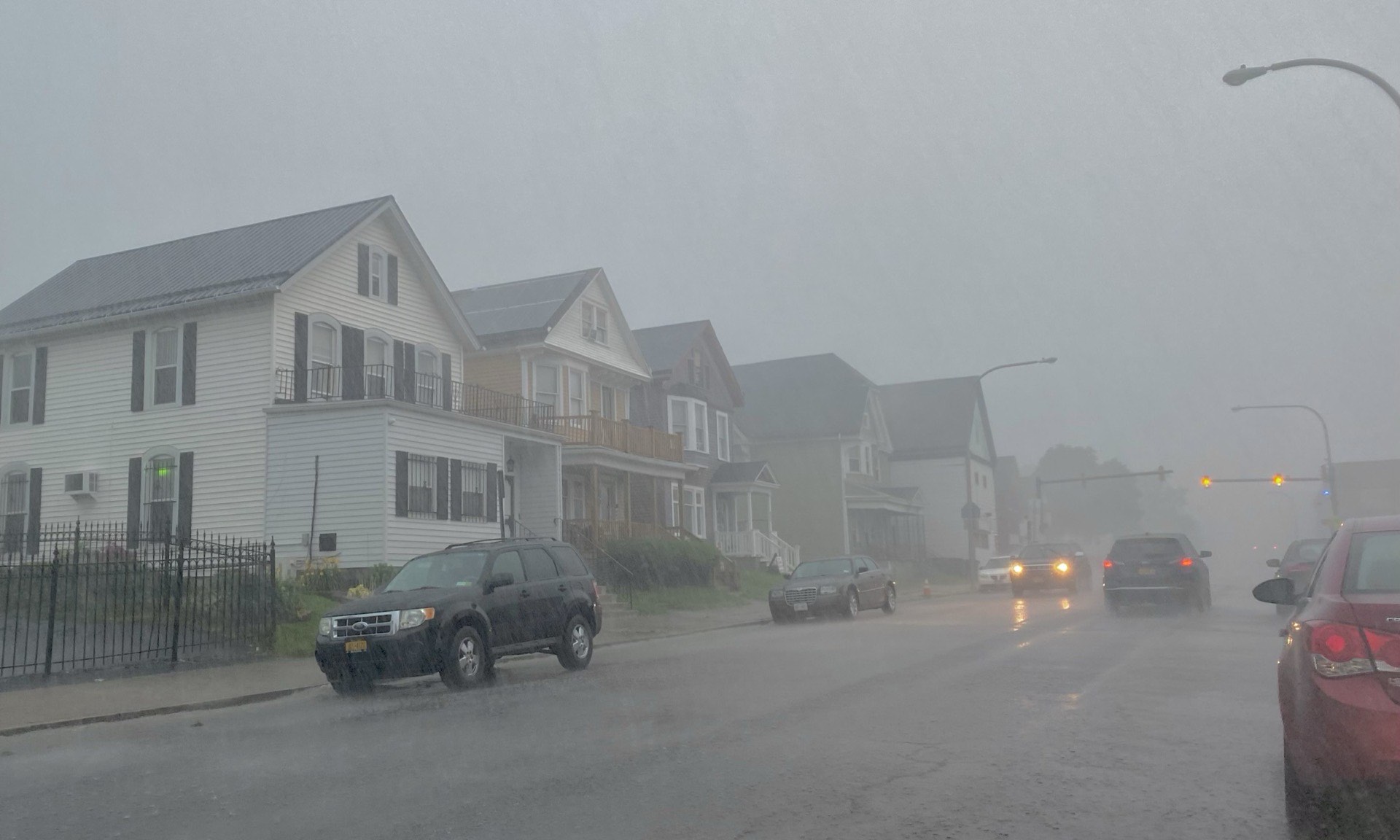
Phenomenon: Same water, the next day
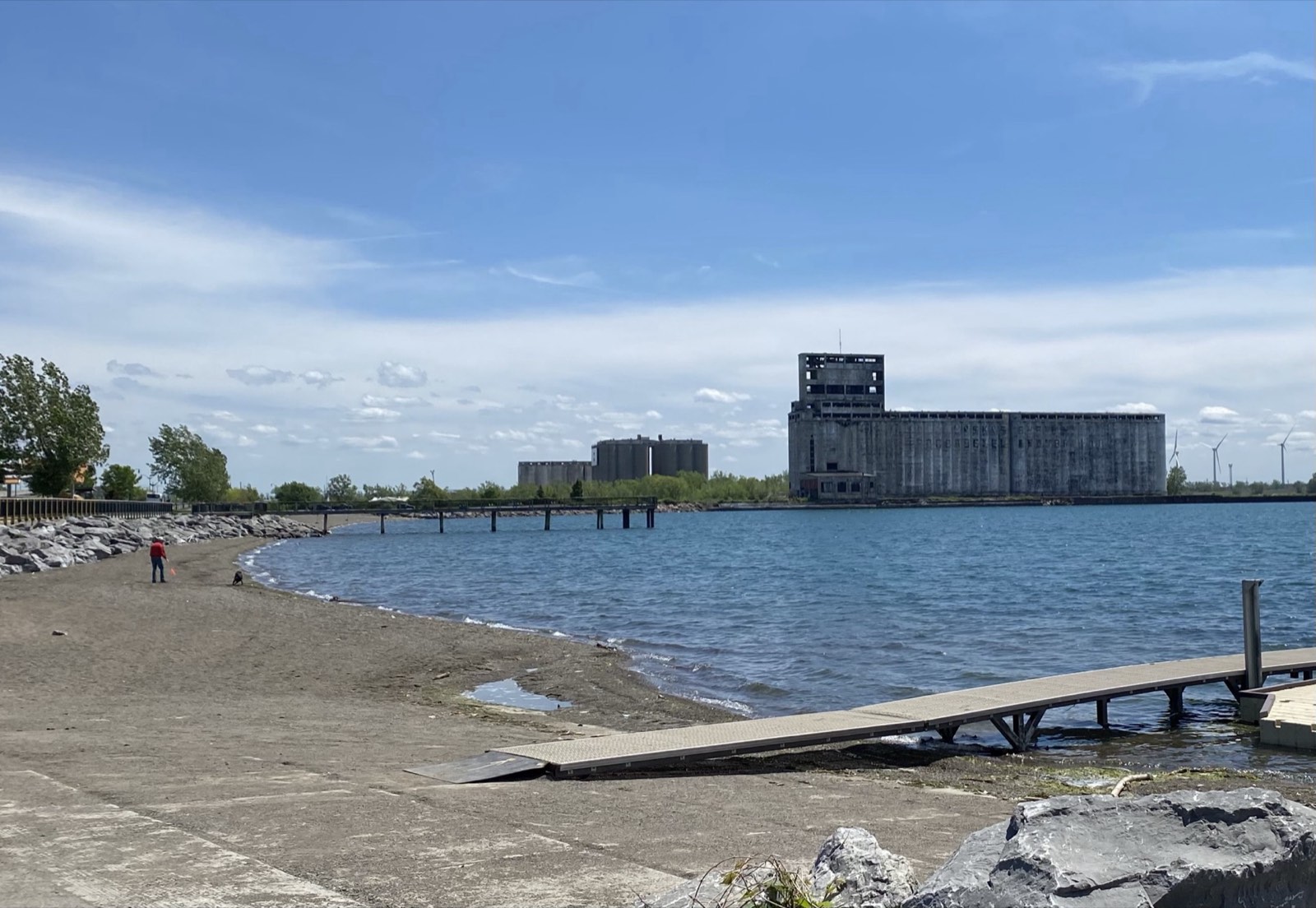
Photo: Andre Carrotflower, CC BY-SA 4.0 · Photo: G. Edward Johnson, CC BY 4.0
START HERE
Observe, wonder, predict
On a clear day, people swim and play in the water. After a big rainstorm, signs go up telling people to stay out of it. Rain is just water. How could rain make a river or a lake unsafe?
OBSERVEWhat is different about the water in the two photos?
WONDERWhat could rain carry into a river?
PREDICTWhich storm would be worse for a river: a short, hard thunderstorm or a gentle rain that lasts all day? Why?
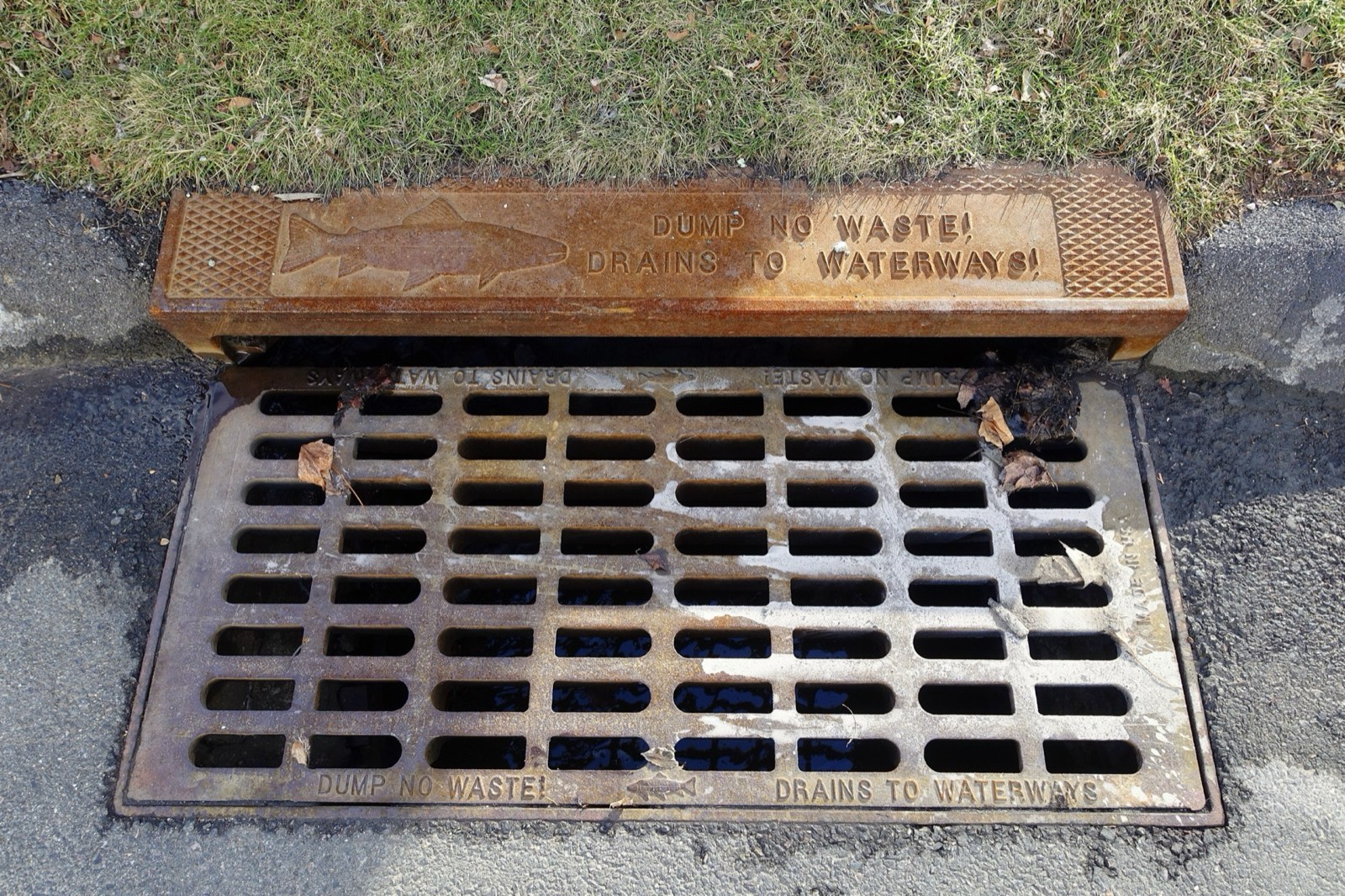
A storm drain in Massachusetts. Some drains have a sign like this one.
Photo: Daderot, CC0
DRIVING QUESTION
Why does a hard rain in Buffalo send sewage into the river, and what can a city do about it?
START HERE
What happened here?
Finished observing? Click here to find out.
In many older cities, Buffalo among them, one set of pipes carries sewage from homes and rain from the streets. In a big storm those pipes get more water than the treatment plant can take. The extra, rain and raw sewage together, spills into the river through a pipe called an outfall. It is called a combined sewer overflow, or CSO. The bacteria in the sewage are why the signs go up.
Today you will run a model of a city, its sewer and its river. You will follow the water through one storm, try four storms, test three ways to fix the sewer, and see what reaches the river. At the end you will come back to the driving question.
START HERE
What an overflow looks like
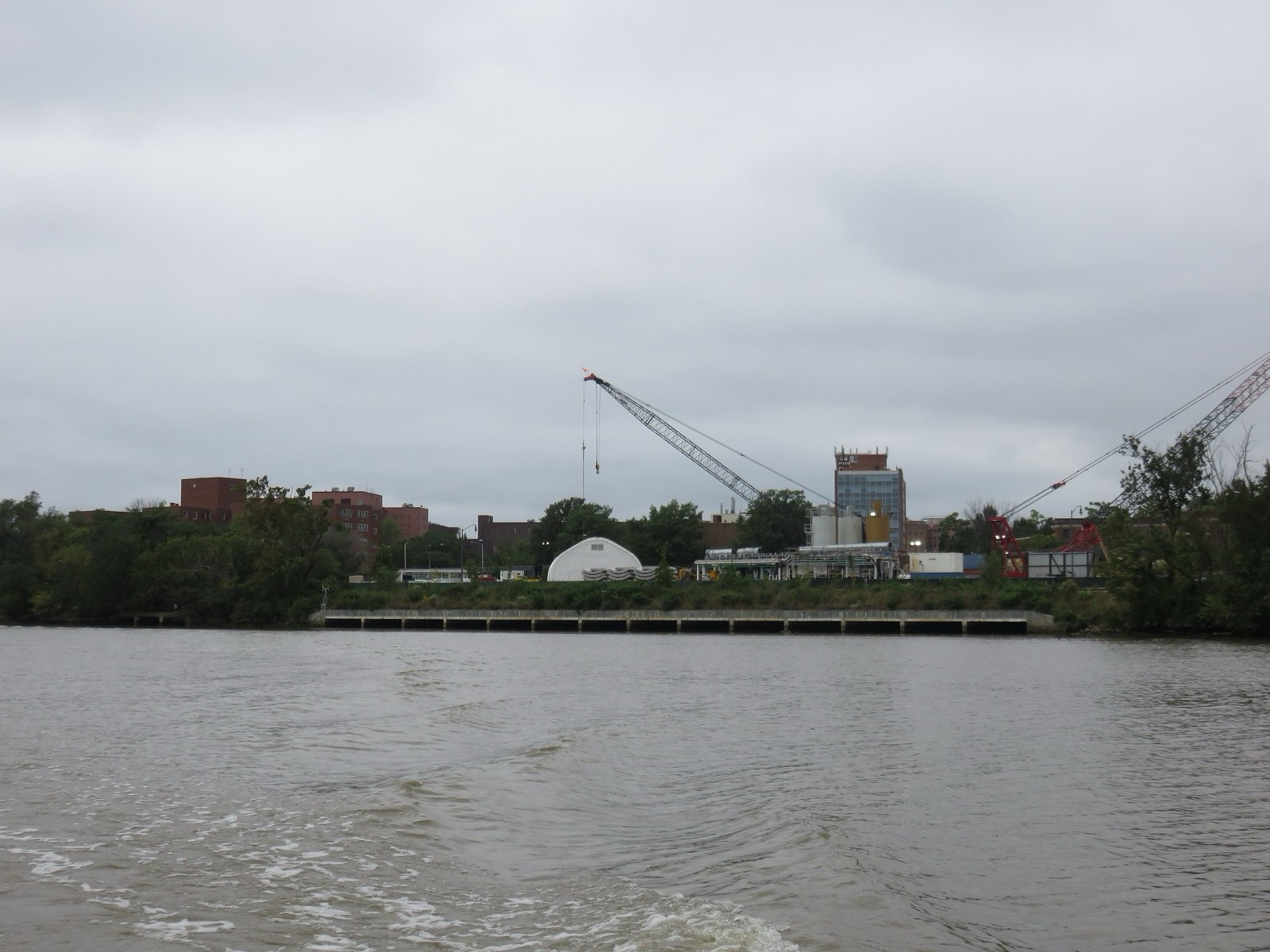
Photo: Antony-22, CC BY-SA 4.0 · Photo: Z22, CC BY-SA 4.0 · Photo: George Burns, EPA Documerica, National Archives, public domain
BEFORE YOU START
Six words you will need
Combined sewer
One pipe that carries sewage from homes and stormwater from the streets.
Interceptor
The pipe to the treatment plant. It can only carry so much.
Regulator
The chamber where the flow splits: to the plant, to the tank, or over the wall.
Storage tank
Holds extra water during a storm, then sends it to the plant later.
Outfall
The end of the pipe where an overflow leaves for the river.
m³ and m³/s
A cubic meter is 1,000 liters. m³/s is how many pass each second.
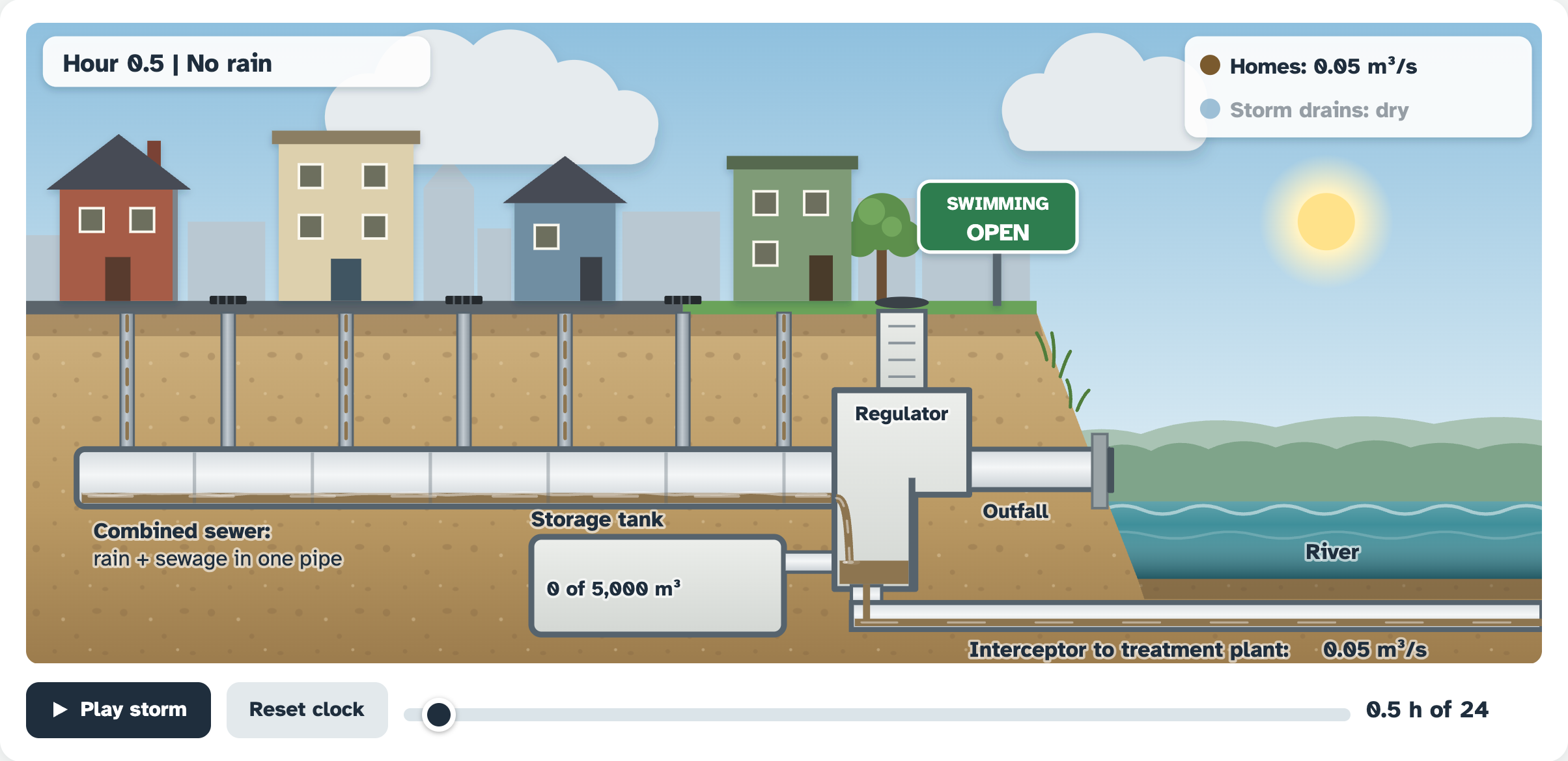
Find each part in the lab drawing: the sewer pipe, the regulator, the tank, the outfall and the pipe to the plant.
Screenshot: mrsajdak.com/sewer-overflow
BEFORE YOU START
What you will learn
I can use a model to explain how a pipe that carries both sewage and rain ends up spilling into a river.
I can use numbers from a simulation to compare ways to cut sewer overflows and defend the best one.
BEFORE YOU START
Get set up
1
Open mrsajdak.com/sewer-overflow on your device.
2
Write your name, the date and your period on the worksheet.
3
Get a calculator.
4
Find the drawing at the top, the sliders on the left and the results on the right.
5
Play storm runs one day. The time slider moves to any minute.

| Worksheet | What you change | Questions |
|---|---|---|
| Part 1 | Only the clock | 1 to 4 |
| Part 2 | The storm and the paving | 5 to 7 |
| Part 3 | Tank, green, interceptor | 8 to 10 |
| Part 4 | River flow | 11 to 13 |
| Wrap it up | Nothing: you decide | 14 |
Screenshot: mrsajdak.com/sewer-overflow
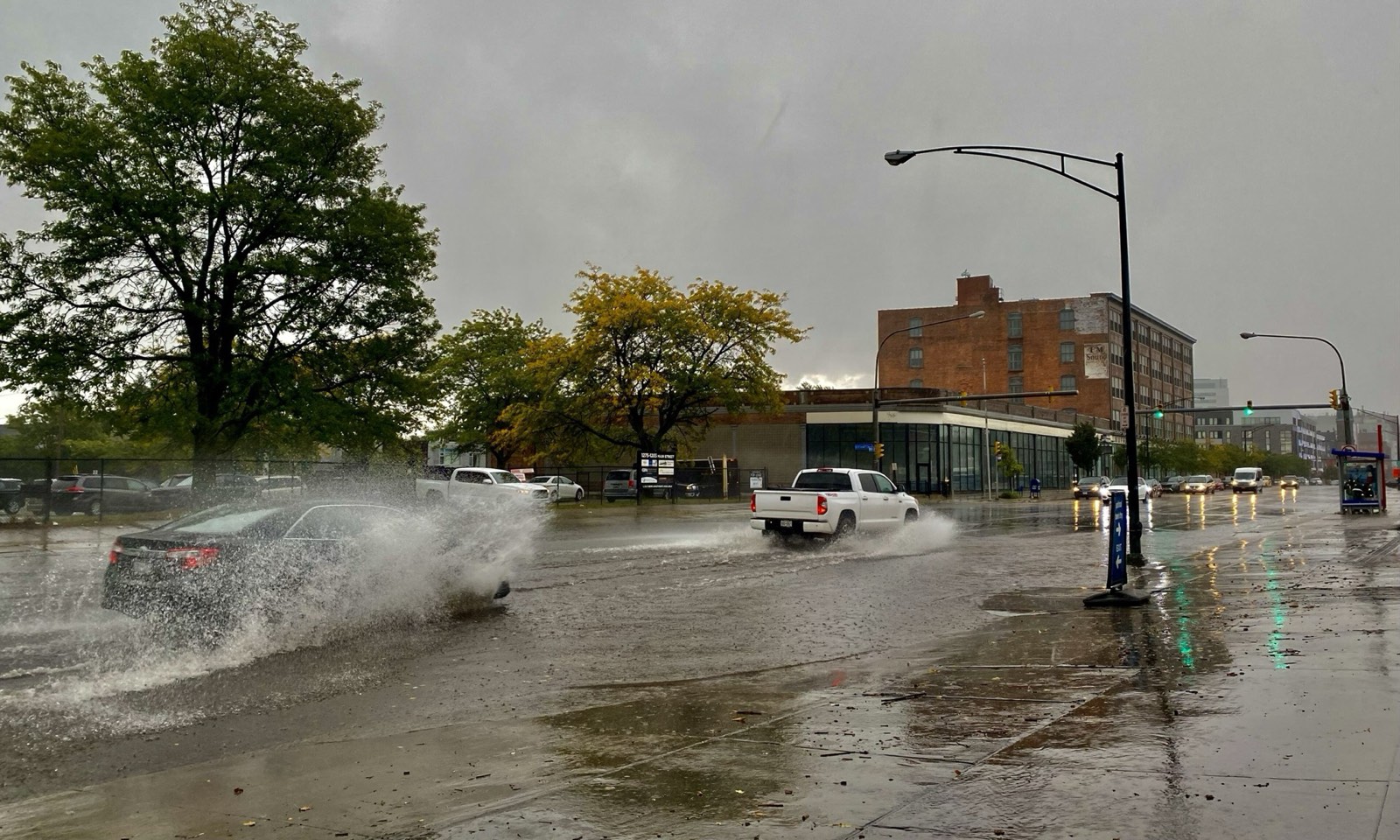
QUESTIONS 1 TO 4
Part 1. One pipe, two jobs
Leave every slider where it starts. You will only move the clock.
Watch where the water from homes and streets goes at four times of day.
Photo: Andre Carrotflower, CC BY-SA 4.0
PART 1 · QUESTION 1
Read the lab at four times of day
1
Drag the time slider to hour 0.5.
2
Is it raining? Read Homes and Storm drains in the top right corner.
3
Read the flow on the pipe to the treatment plant, at the bottom.
4
Read the storage tank.
5
Do the same at hours 2.5, 6.0 and 12.0. Combined flow = homes + storm drains.
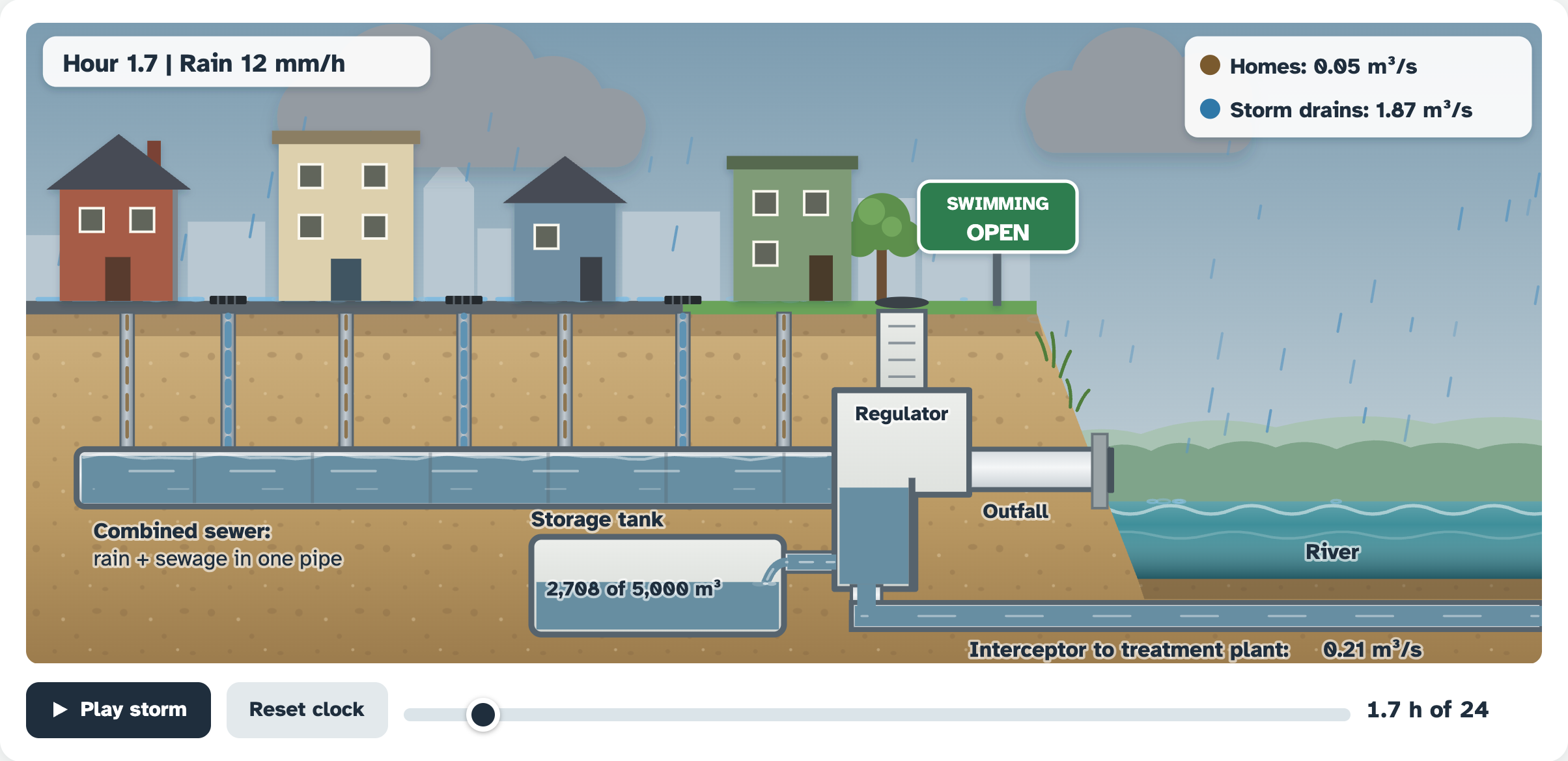
Hour 1.7 of the starting storm: rain is falling and the tank is filling.
Screenshot: mrsajdak.com/sewer-overflow
PART 1 · QUESTIONS 2 AND 3
Two sources, one pipe
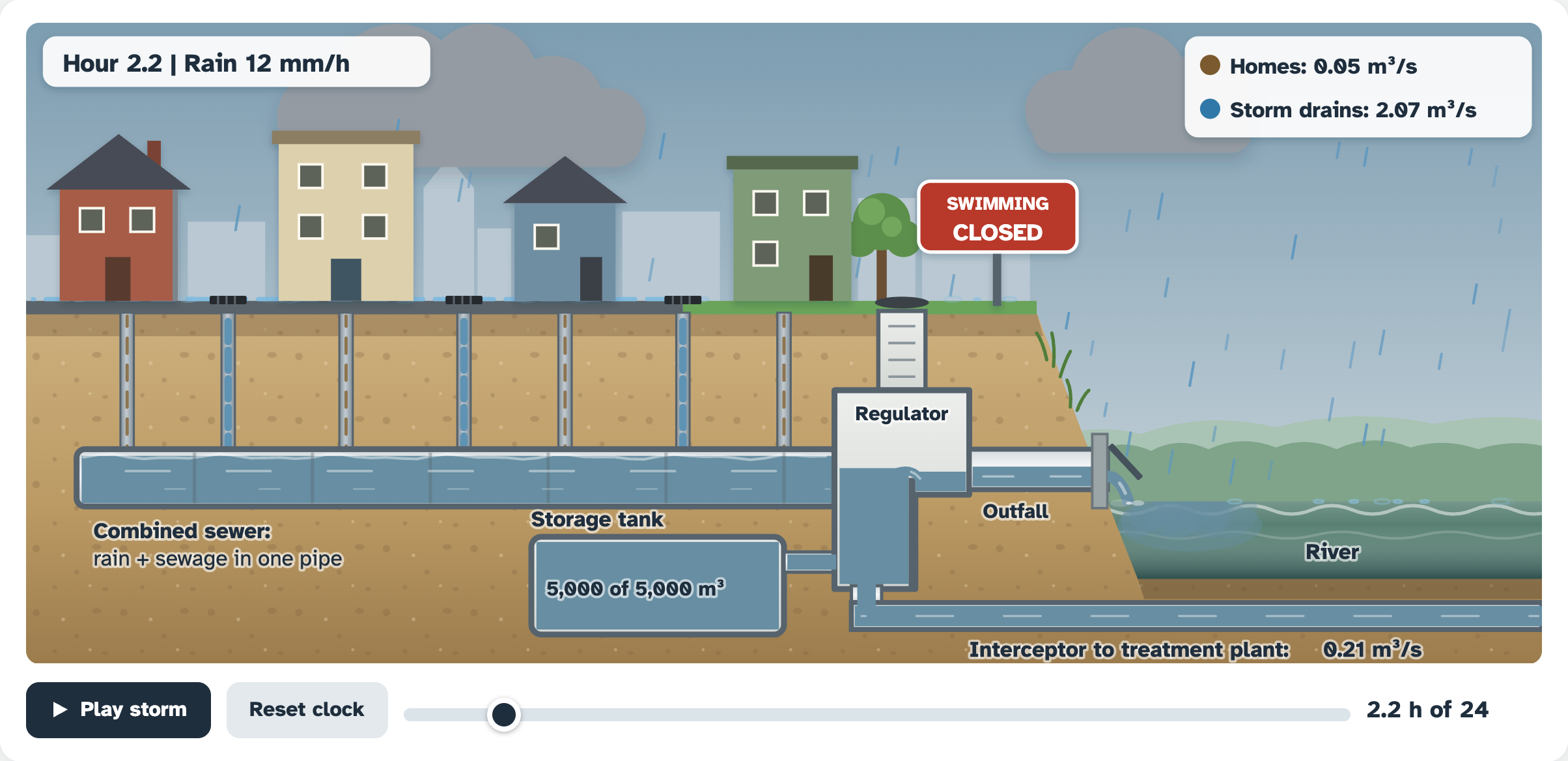
Hour 2.2. Watch the box labeled Regulator, and the outfall.
QUESTION 2
Streets against homes
At hour 2.5, divide storm drains by homes. How many times bigger?
QUESTION 3
Where does the rest go?
Only 0.21 m³/s goes to the plant. Press Play storm and watch the regulator. Describe where the rest of the water goes, in order.
Screenshot: mrsajdak.com/sewer-overflow
PART 1 · LEARN IT · 1 OF 4
One pipe, two jobs
Older parts of Buffalo have combined sewers: one pipe for sewage from homes and stormwater from the streets. Newer places use two separate pipes.
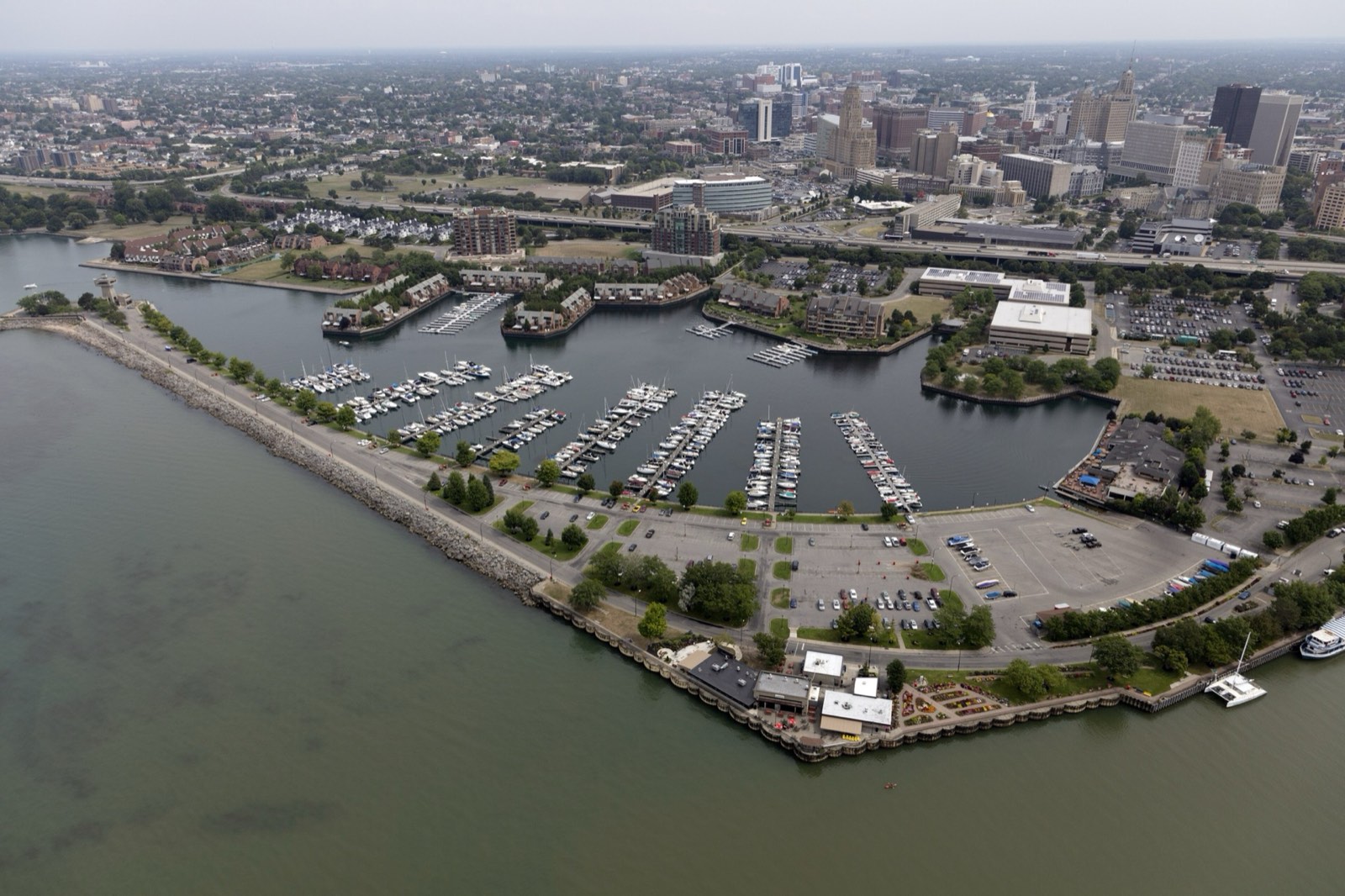
Photo: Carol M. Highsmith, Library of Congress, public domain
PART 1 · LEARN IT · 2 OF 4
The plant has a limit
The interceptor carries water to the treatment plant, but only so much. In the lab it takes 0.21 m³/s: three times a normal day's sewage.
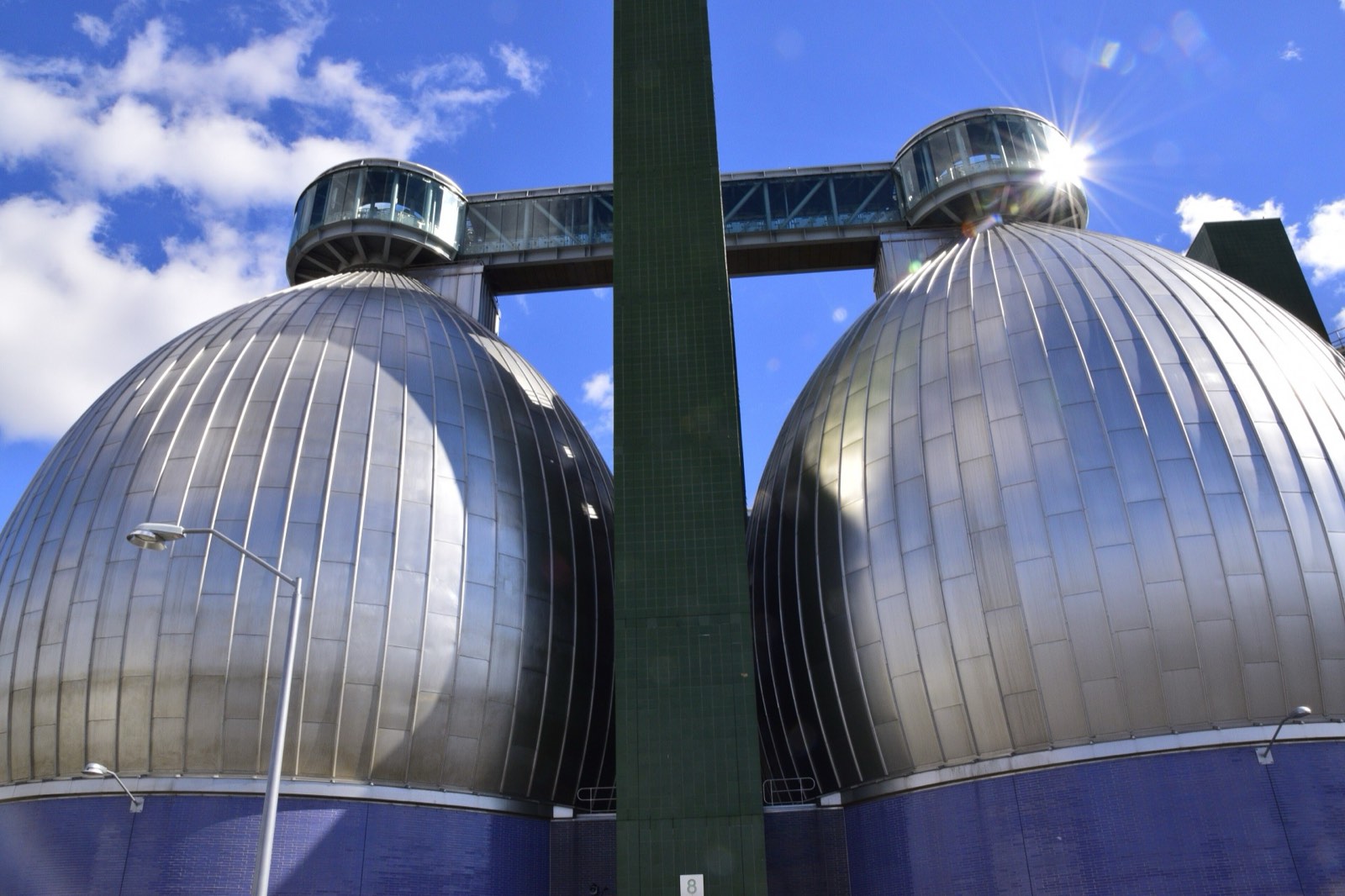
Photo: Steven Olswang, CC BY-SA 4.0
PART 1 · LEARN IT · 3 OF 4
Extra water waits, then spills
Extra flow fills a storage tank. When the tank is full, the water climbs over a low wall called a weir and leaves through the outfall.
Screenshot: mrsajdak.com/sewer-overflow
PART 1 · LEARN IT · 4 OF 4
That spill is a CSO
A combined sewer overflow is rain and raw sewage pouring into a river with no treatment. Sewage carries bacteria, so beaches downstream close.
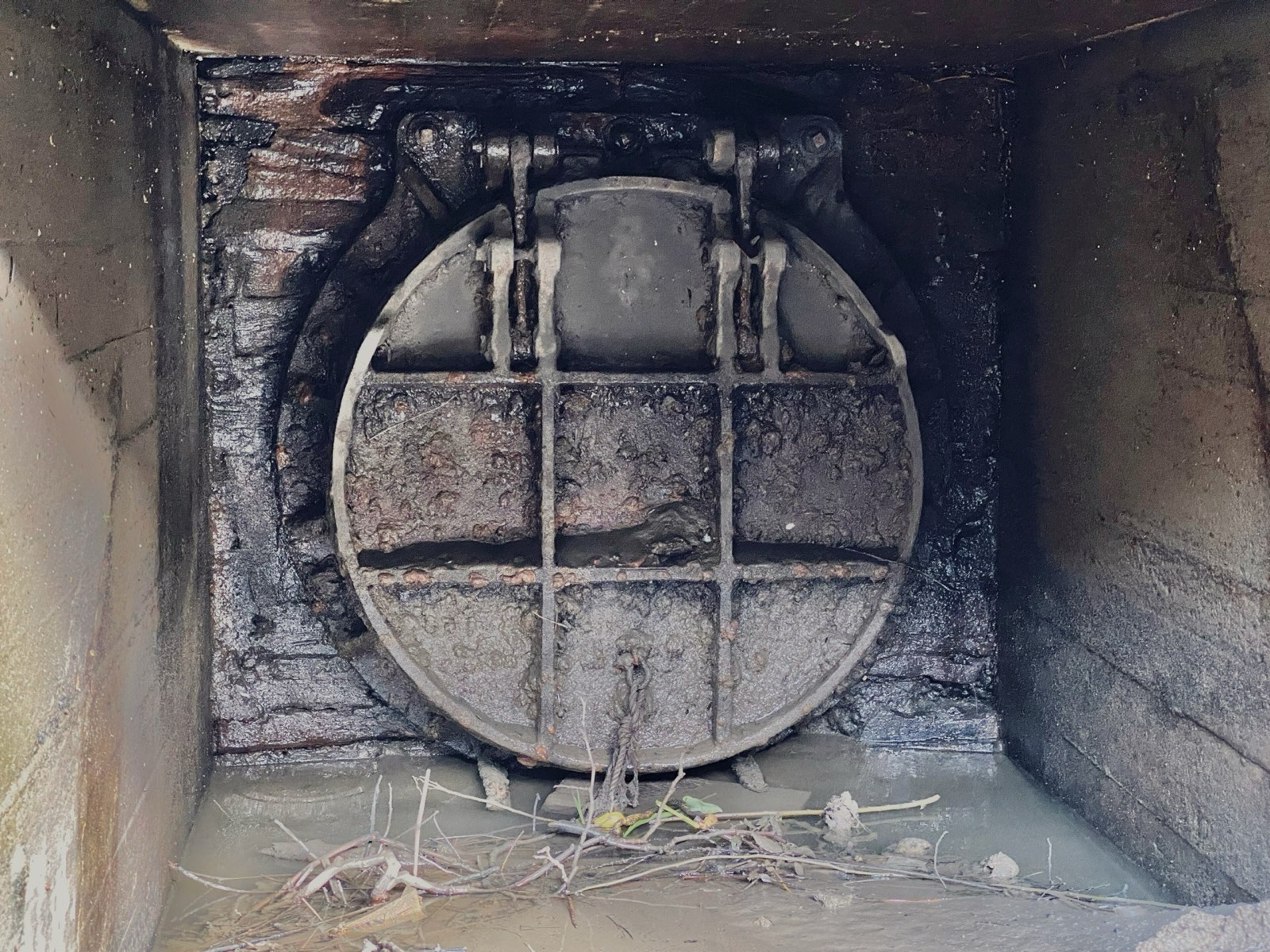
Photo: Z22, CC BY-SA 4.0
PART 1 · QUESTION 4
After the storm
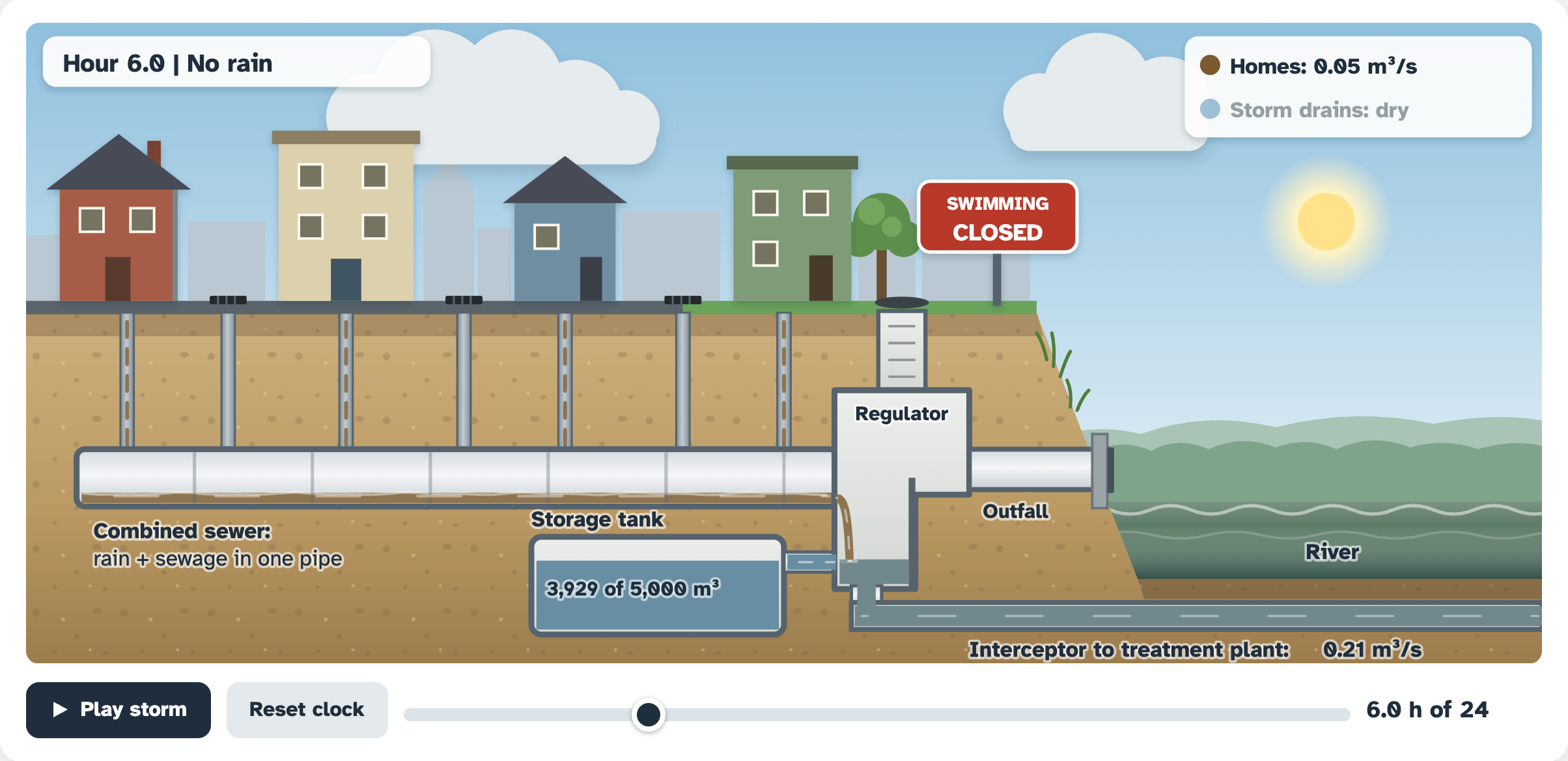
Hour 6. No rain, but look at the tank and the pipe to the plant.
QUESTION 4
0.05 → 0.21
More out than in
Homes send about 0.05 m³/s, but the plant gets 0.21. Where does the extra come from?
Why does that make the tank useful for the next storm?
Screenshot: mrsajdak.com/sewer-overflow
QUESTIONS 5 TO 7
Part 2. Storms and streets
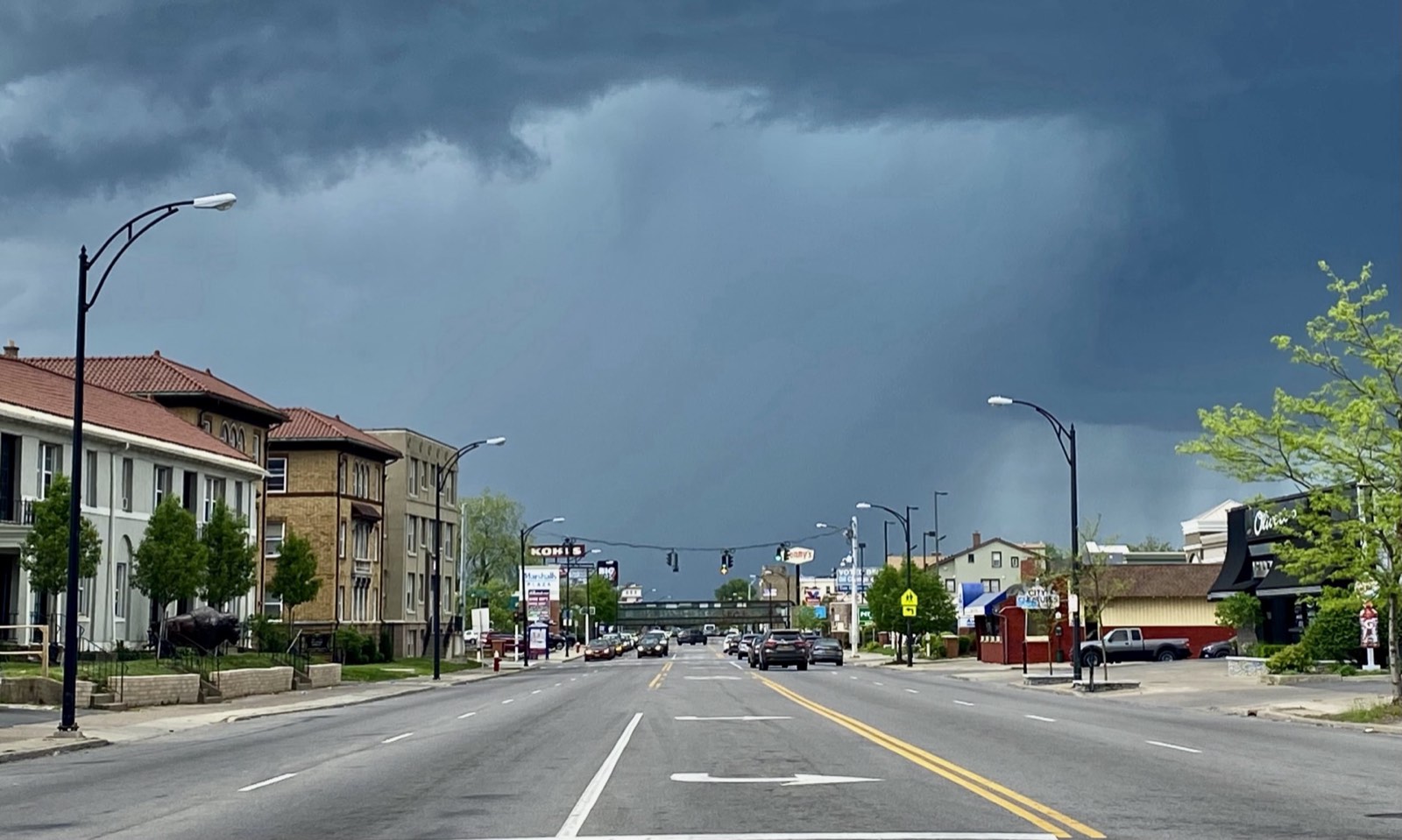
Not every storm is the same. Some are short and violent. Some are gentle and never stop.
Which one is worse for the river?
Photo: Andre Carrotflower, CC BY-SA 4.0
PART 2 · QUESTION 5
Try four storms
1
First row: the starting storm, 12 mm/h for 2 h.
2
Press each storm preset: Light drizzle, Thunderstorm, All-day soaker.
3
Copy the intensity and length from the sliders.
4
Total rain = intensity × length.
5
Read the results boxes. They fill in right away.

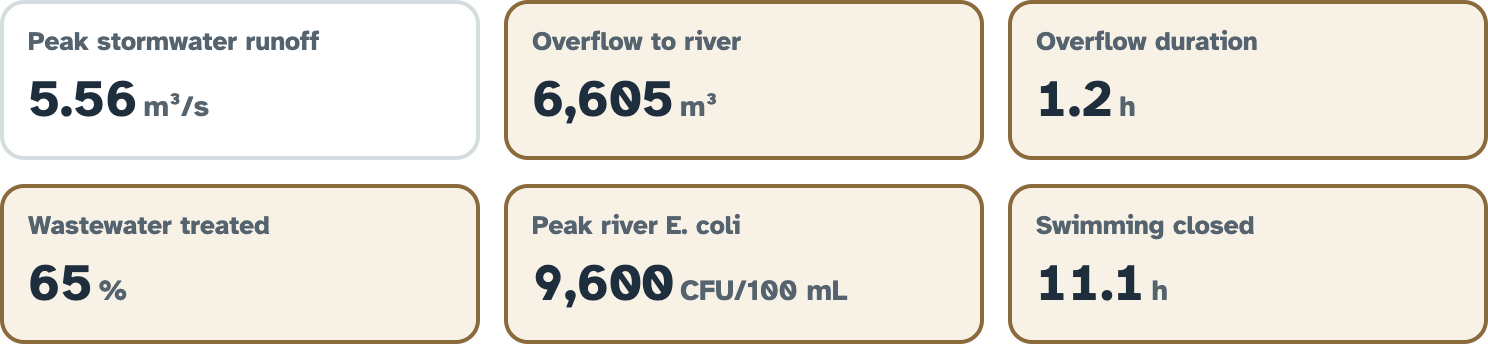
The results for the thunderstorm. You do not have to play the storm to read them.
Screenshot: mrsajdak.com/sewer-overflow
PART 2 · LEARN IT · 1 OF 3
How hard, or how much?
Total rain = intensity × length. 40 mm/h for half an hour is 20 mm. 6 mm/h for 8 hours is 48 mm: more than twice as much water.
Screenshot: mrsajdak.com/sewer-overflow
PART 2 · LEARN IT · 2 OF 3
Limits that do not care how hard it rains
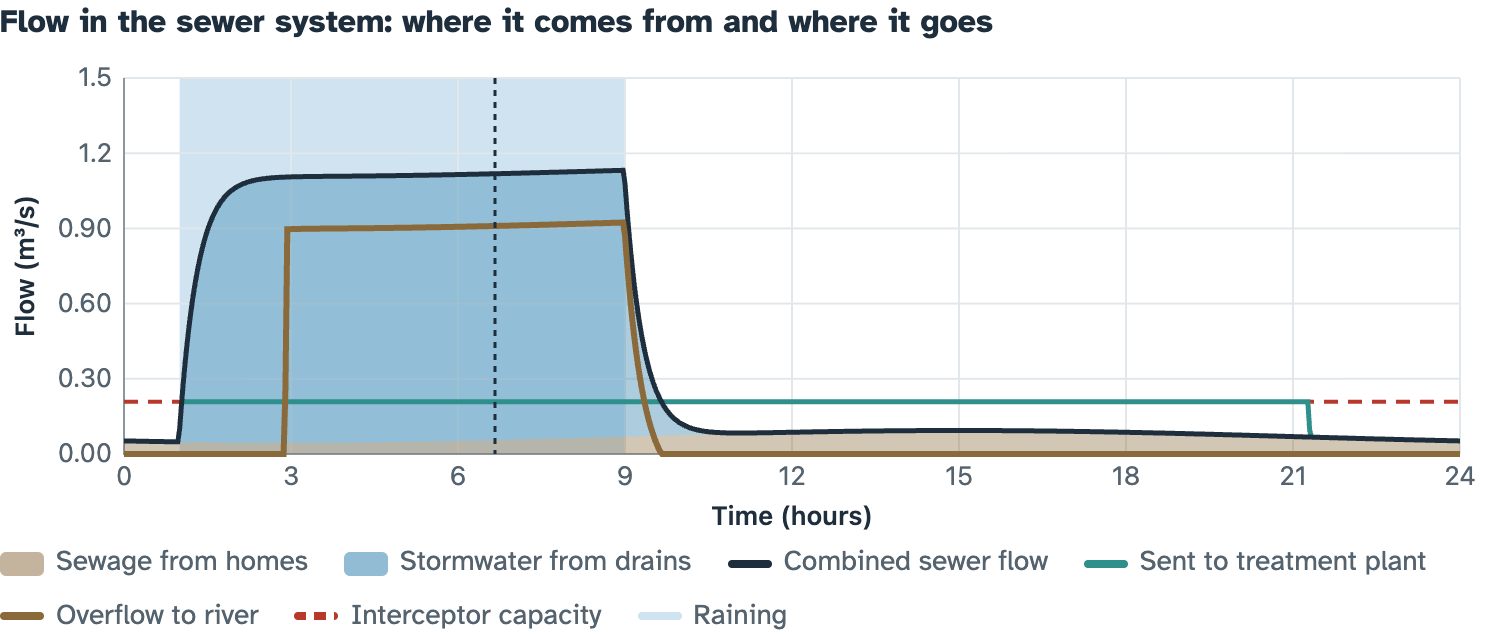
The plant takes 0.21 m³/s and the tank holds 5,000 m³, whatever the storm. Every bit of water above those limits overflows.
Screenshot: mrsajdak.com/sewer-overflow
PART 2 · LEARN IT · 3 OF 3
Hard surfaces shed water
Roofs, roads and parking lots are impervious: in the lab, 90 out of every 100 drops run off. Lawns and soil soak up most of it: only 15 run off.
Photo: Andre Carrotflower, CC BY-SA 4.0
PART 2 · QUESTIONS 6 AND 7
The surprise, and the streets
QUESTION 6
3×
The gentle storm wins
The all-day soaker sends about three times as much overflow as the thunderstorm.
Explain why, using total rain and how long the sewer stays over its limit.
QUESTION 7
10% → 95%
Pave the city
Set the storm back to 12 mm/h for 2 h. Change only Paved and roofed area: 10%, 65%, 95%.
Explain why paving sends more water into the sewer.
QUESTIONS 8 TO 10
Part 3. Fix the sewer
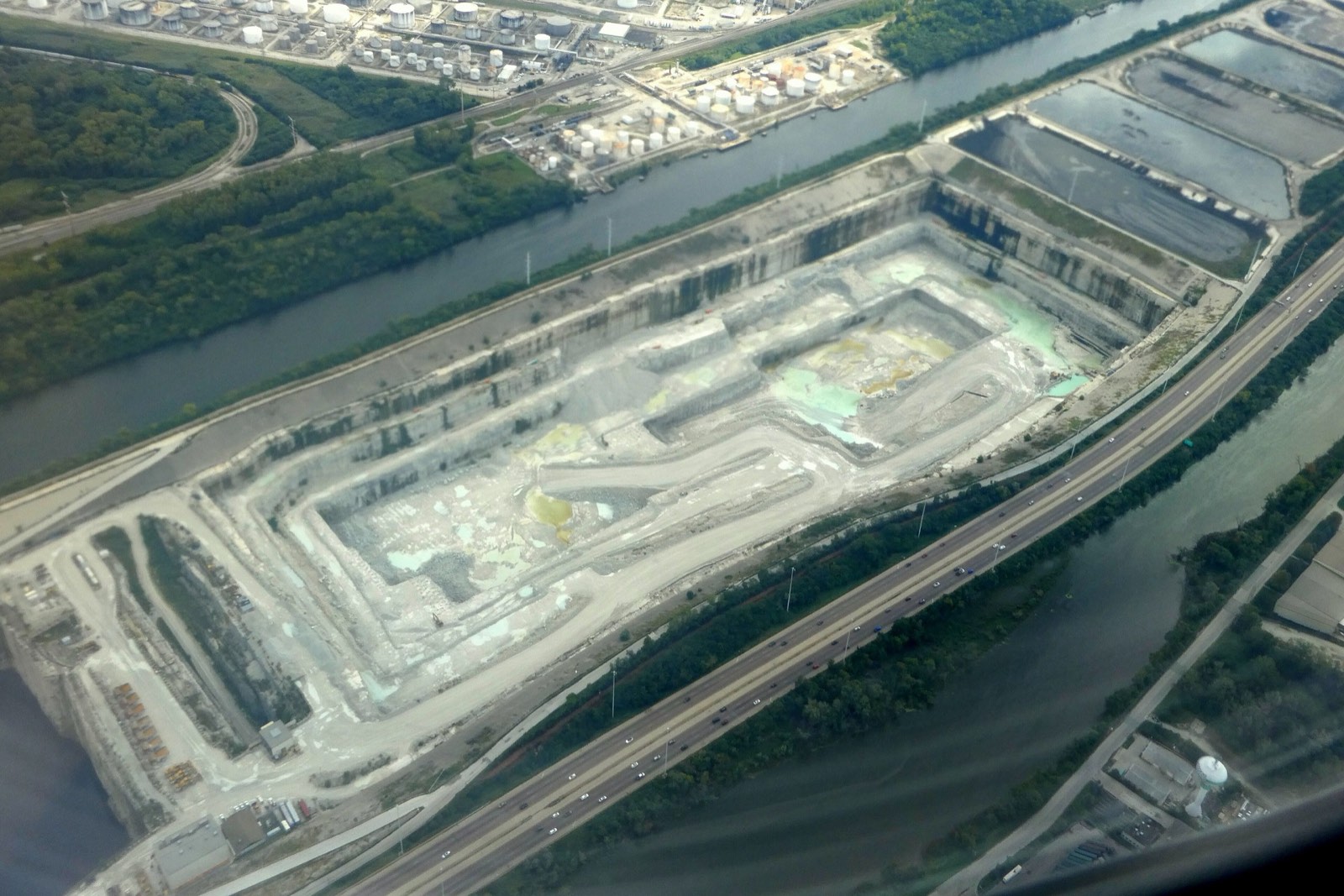
Cities have three ways to stop overflows: store the water, carry more of it, or keep it out of the sewer.
Test all three on two storms.
Photo: Pi.1415926535, CC BY-SA 4.0
PART 3
Three ways to fix it, for real
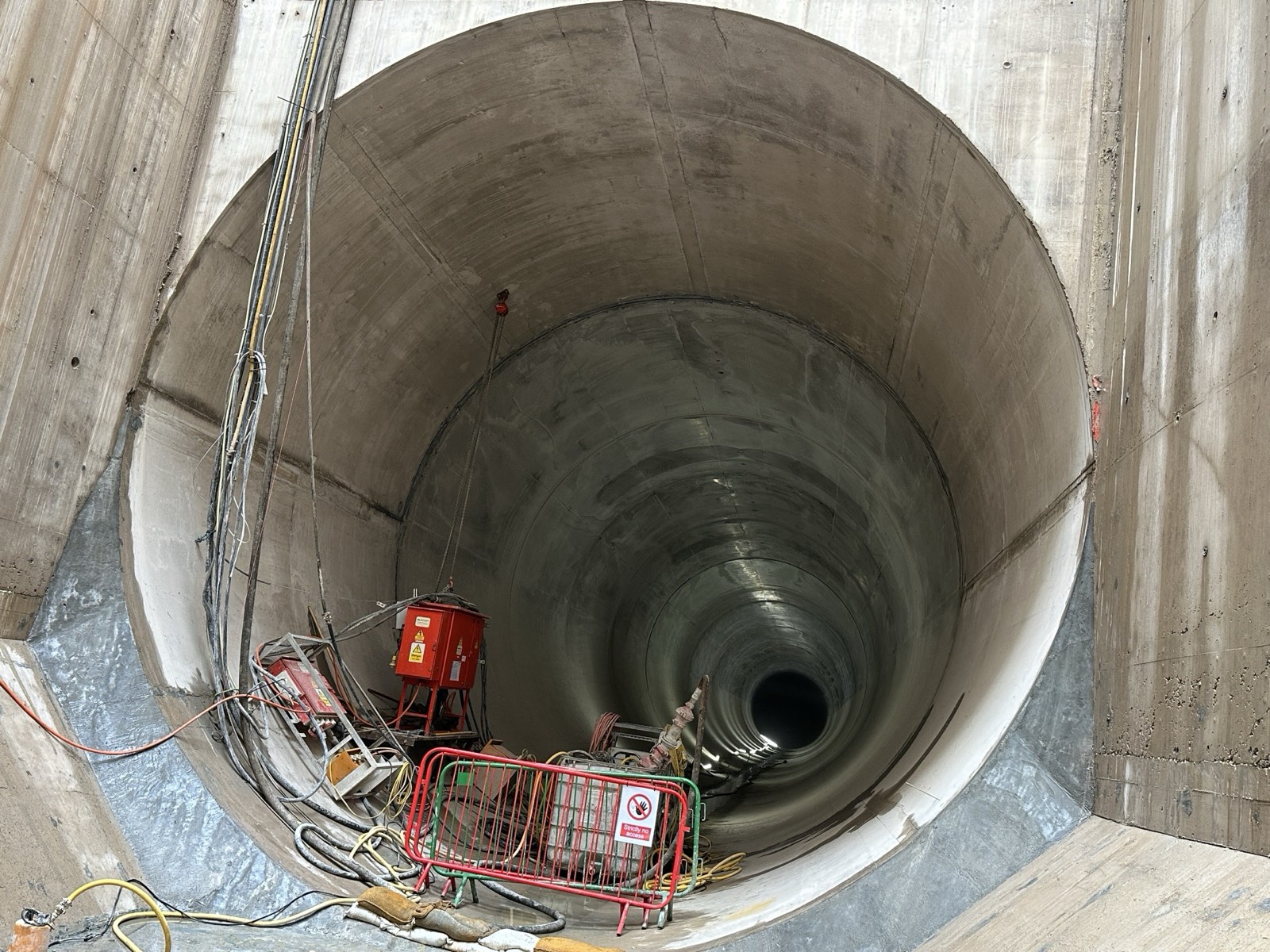

Photo: Matt Brown, CC BY 2.0 · Photo: Steven Olswang, CC BY-SA 4.0 · Photo: TonyTheTiger, CC BY-SA 3.0
PART 3 · QUESTION 8
One change at a time
1
Paved area back to 65%. Press Thunderstorm.
2
Read Overflow to river. That is the "no upgrade" row.
3
Make one change. Read the overflow. Put that slider back.
4
Tank 10,000 m³. Then green infrastructure 40%. Then interceptor 6×.
5
Do it all again with All-day soaker.
| Upgrade | Slider to move | Change it to |
|---|---|---|
| Bigger tank | Storage tank volume | 10,000 m³ |
| Green infrastructure | Green infrastructure | 40% |
| Bigger pipe | Interceptor capacity | 6× |
| No upgrade | Put them all back | 5,000 m³, 0%, 3× |
The sliders are in the box Set up the storm and the city, under The city and The sewer system.
PART 3 · LEARN IT · 1 OF 4
A tank holds a fixed amount
A tank can only fill once per storm. Doubling it catches exactly 5,000 m³ more, as long as the storm is big enough to fill it.
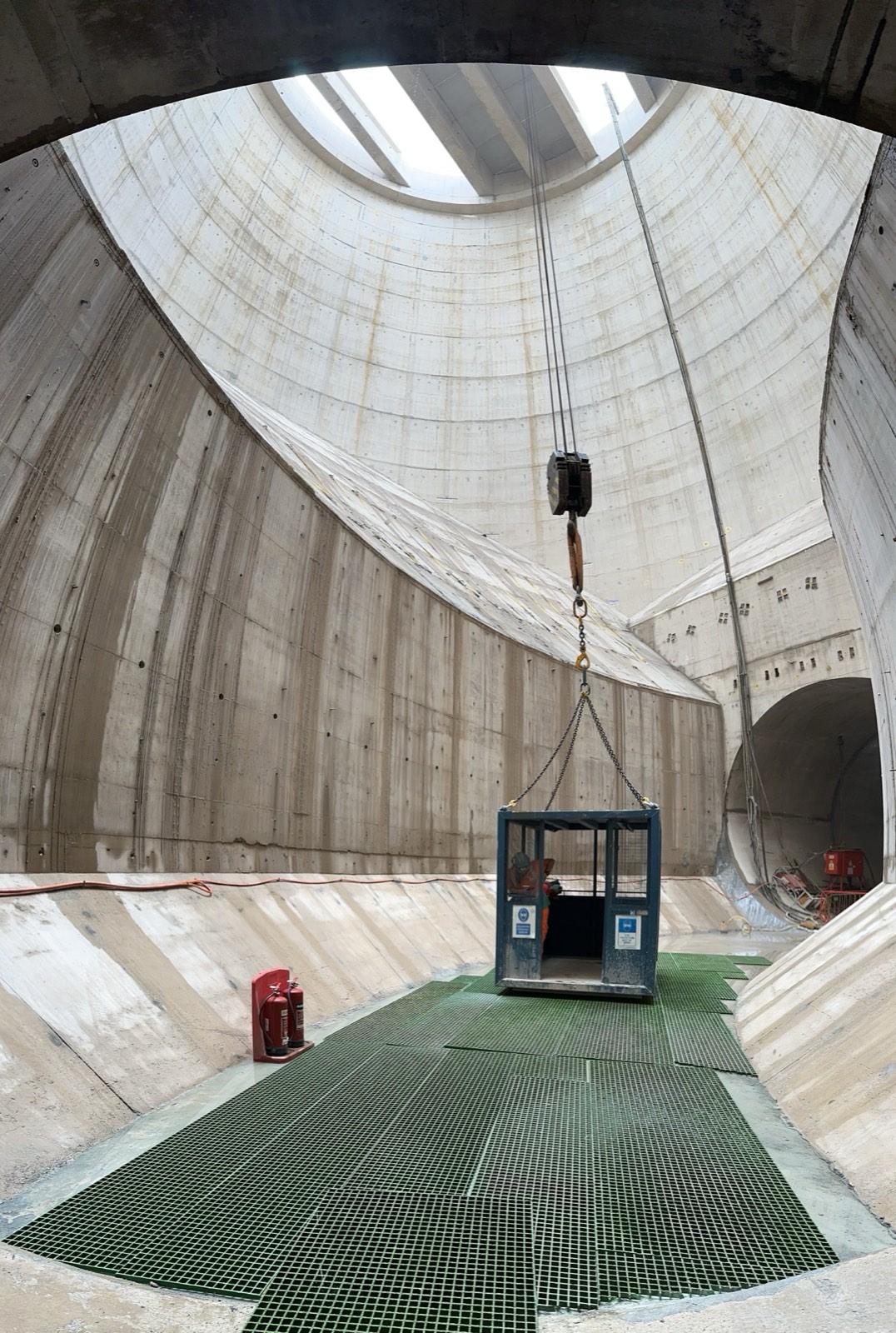
Photo: Matt Brown, CC BY 2.0
PART 3 · LEARN IT · 2 OF 4
Short storms: store the burst
A thunderstorm sends a short, huge burst. A big enough tank can catch most of it before it ever reaches the outfall.
Photo: Pi.1415926535, CC BY-SA 4.0
PART 3 · LEARN IT · 3 OF 4
Long storms: keep it out
An all-day storm sends more water than any tank holds. Green infrastructure keeps rain out of the sewer the whole time it falls.

Photo: DASonnenfeld, CC BY-SA 4.0
PART 3 · LEARN IT · 4 OF 4
Every fix has a cost
Tanks and tunnels cost billions and take years to dig. Bigger pipes mean torn-up streets. Green infrastructure needs land and care.
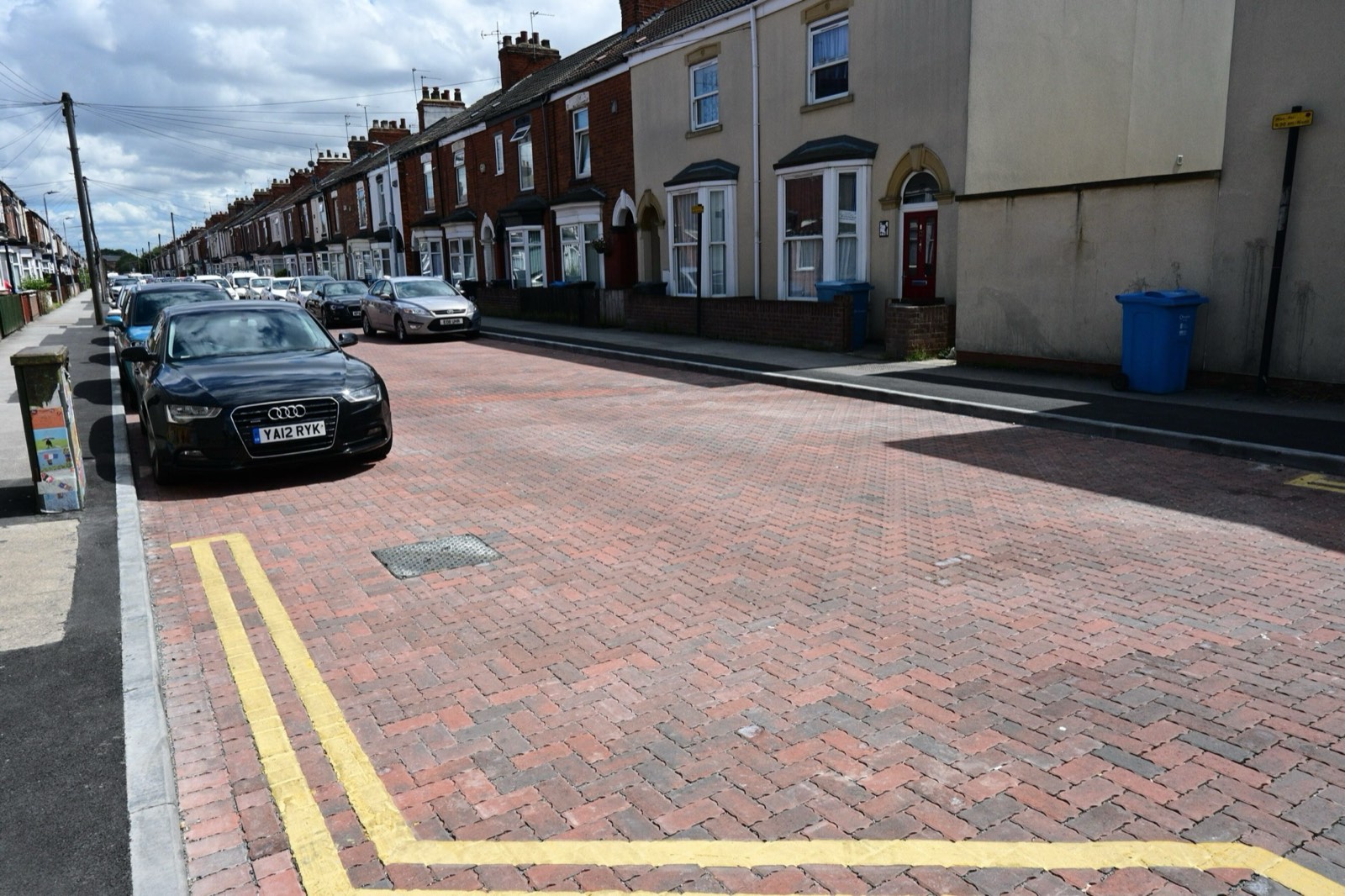
Photo: Hullian111, CC BY-SA 4.0
PART 3 · QUESTIONS 9 AND 10
Which fix wins?
QUESTION 9
5,000
The same cut twice
Doubling the tank cut both storms' overflow by the same amount.
Why the same amount?
QUESTION 10
?
It depends on the storm
Which upgrade worked best for the thunderstorm? For the soaker?
Explain why the best fix depends on the kind of storm.
QUESTIONS 11 TO 13
Part 4. The river
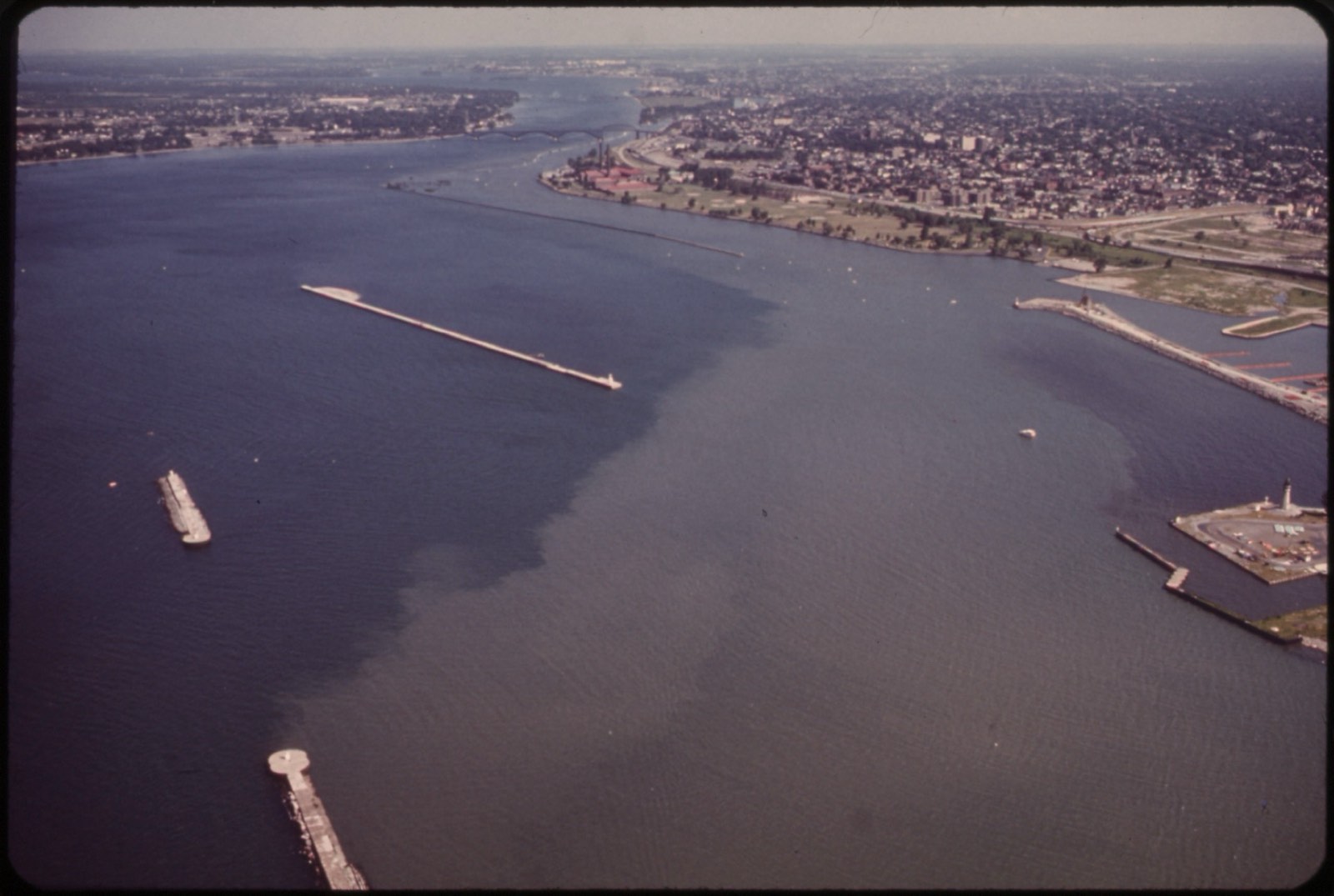
The overflow is over in a couple of hours. The river is not.
Change only how much water the river carries, and watch the beach.
Photo: George Burns, EPA Documerica, National Archives, public domain
PART 4 · QUESTION 11
A small river and a big one
1
Tank, green infrastructure and interceptor back to their starting values.
2
Press Thunderstorm.
3
Change only River flow: 2, 6, then 15 m³/s.
4
Read Peak river E. coli and Swimming closed.
5
A + means still closed at midnight.
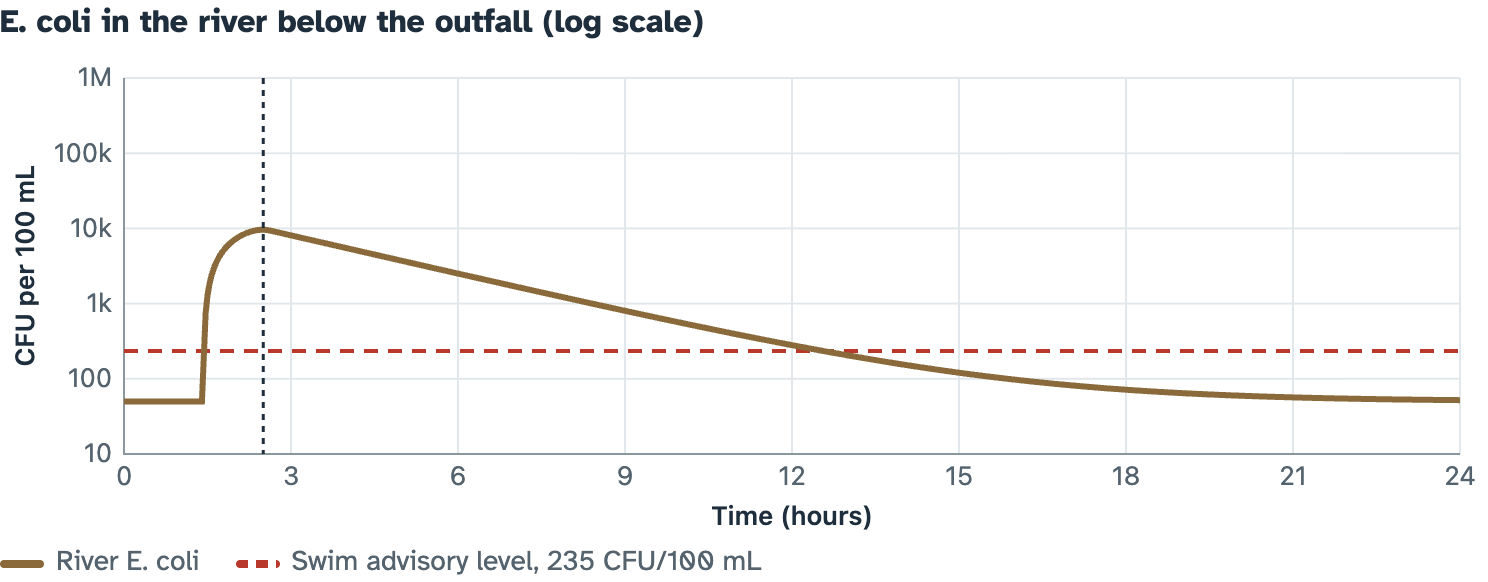
The thunderstorm with a river flow of 6 m³/s. The red dashed line is the swim advisory level.
Screenshot: mrsajdak.com/sewer-overflow
PART 4 · LEARN IT · 1 OF 4
Bacteria tell us about sewage
E. coli lives in human and animal guts. Lots of it in a river means sewage is there. Beaches close above 235 per 100 mL.
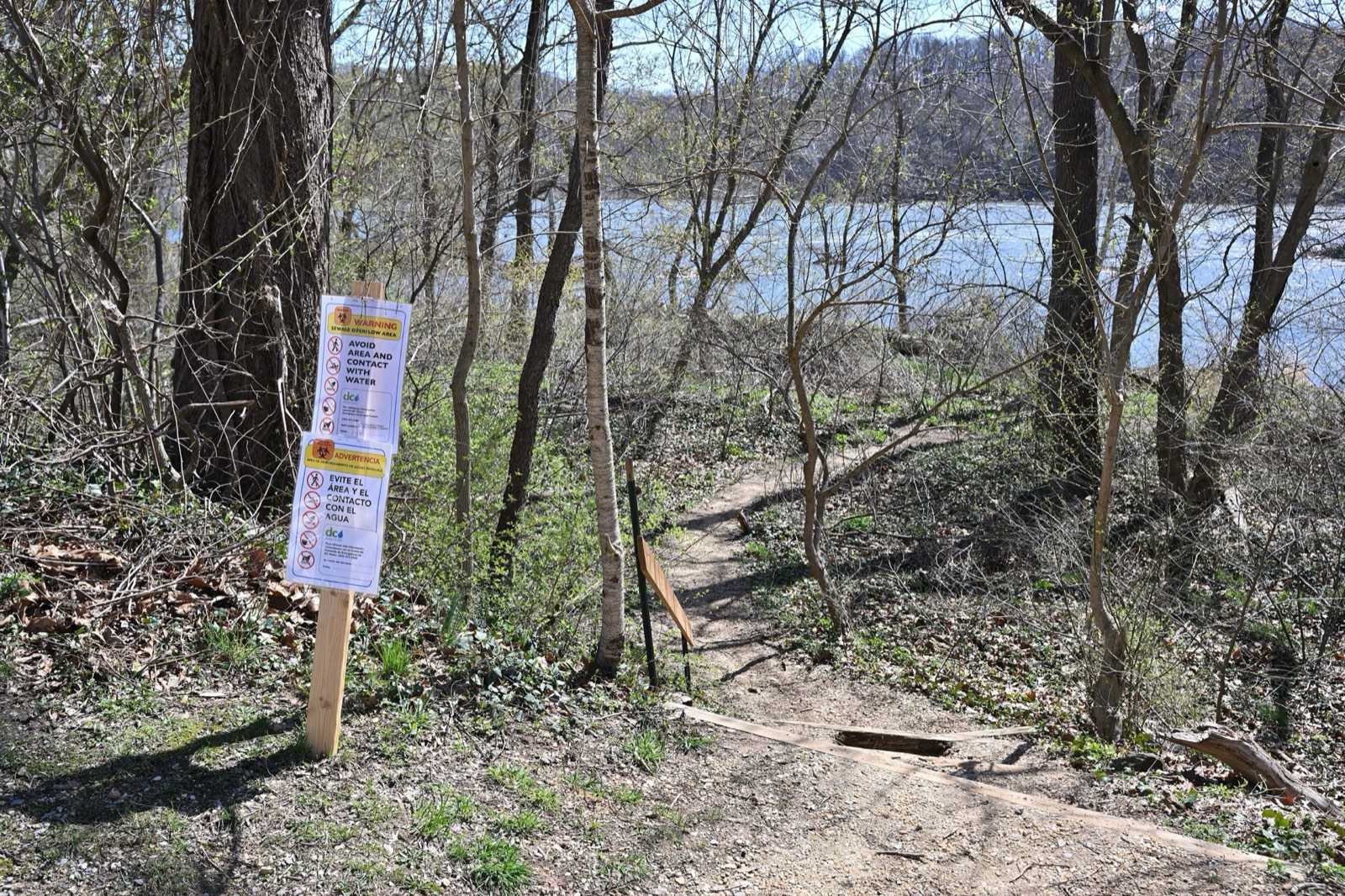
Photo: G. Edward Johnson, CC BY 4.0
PART 4 · LEARN IT · 2 OF 4
Dilution
The same sewage mixed into more water makes a weaker mix. A bigger river dilutes the overflow, so the peak is lower.
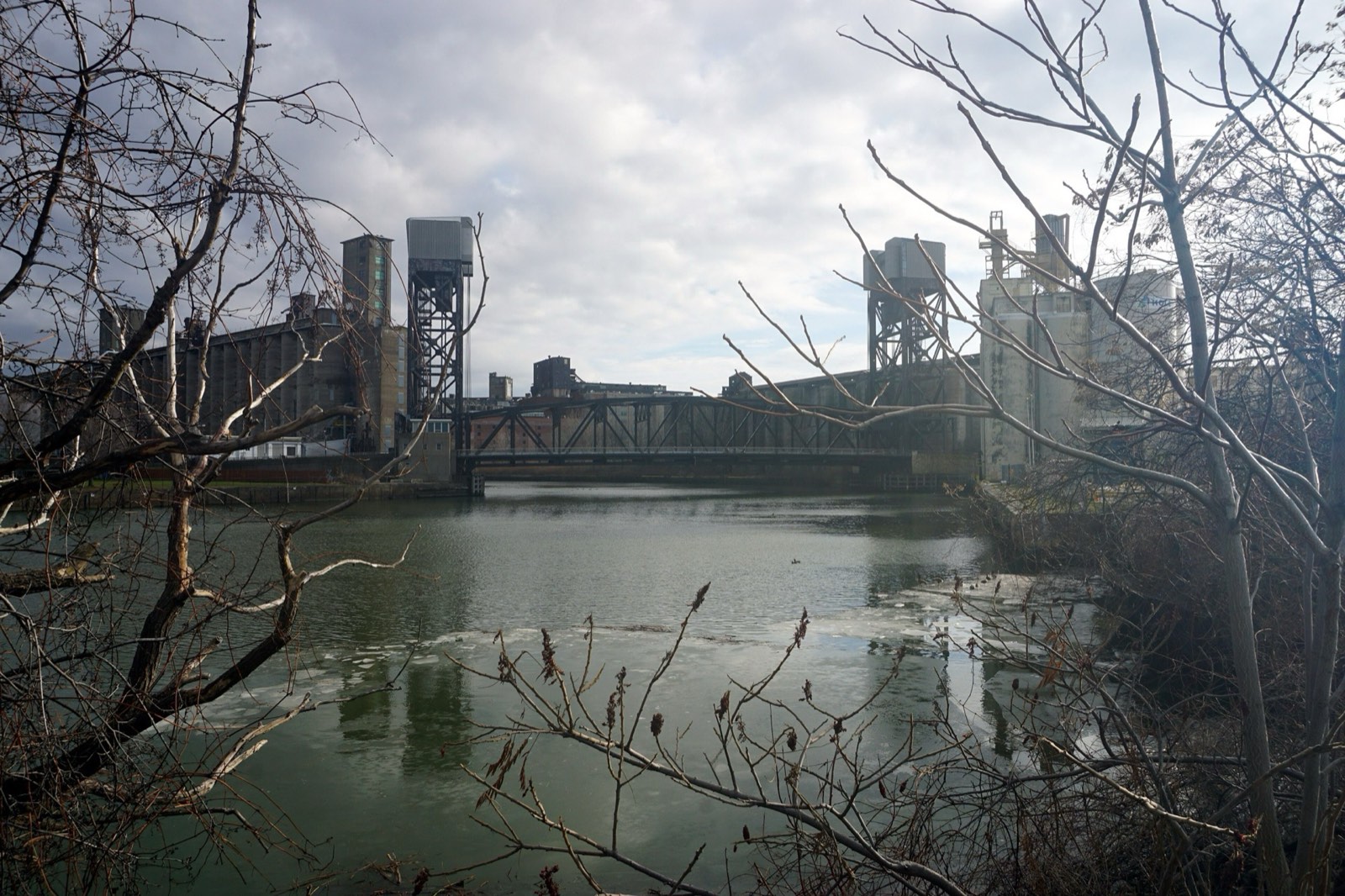
Photo: Michael Barera, CC BY-SA 4.0
PART 4 · LEARN IT · 3 OF 4
Flushing
A river carries polluted water away and brings clean water in. A faster river flushes it out sooner, so the beach reopens sooner.
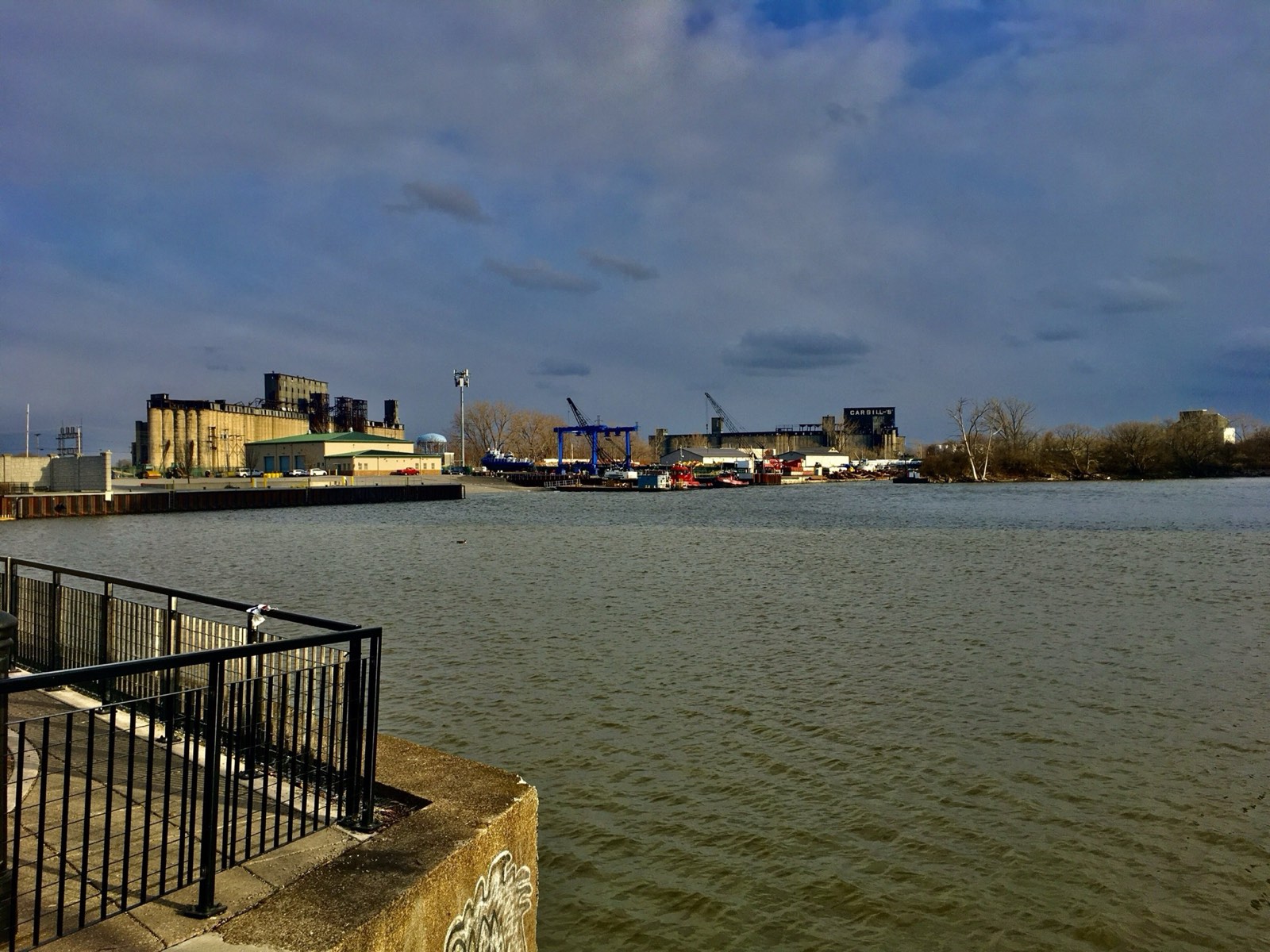
Photo: Andre Carrotflower, CC BY-SA 4.0
PART 4 · LEARN IT · 4 OF 4
Slow to clear
The overflow stops, but the bacteria are still in the water. In the lab, the river has to wash the bacteria out over and over before the count drops below 235.
Screenshot: mrsajdak.com/sewer-overflow
PART 4 · QUESTIONS 12 AND 13
The river remembers
QUESTION 12
2 → 15
Dilution and flushing
The same overflow reached the river all three times.
Use dilution and flushing to explain your table.
QUESTION 13
~2.6 → ~12.6
Closed long after
River flow back to 6. The overflow stops near hour 2.6, but swimming stays closed until about hour 12.6.
Use both graphs to explain why.
WRAP IT UP · QUESTION 14
You run the sewer authority
Your choice
Your city can pay for one upgrade: a bigger tank, more green infrastructure, or a bigger interceptor.
Evidence
Back it with at least two numbers from two different storms.
Reasoning
Explain why those numbers make it the best choice for your city.
The cost
Name one cost or drawback of your choice.
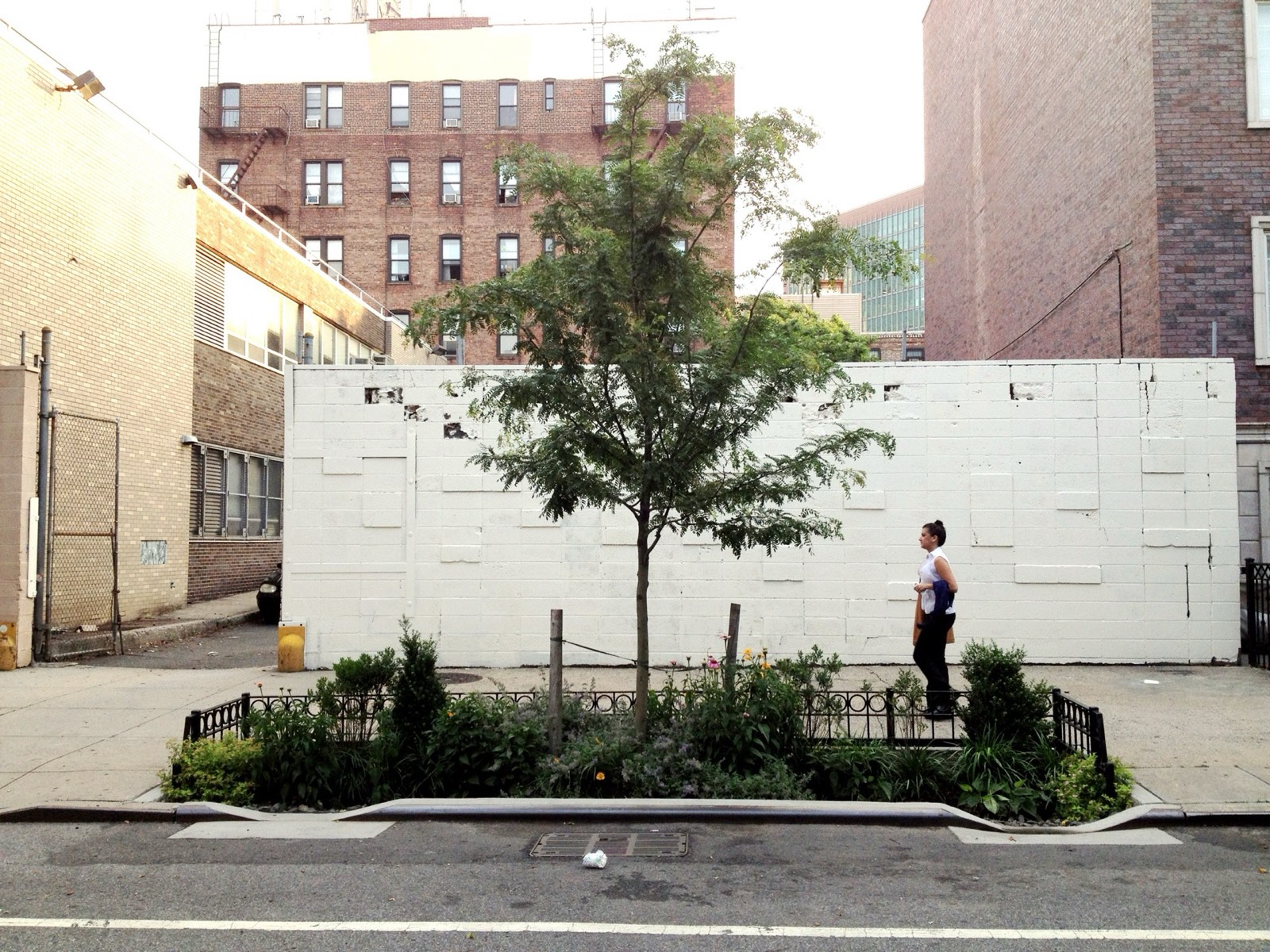
A curbside rain garden in New York City, built to catch street runoff before it reaches a storm drain.
Photo: ChrisHamby, CC BY-SA 4.0
WRAP IT UP · BACK TO THE START
Revisiting the phenomenon
Why does a hard rain in Buffalo send sewage into the river, and what can a city do about it?
1Rain is just water. Explain how a hard rain sends sewage into the river. Use the words interceptor, storage tank and outfall.
2Look back at your PREDICT answer. Which storm was worse for the river, and what number from the lab shows it?
3Why do beaches stay closed so long after the rain stops?
4Name one thing at your home or school that sends rain to the sewer, and one change that could keep it out.

LAST CHECK
Before you hand it in
Name, date and period are on top.
All five tables are full.
Every number has its unit.
Question 14 has a fix, two numbers from two storms, and a cost.
Photo: Andre Carrotflower, CC BY-SA 4.0