ANATOMY & PHYSIOLOGY · SECTION 8.3
Sliding Filaments
Follow along with your worksheet, one question at a time.
mrsajdak.com/sliding-filament
Micrograph: Louisa Howard, public domain
START HERE · PICK AN OPENER
Choose how to open the lesson
Click a card to jump to it. Every option ends at the same Observe, Wonder, Predict slide and the same driving question.
OPTION A · VIDEO
A Cell That Shortens
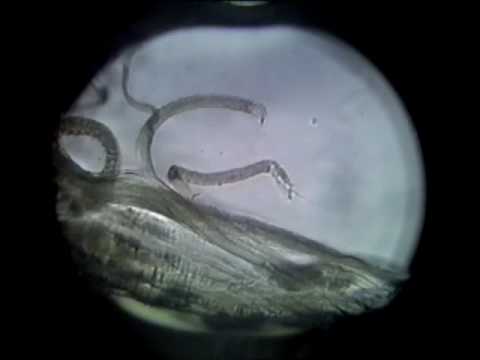
Clip 1 is a real skeletal muscle cell under a light microscope, shortening (46 seconds). Clip 2 is a second short clip of muscle cells contracting under a microscope (22 seconds).
Watch for
What happens to the stripes as the cell shortens?
Do the stripes get thinner, or just closer together?
What could be pulling the stripes closer?
Videos on YouTube: Laurie Shannon Meadows; Caleb Schwenk.
OPTION B · TRY IT · 2 MINUTES
Finger Slide
1
Hold your hands up, palms facing you, fingertips pointing at each other.
2
Lace the tips of your fingers together, just the tips.
3
Slowly slide your fingers deeper between each other.
4
Watch the distance between your palms. Watch your fingers.
You need
Your own two hands
Nothing else
Watch for
What happened to the distance between your palms?
Did any finger get shorter?
What did change?
OPTION C · PHOTOS
Phenomenon: The Stripes
Micrographs: Berkshire Community College Bioscience Image Library, CC0 · Louisa Howard, public domain
START HERE
Observe, wonder, predict
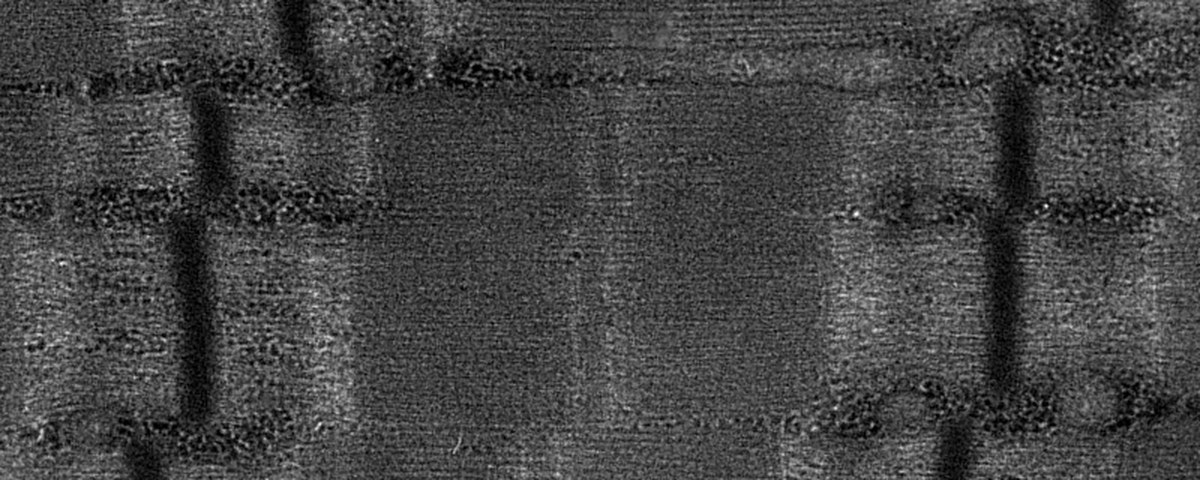
When a muscle contracts, the dark stripes move closer together.
OBSERVEDescribe the pattern of light and dark stripes.
WONDERWhat do you wonder about what the stripes are made of?
PREDICTWhen the stripes move closer, does each dark stripe get thinner, stay the same, or get wider?
Look at the wide dark bands and the thin dark lines.
Micrograph: Louisa Howard, public domain
DRIVING QUESTION
A muscle can get shorter by centimeters, but none of its protein threads get shorter. How?
START HERE
What Happened Here?
Finished observing? Click here to find out.
The stripes come from two kinds of protein threads, thick and thin, lying side by side in a pattern that repeats. When the cell contracts, the threads change how they sit next to each other.
Today, you will measure the bands of one unit of muscle, the sarcomere. You will add thousands of them up. Then you will find the length where a muscle pulls hardest.
TAB 1 · QUESTIONS 1 TO 7
Part 1. Measure the bands
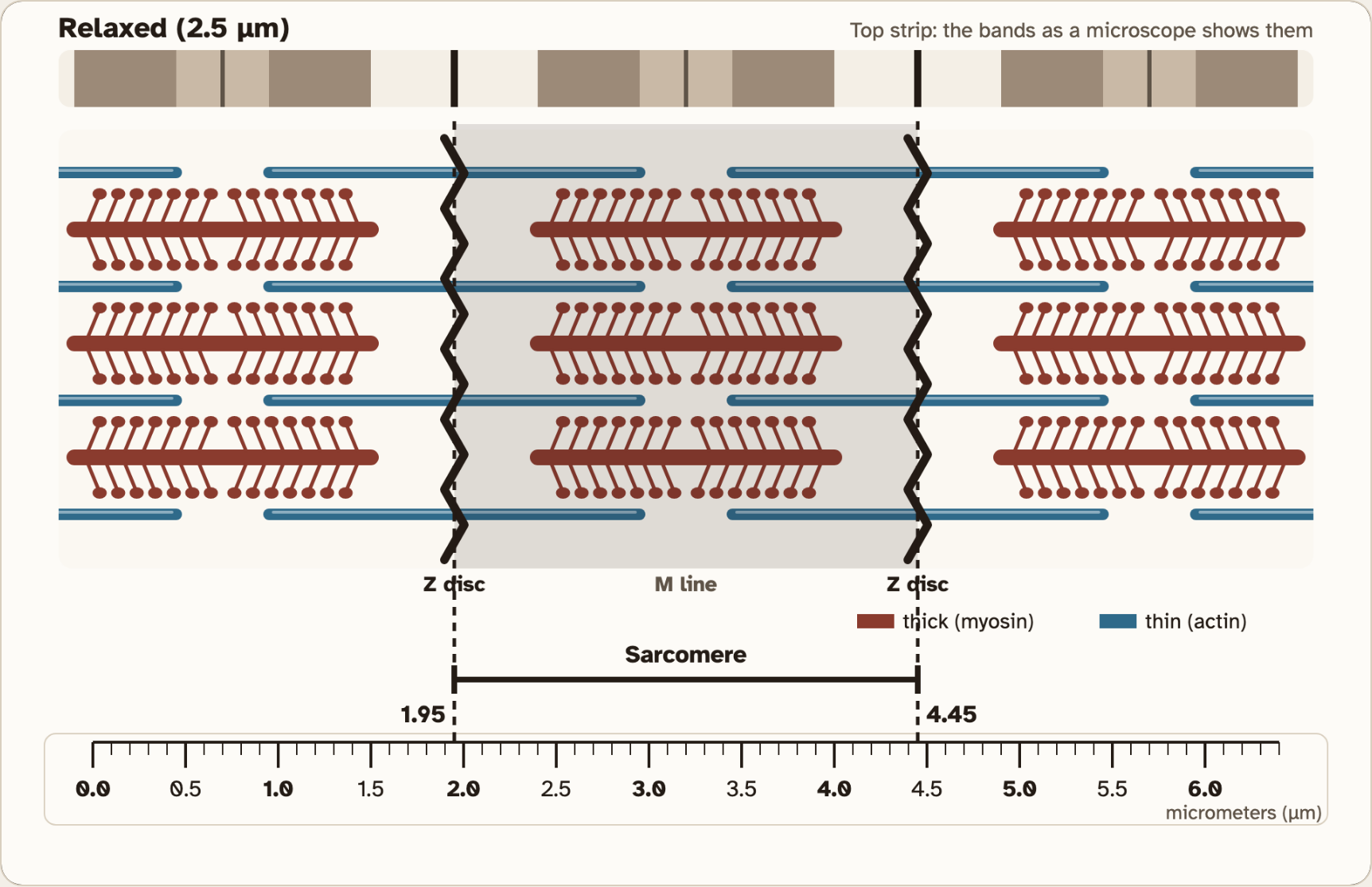
One sarcomere, drawn to scale. Which parts get shorter?
Photo: Louisa Howard, public domain
PART 1 · QUESTIONS 1 TO 4
Measure every band, twice
1
Pick Relaxed.
2
Tap a band. Read where it starts and ends.
3
Subtract. Type the length. Press Check.
4
Do all four bands. Then do Contracted.
5
Answer Questions 1 to 4.
PART 1 · QUESTION 1
Reading the ruler
THE MATH
End minus start
Read the number where the band ends.
Subtract the number where it starts.
That is the length, in micrometers (µm).
Example
A band starts at 1.30 and ends at 2.10.
2.10 − 1.30
= 0.80 µm
These are not your numbers. Use your own.
PART 1 · LEARN IT · 1 OF 4
New words
A sarcomere is one unit of a muscle fiber, from one Z disc to the next. A thick filament is made of myosin and has heads that can grab. A thin filament is made of actin and is joined to a Z disc.
Lab model: Ryan Sajdak
PART 1 · LEARN IT · 2 OF 4
What you measured
Relaxed to contracted, the sarcomere got 0.4 µm shorter. The I band and the H zone each got 0.4 µm shorter too. The A band did not change at all. It stayed 1.6 µm.
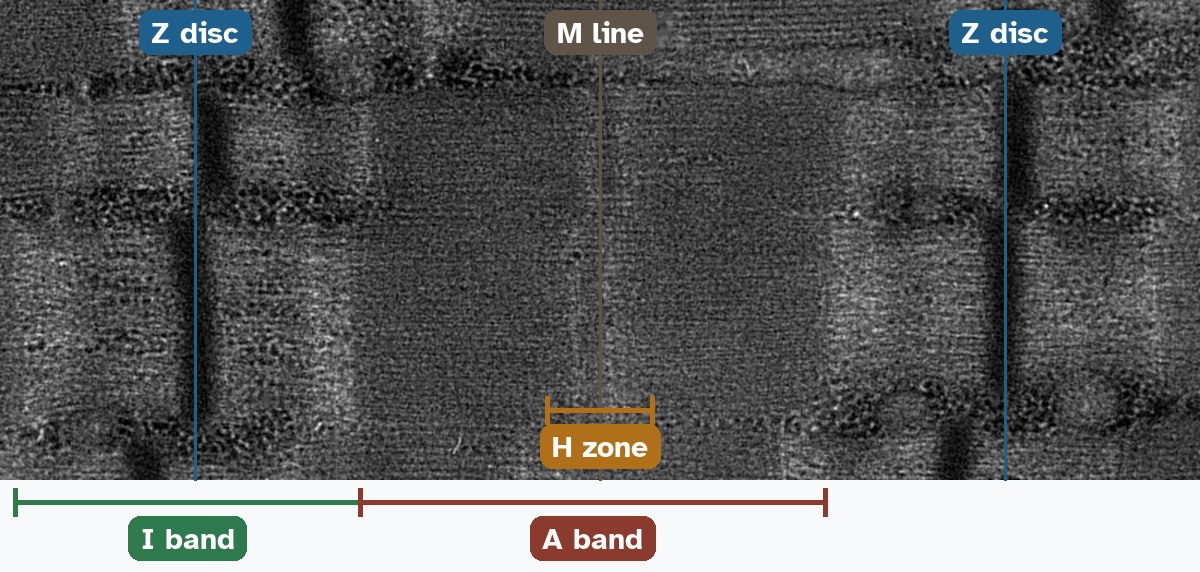
Micrograph: Louisa Howard, public domain. Labels added
PART 1 · LEARN IT · 3 OF 4
The filaments slide. They do not shrink.
The A band is exactly as long as the thick filaments. It stayed the same, so the thick filaments did not shrink. Myosin heads pull the thin filaments toward the middle. The overlap grows and the Z discs come closer.
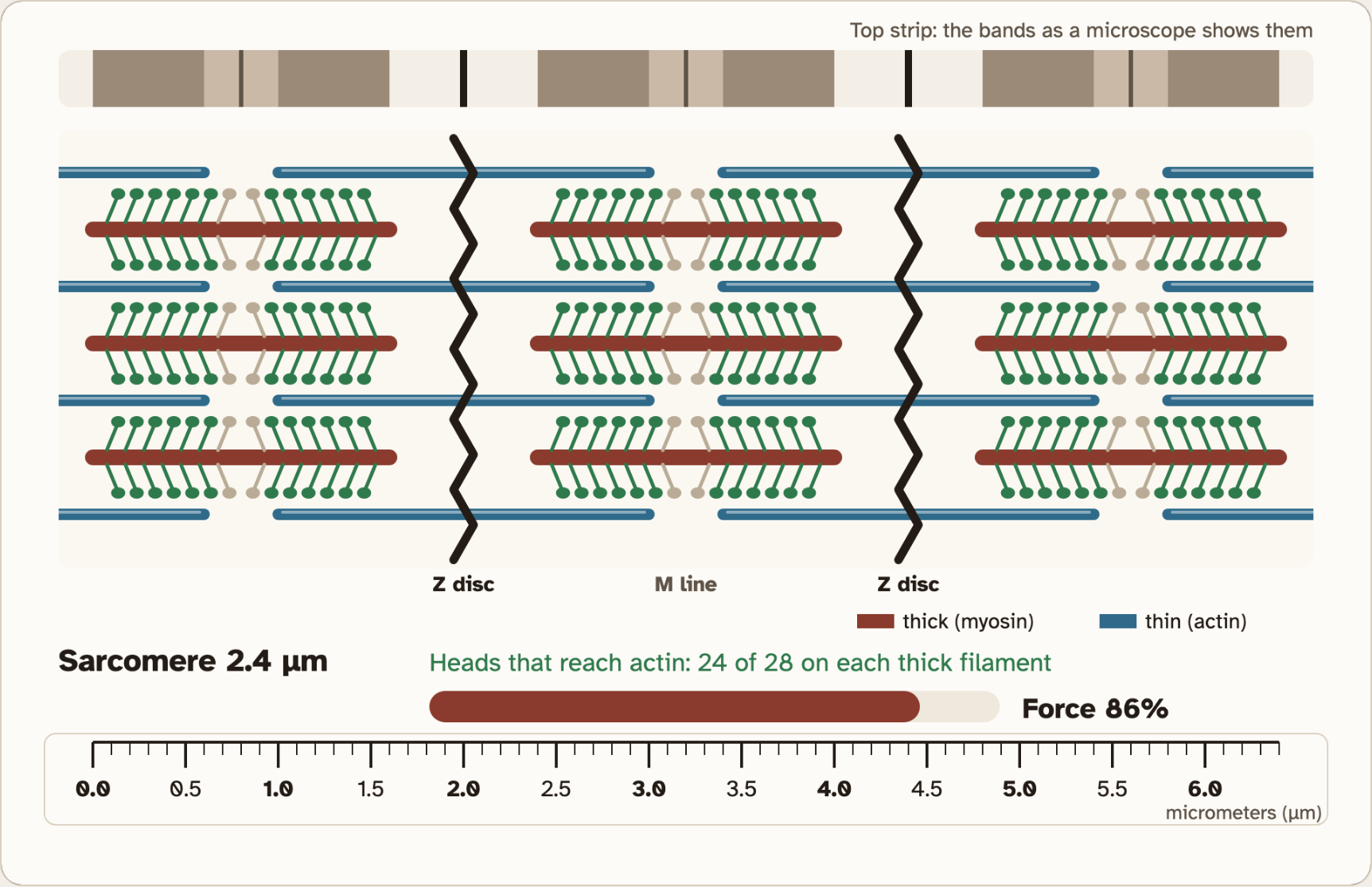
Lab model: Ryan Sajdak
PART 1 · LEARN IT · 4 OF 4
The sliding filament model
A muscle shortens because thin filaments slide past thick ones. No filament gets shorter. The light parts (I band, H zone) shrink, and the whole sarcomere gets shorter.
Micrograph: Louisa Howard, public domain
PART 1 · QUESTIONS 5 TO 7
Use the model
QUESTION 5
What makes each band?
Tick one for each band.
QUESTION 6
Predict a stretched sarcomere
A band = 1.6
I band = length − 1.6
H zone = length − 2.0
QUESTION 7
Answer the student
Use your numbers from Question 1.
Example
A 2.8 µm sarcomere: I band = 2.8 − 1.6
H zone = 2.8 − 2.0
I band 1.2 µm, H zone 0.8 µm
These are not your numbers. Use your own.
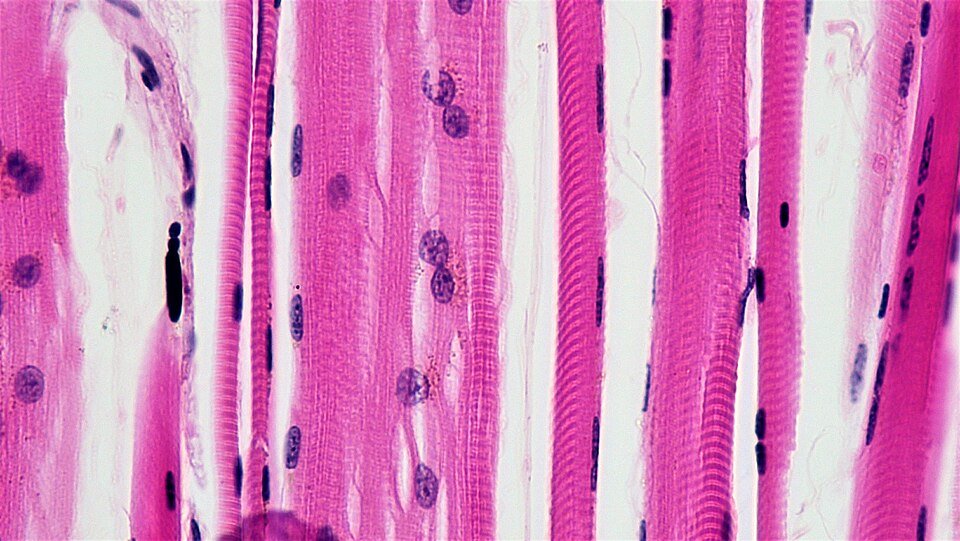
TAB 2 · QUESTIONS 8 TO 12
Part 2. Add them up
A fiber is a chain of thousands of sarcomeres.
Photo: Berkshire Community College Bioscience Image Library, CC0
PART 2 · QUESTIONS 8 TO 10
Contract three fibers
1
Pick a fiber length.
2
Press Contract. Copy the record.
3
Do all three fibers.
4
Try "Only one sarcomere" once.
5
Do the math in Step 3.
PART 2 · QUESTION 10
Percent shorter
THE MATH
Change ÷ start
How much shorter did it get?
Divide by the starting length.
Times 100 gives a percent.
Example
A rope goes from 10 m to 8 m.
2 ÷ 10 = 0.20
= 20% shorter
These are not your numbers. Use your own.
PART 2 · LEARN IT · 1 OF 3
Many sarcomeres, one muscle
A muscle fiber is a chain of sarcomeres, end to end. A fiber 1 cm long holds about 4,000 of them. When the muscle contracts, every sarcomere shortens at the same time.
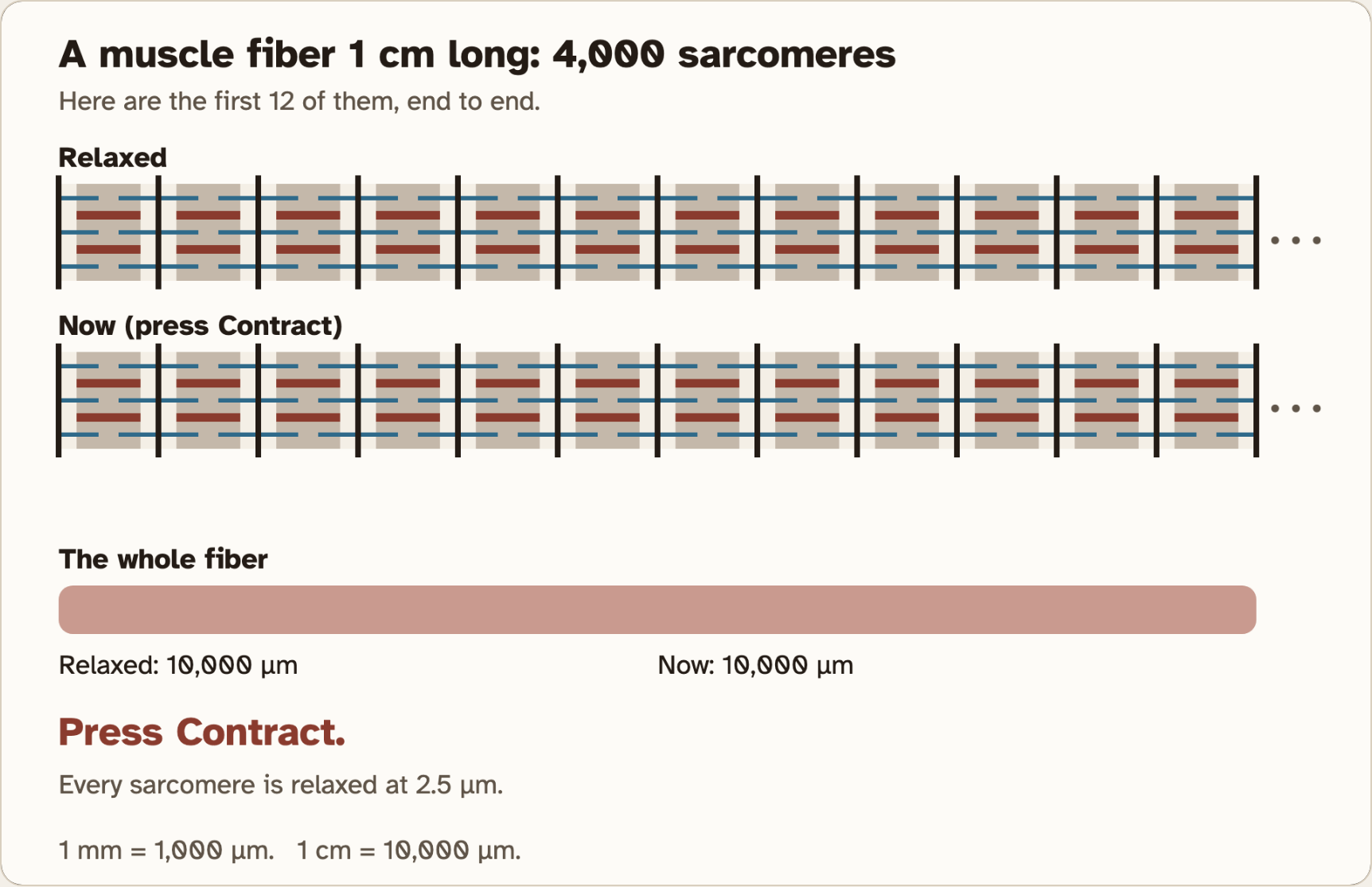
Lab model: Ryan Sajdak
PART 2 · LEARN IT · 2 OF 3
Tiny bits add up
Each sarcomere shortens only a tiny bit. Thousands of tiny bits add up to a change you can see. Every sarcomere shortens by the same fraction, so the whole fiber does too. About 16% here.
Micrograph: Berkshire Community College Bioscience Image Library, CC0
PART 2 · LEARN IT · 3 OF 3
From sarcomere to bone
All the fibers in a muscle pull together. The muscle gets shorter and pulls on its tendon. The tendon pulls the bone, and the body part moves.
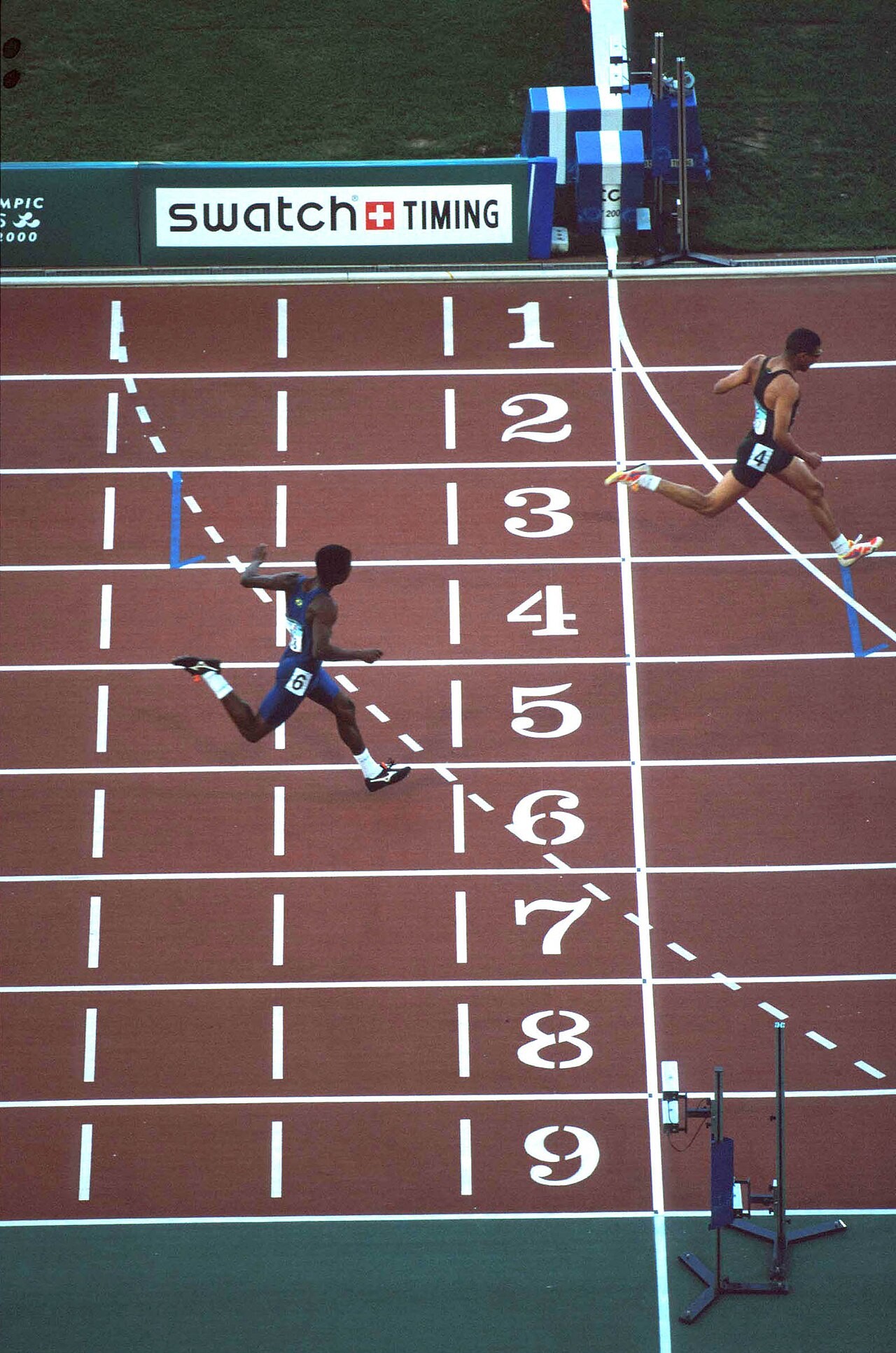
Photo: Sport the library, CC BY-SA 3.0
PART 2 · QUESTIONS 11 AND 12
Use the idea
QUESTION 11
Tiny to big
One sarcomere shortens 0.4 µm. How can a muscle shorten by centimeters?
QUESTION 12
A 5 cm fiber
Length ÷ 2.5 = how many sarcomeres.
That number × 0.4 = how much shorter.
10,000 µm = 1 cm.
TAB 3 · QUESTIONS 13 TO 16
Part 3. Length and force
Is a muscle strongest when it is stretched out, squeezed, or in the middle?
Photo: Frank Schulenburg, CC BY-SA 4.0, cropped
PART 3 · QUESTIONS 13 AND 14
Find the strongest length
1
Slide to 1.8 µm. Press Record.
2
Do 2.1, 2.5, 2.9 and 3.6.
3
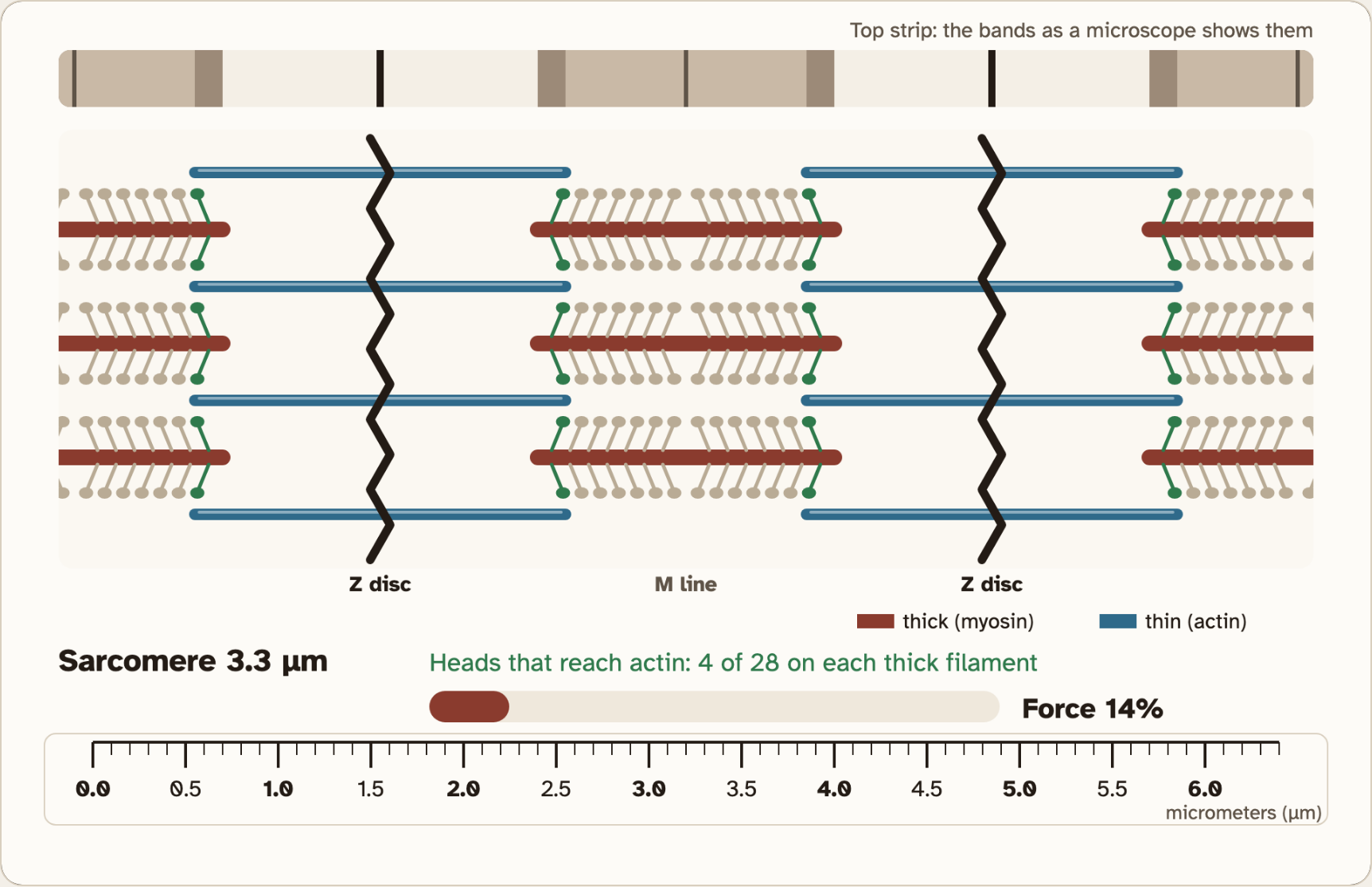
Count the green heads. Read the force.
4
Answer Questions 13 and 14.
PART 3 · LEARN IT · 1 OF 3
New words
A cross-bridge is a myosin head holding on to a thin filament. Overlap is where thick and thin filaments lie side by side. The length-tension relationship: how hard a muscle can pull depends on how long its sarcomeres are.
Lab model: Ryan Sajdak
PART 3 · LEARN IT · 2 OF 3
Overlap makes force
A head can only pull if it reaches a thin filament. Too stretched: few heads reach, so the pull is weak. Middle length: every head reaches. Too squeezed: the filaments crowd and the pull drops again.
Lab model: Ryan Sajdak
PART 3 · LEARN IT · 3 OF 3
Real data
In 1966, scientists in London stretched single frog muscle fibers to set lengths and measured the force. It was highest at about 2.0 to 2.25 µm and fell to zero at about 3.65 µm, where the filaments no longer overlap.
Photo: Frank Schulenburg, CC BY-SA 4.0, cropped
PART 3 · QUESTION 15
Why zero?
QUESTION 15
No force at 3.6 µm
Look at the model at 3.6 µm.
Where are the thin filaments?
Can any head reach one?

Photo: Nenad Stojkovic, CC BY 2.0
EXPLAIN IT · QUESTION 16
Is the therapist right?
"Your thigh muscle pulls hardest at a middle length, not when it is stretched all the way."
Claim
Right or wrong, in one sentence.
Evidence
Use two force numbers from your Question 13 table.
Reasoning
Say how overlap changes how many heads can pull.
WRAP IT UP · BACK TO THE START
Revisiting the Phenomenon
A muscle can get shorter by centimeters, but none of its protein threads get shorter. How?
EVIDENCEWhich band stayed the same? What does that tell you?
EVIDENCEHow do tiny shortenings make a big one?
BACK TO THE DO NOWDid the dark stripes get thinner? Were you right?
Hand in your worksheet.
The filaments slide. They do not shrink.