ANATOMY AND PHYSIOLOGY · CHAPTER 6
Thermoregulation Lab
Follow along with your worksheet, one question at a time.
mrsajdak.com/thermoregulation
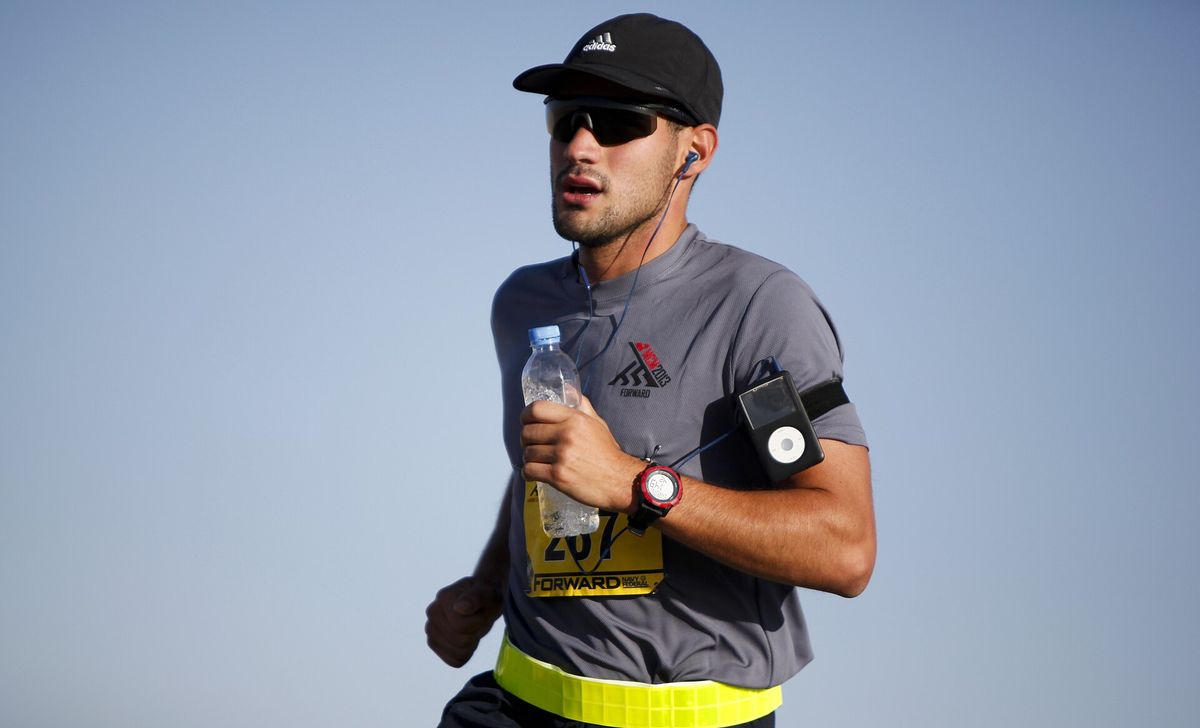
Photo: Sgt. Bobby Yarbrough, U.S. Marine Corps, public domain
START HERE
Phenomenon: One Hand, Three Photos
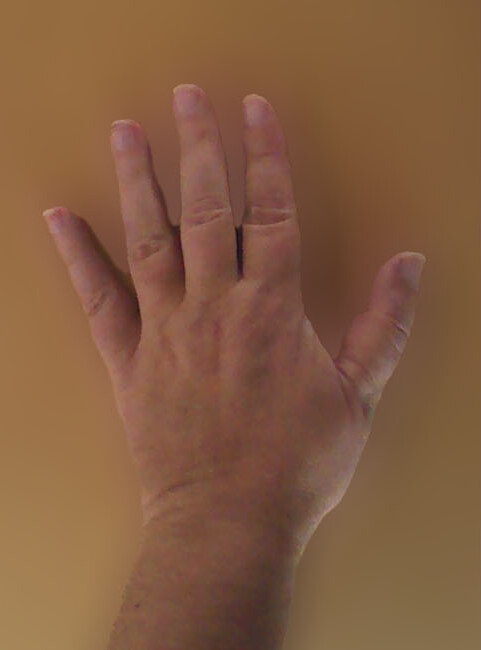
Photos: Amfeli, CMPLab, Centro Universitario de Mérida, CC BY 4.0
START HERE
Observe, wonder, predict
A thermal camera shows warm things as bright yellow and cool things as dark purple. Photos B and C were taken with one.
OBSERVEWhat do you notice in Photos B and C? Which parts are warmest?
WONDERWhere does the heat in this hand come from? Where is it going?
PREDICTWhat would Photo B look like after a run on a hot day? After waiting at a cold bus stop?
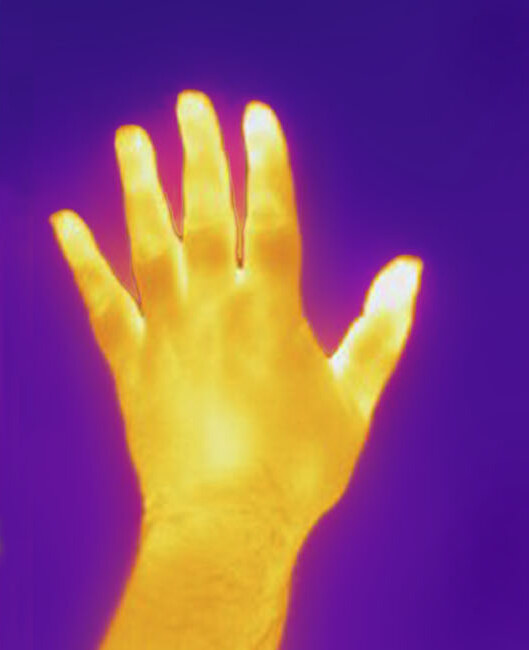
Photo B, up close.
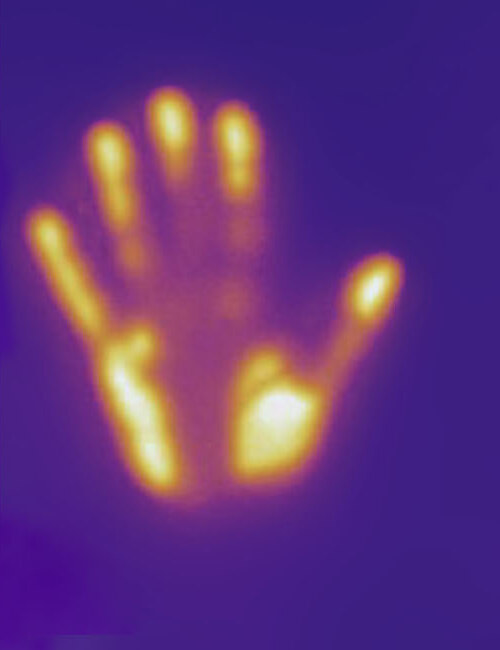
Photo C, up close.
Photos: Amfeli, CMPLab, Centro Universitario de Mérida, CC BY 4.0
DRIVING QUESTION
Your cells make heat all day. How does your body stay at 37°C?
START HERE
What Happened Here?
Finished observing? Click here to find out.
At a university lab in Mérida, Spain, a person laid a hand flat on a surface. An ordinary camera (Photo A) and a thermal camera (Photo B) took a picture at the same moment. The hand read up to about 33°C; the coolest spots were about 14°C. Then the hand was lifted, and the thermal camera took Photo C. The hand had left a warm print of itself on the surface.
Today, you will investigate the ways heat leaves your skin, why humid heat is dangerous, and the loop in your brain that turns sweat, blood vessels and shivering on and off. At the end, you will come back to these photos and the driving question.
BEFORE YOU START
Heat on the move
Photo B again. This hand is giving off heat right now.
Words for this lab
Heat always moves from something warmer to something cooler.
Your core is deep inside you: brain, heart, gut. It stays near 37°C (98.6°F).
Humidity is how much water vapor is in the air.
The dermis is the thick layer of skin with the blood vessels and sweat glands.
A fan only moves warm room air around. So why does it cool you off?
Photo: Amfeli, CC BY 4.0
BEFORE YOU START
What you will learn
DAY 1: HEAT OUT
I can name four ways heat leaves the skin, and show with data that evaporation cools.
I can explain how sweat glands and dermis blood vessels change how fast heat leaves, and why humid heat is dangerous.
DAY 2: THE LOOP
I can name the parts of a negative feedback loop and find them in my own data.
I can explain why a fever makes you shiver at a normal temperature and sweat when it breaks.
BEFORE YOU START
Get set up
1
Open mrsajdak.com/thermoregulation on your device.
2
Write your name, the date and your period on the worksheet.
3
Find the tabs at the top of the lab. Each tab goes with one part of the worksheet.
4
Day 1 is the front of the worksheet. Day 2 is the back.
5
Start on Tab 1. Do not skip ahead.

| Tab in the lab | Worksheet | Questions |
|---|---|---|
| 1. Wet and dry | Part 1 | 1 to 4 |
| 2. Four ways out | Part 2 | 5 to 7 |
| 3. Football practice | Part 3 | 8 to 10 |
| 4. The loop | Part 4 | 11 to 15 |
| 5. Fever | Part 5 and Wrap it up | 16 to 19 |
Screenshot: mrsajdak.com/thermoregulation
DAY 1 · TAB 1 · QUESTIONS 1 TO 4
Part 1. Wet and dry
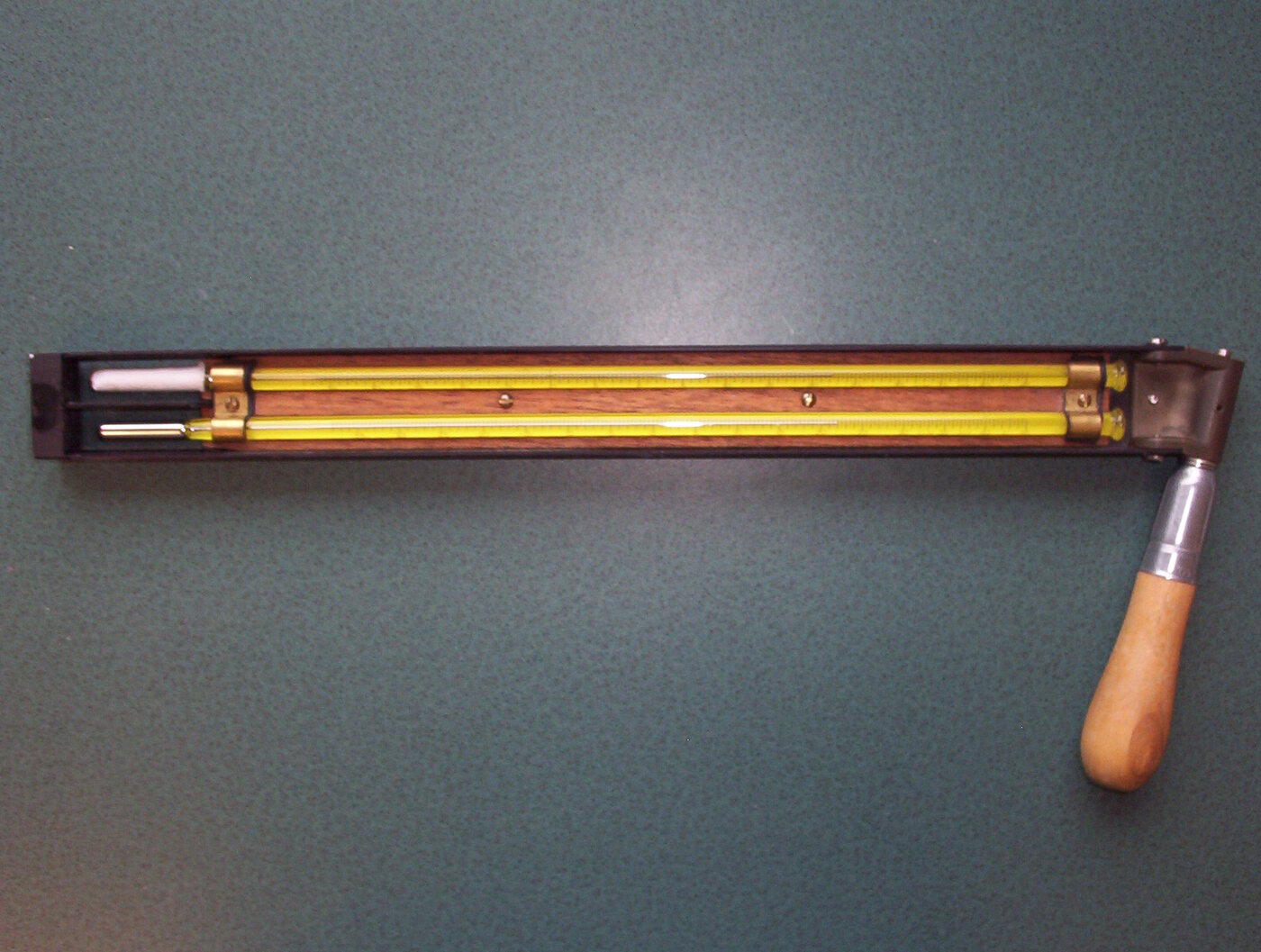
Weather watchers have measured humidity this way for more than 100 years: two thermometers, one in a wet cloth sleeve, swung through the air.
The wet one always reads lower. You will find out why.
Photo: CambridgeBayWeather, public domain
PART 1 · QUESTION 1
A fair test
1
Set Humidity to 50% and the water to Room temperature.
2
Pick Dry and Still. Press Run 5 minutes.
3
Watch the big Start, Now and Drop numbers and the graph.
4
A row is added to Your runs. Copy the start, the reading after 5 minutes and the drop.
5
Now run Dry, fanned, Wet, still air and Wet, fanned. Change nothing else.
PART 1 · QUESTIONS 2 AND 3
Control, cold water, humidity
QUESTION 2
The control, and a myth check
The control is the run with nothing added: no water, no fan. What does Dry, fanned prove?
Myth: a wet towel cools you because the water is cold. Run Wet, fanned with Cold, from the fridge. Compare where it ends with your room-water run.
QUESTION 3
Change only the humidity
Wet, fanned, room-temperature water. Run 20%, 80% and 100%. Your 50% run is already done.
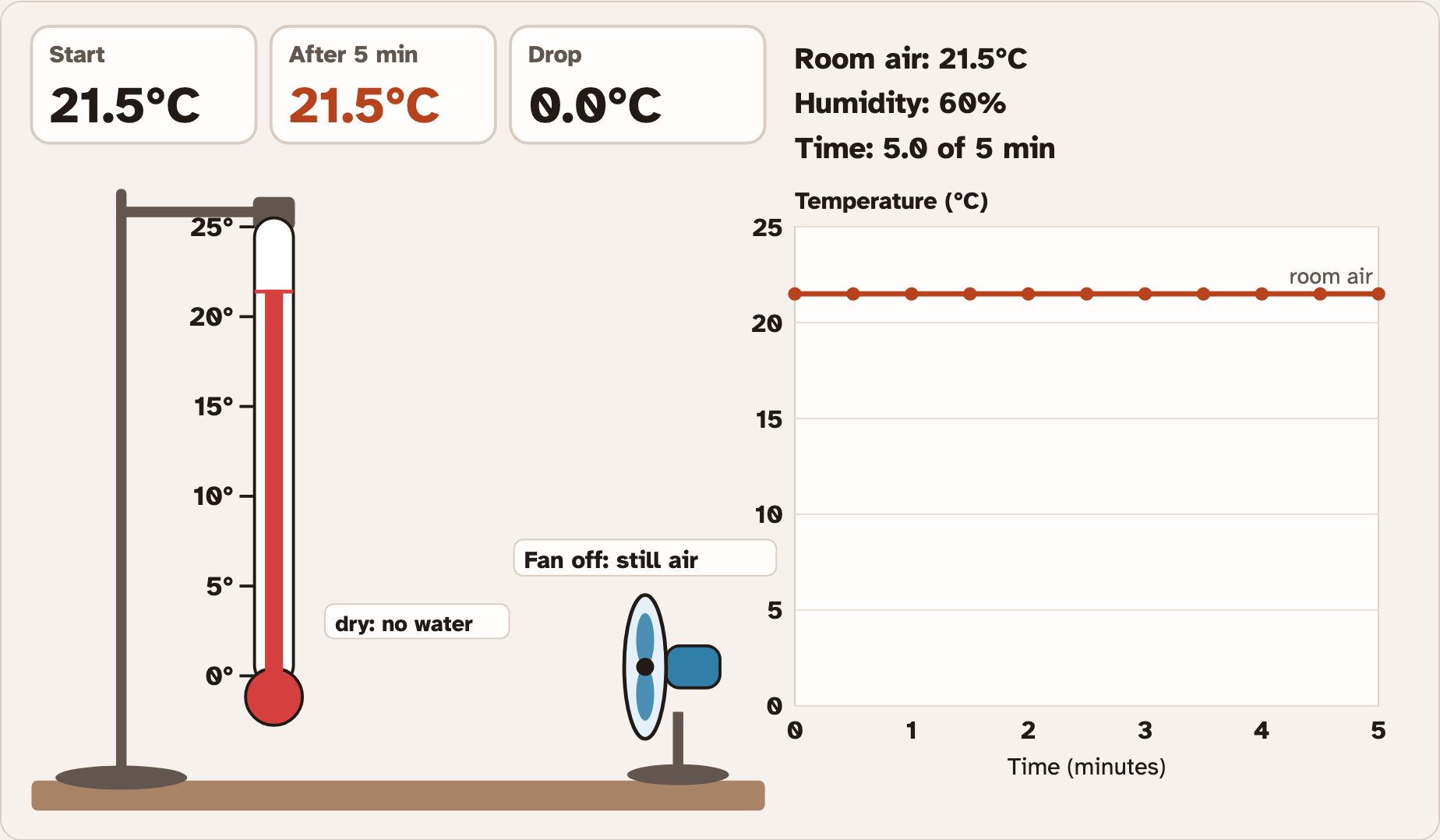
Dry, still air, 60%. This run is not on your worksheet.
Screenshot: mrsajdak.com/thermoregulation, Tab 1
PART 1 · LEARN IT · 1 OF 4
Your body makes heat all day
The chemical reactions in your cells, your metabolism, give off heat. Working muscles make the most. To stay near 37°C, heat has to leave as fast as it is made.
Photo: Sgt. Bobby Yarbrough, U.S. Marine Corps, public domain
PART 1 · LEARN IT · 2 OF 4
Evaporation takes heat with it
Turning liquid water into vapor takes energy. The water takes that energy as heat from whatever it is on: a thermometer, or your skin.
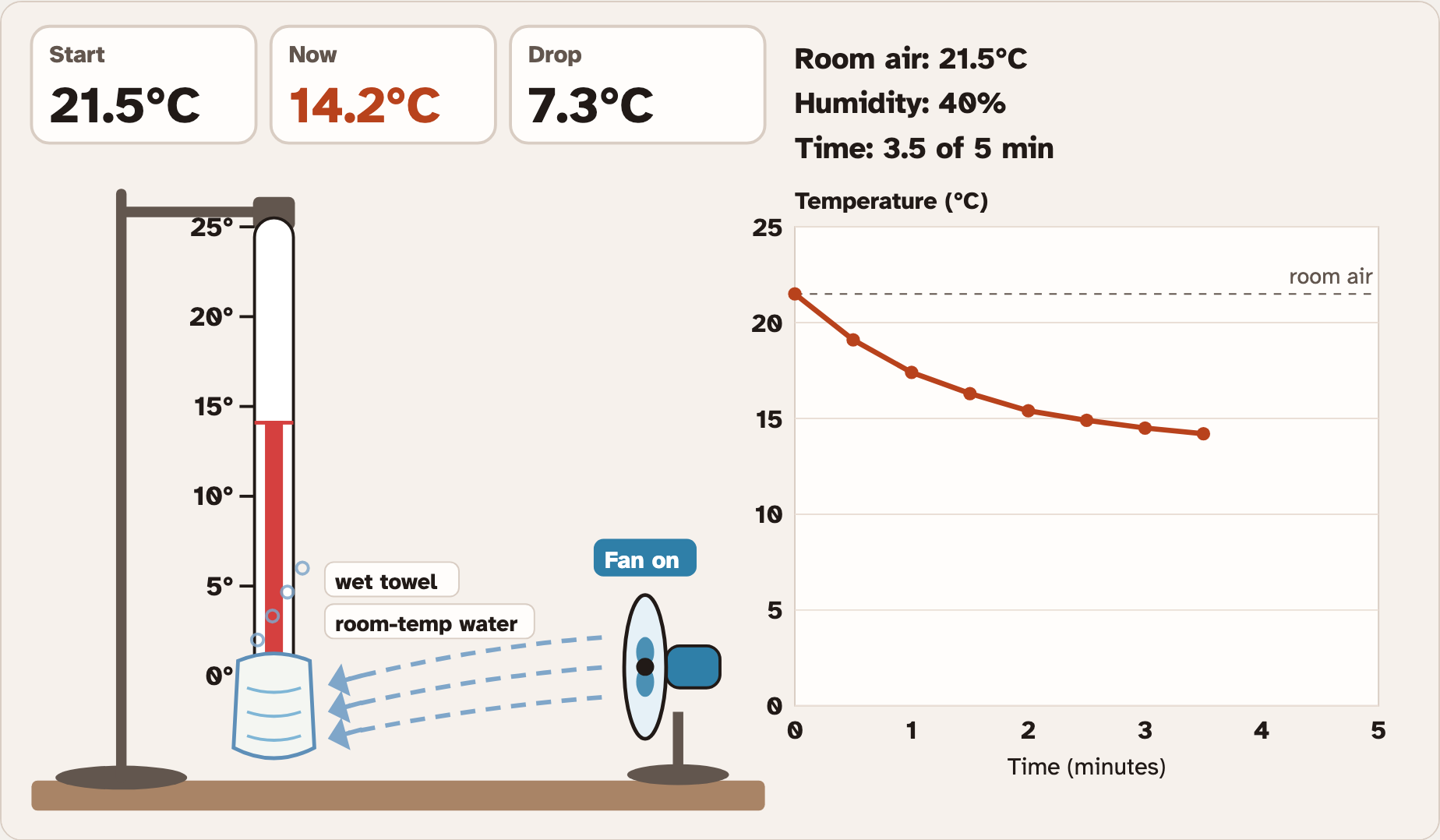
Screenshot: mrsajdak.com/thermoregulation, Tab 1
PART 1 · LEARN IT · 3 OF 4
Sweat is not cold
Sweat comes out about as warm as your skin. It cools you only when it evaporates. A drop that drips onto the floor took almost no heat with it.
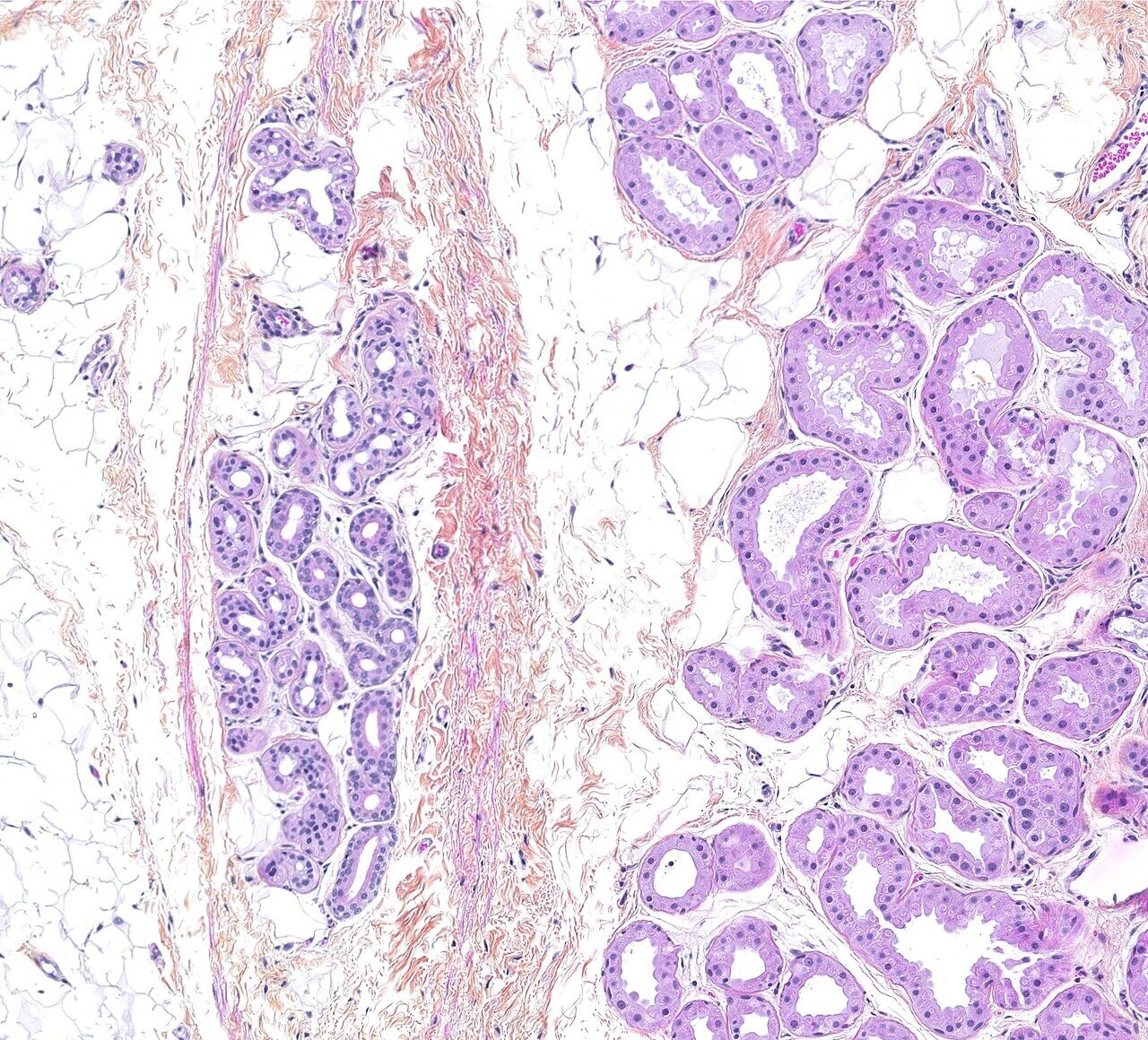
Photo: Le-prof-histo, CC BY-SA 4.0
PART 1 · LEARN IT · 4 OF 4
Moving air and dry air help
A fan sweeps away the damp air next to wet skin, so more water can evaporate. In humid air, water evaporates slowly. At 100% humidity it stops.
Photo: CambridgeBayWeather, public domain
PART 1 · QUESTION 4
Explain what you saw
QUESTION 4a
Room-temperature water, colder thermometer
The water was not cold, yet the wet thermometer got colder.
Use the word evaporation to explain why.
QUESTION 4b
Fanning and dry air
Use one number from your Question 1 table and one from your Question 3 table.
Explain why fanning and dry air both help.
PART 1 · THE BIG IDEA
Water cools a surface only by evaporating, because evaporation takes heat with it. Moving air speeds it up. Humid air slows it down.
IN YOUR WORDSWhy does a fan cool you, even though it only moves warm air?
DAY 1 · TAB 2 · QUESTIONS 5 TO 7
Part 2. Four ways out
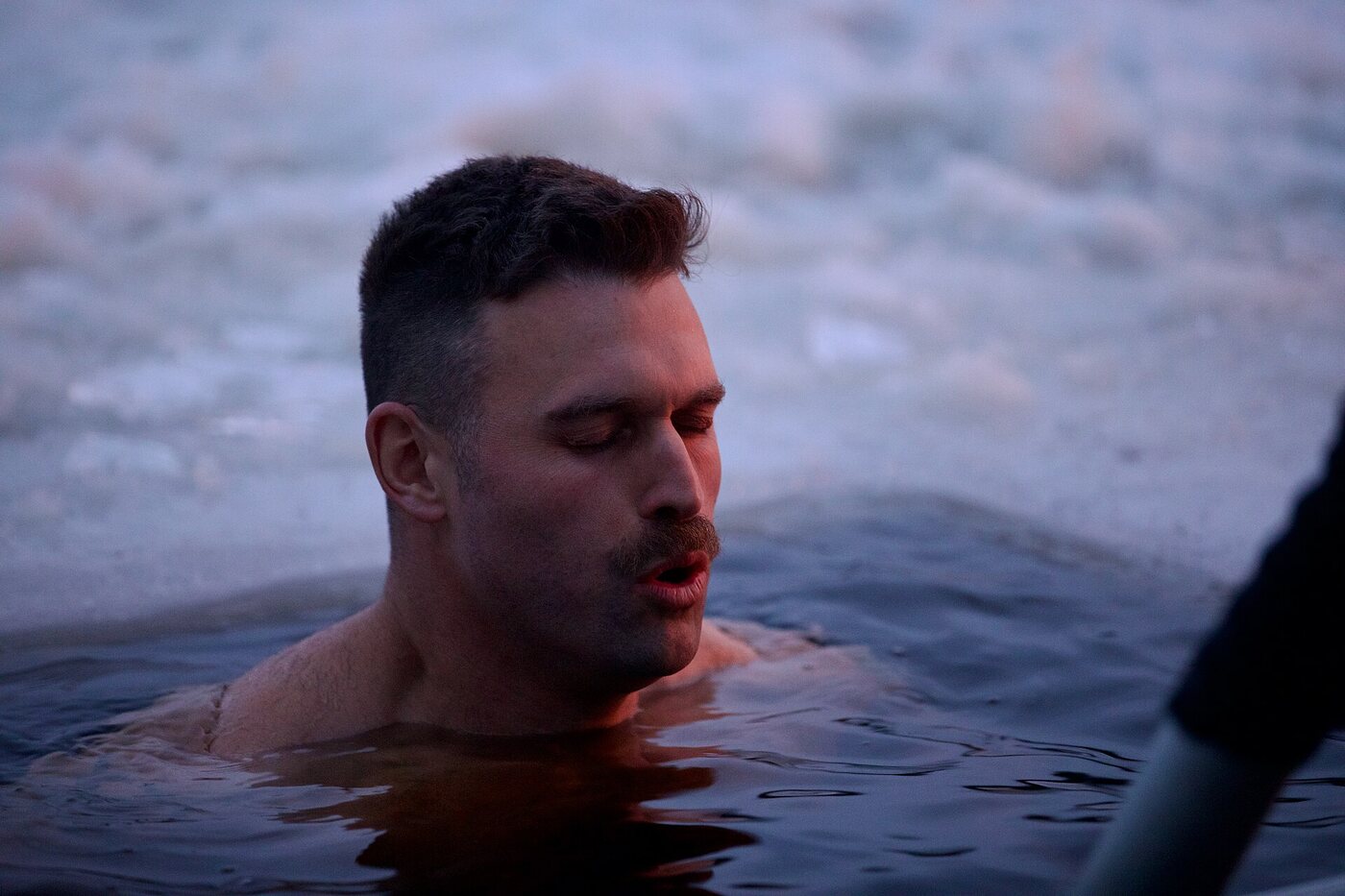
This soldier is in an ice hole in Finland. Ice swimmers stay in for only a minute or two.
Heat can leave your skin four ways. Which one is pulling heat out of him so fast?
You will measure all four in six places.
Photo: Staff Sgt. Marc Heaton, Virginia National Guard, public domain
PART 2 · QUESTION 5
Six scenes
1
Under Scene, press 1. Read the story.
2
Read the four bars. Each one is the watts of heat leaving by that way.
3
Pick the main way heat leaves. A wrong pick gets crossed out.
4
Copy the row from Scenes you solved: the main way and its watts.
5
Do all six.
PART 2 · QUESTION 6
A run on a hot day
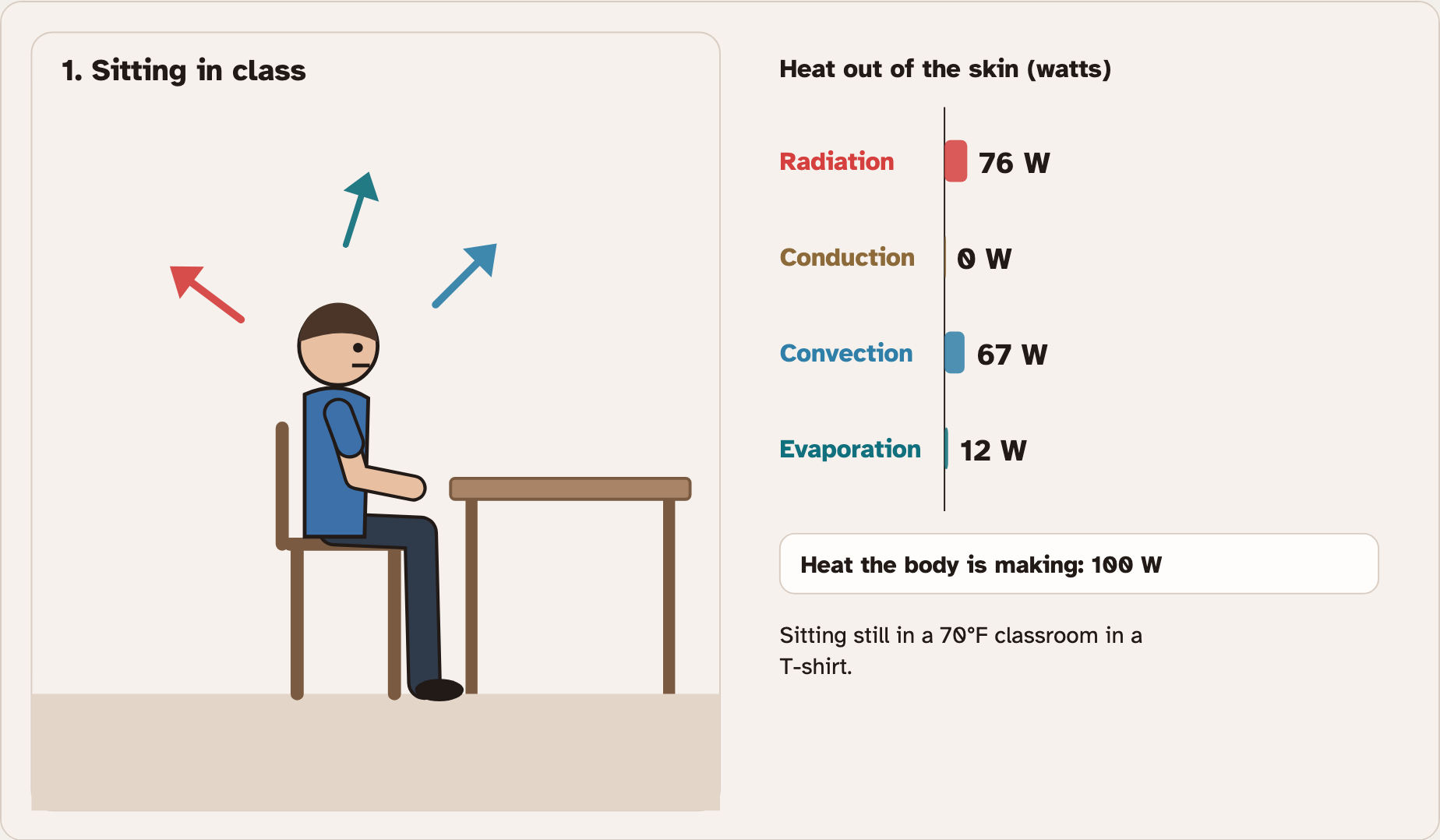
Scene 1, before it is solved.
QUESTION 6
Look at scene 6
Write the watts for radiation and for convection.
The table note in the lab says what a minus sign means.
Which way is left to lose heat?
Think
The air is 99°F. Your skin is about 95°F. Which way does heat move?
Screenshot: mrsajdak.com/thermoregulation, Tab 2
PART 2 · LEARN IT · 1 OF 4
Radiation
Warm skin gives off heat as invisible infrared waves, into anything cooler around it. No touching needed. A thermal camera sees it. At rest in a room, it is the biggest way out.
Photo: Amfeli, CC BY 4.0
PART 2 · LEARN IT · 2 OF 4
Conduction
Heat passes straight into something cooler that you touch. Water conducts heat about 25 times better than air, so cold water chills you very fast.
Photo: Amfeli, CC BY 4.0
PART 2 · LEARN IT · 3 OF 4
Convection
Moving air or water carries away the warm layer next to your skin, and cooler air takes its place. The faster it moves, the more heat it carries off.
Screenshot: mrsajdak.com/thermoregulation, Tab 2
PART 2 · LEARN IT · 4 OF 4
Evaporation
Sweat turning to vapor takes heat with it. When the air is hotter than your skin, radiation and convection bring heat in. Then evaporation is the only way left.
Photo: Sgt. Bobby Yarbrough, U.S. Marine Corps, public domain
PART 2 · QUESTION 7
Name the way out
QUESTION 7
Four everyday cases
A thermal camera sees you. A fan blows on you. You sit on a cold step. Sweat dries.
Name the way heat leaves in each one.
QUESTION 7
Lake or wind?
The lake in scene 5 is warmer than the air on the windy walk in scene 4.
Explain why the lake still pulls out more heat.
PART 2 · THE BIG IDEA
Heat leaves the skin four ways: radiation, conduction, convection and evaporation. When the air is hotter than the skin, only evaporation can still take heat out.
IN YOUR WORDSWhy is cold water more dangerous than cold air at the same temperature?
DAY 1 · TAB 3 · QUESTIONS 8 TO 10
Part 3. Football practice
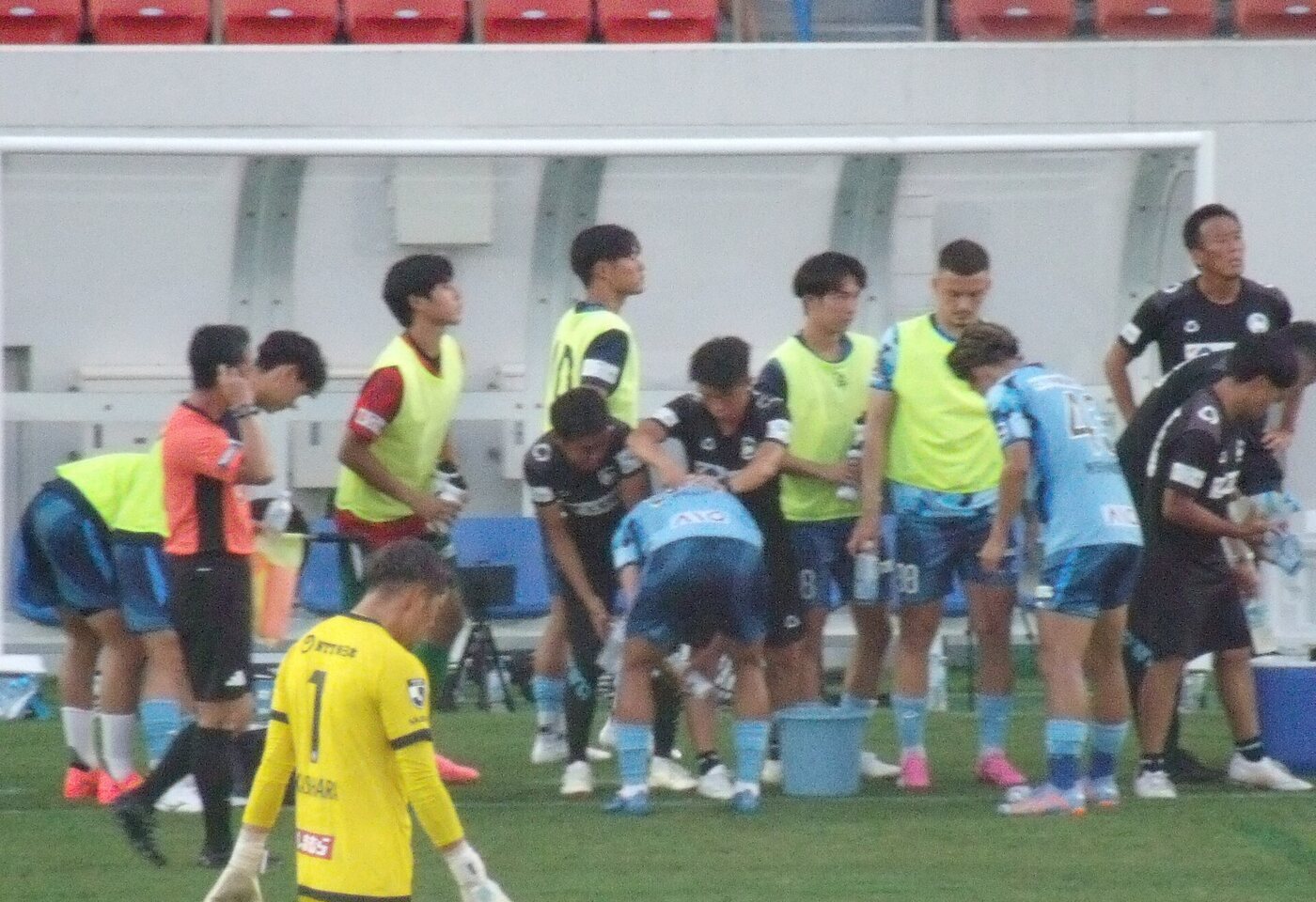
On hot, humid days, many leagues stop the game for a cooling break.
Why does the humidity matter, if the temperature is the same?
You will run one hour of practice in different weather.
Photo: Mr.ちゅらさん, CC0
PART 3 · QUESTION 8
Same heat, more humidity
1
Set 90°F, Shorts and a T-shirt, water breaks None.
2
Pick 40% humidity. Press Run practice.
3
Watch the core temperature and the sweat bar: dark blue evaporates, light blue drips.
4
A row is added to Your practices. Copy it.
5
Run 60% and 80%. Change nothing else.
PART 3 · QUESTION 9
Pads, breaks and the skin
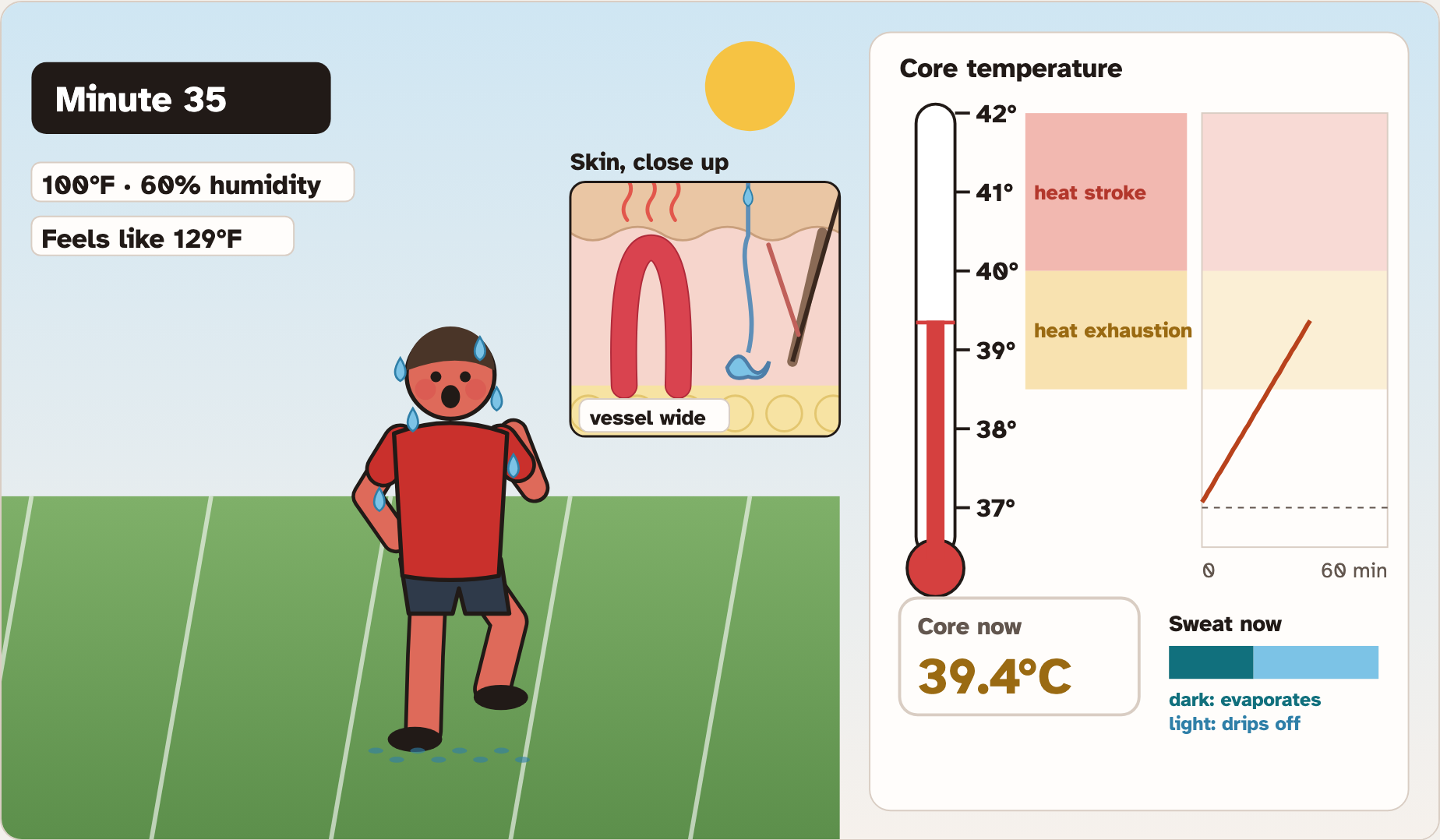
100°F and 60% humidity. This run is not on your worksheet.
QUESTION 9
Full pads
Keep 90°F and 80%. Pick Full pads and helmet. Run it with no breaks, then with water breaks.
QUESTION 9
Skin, close up
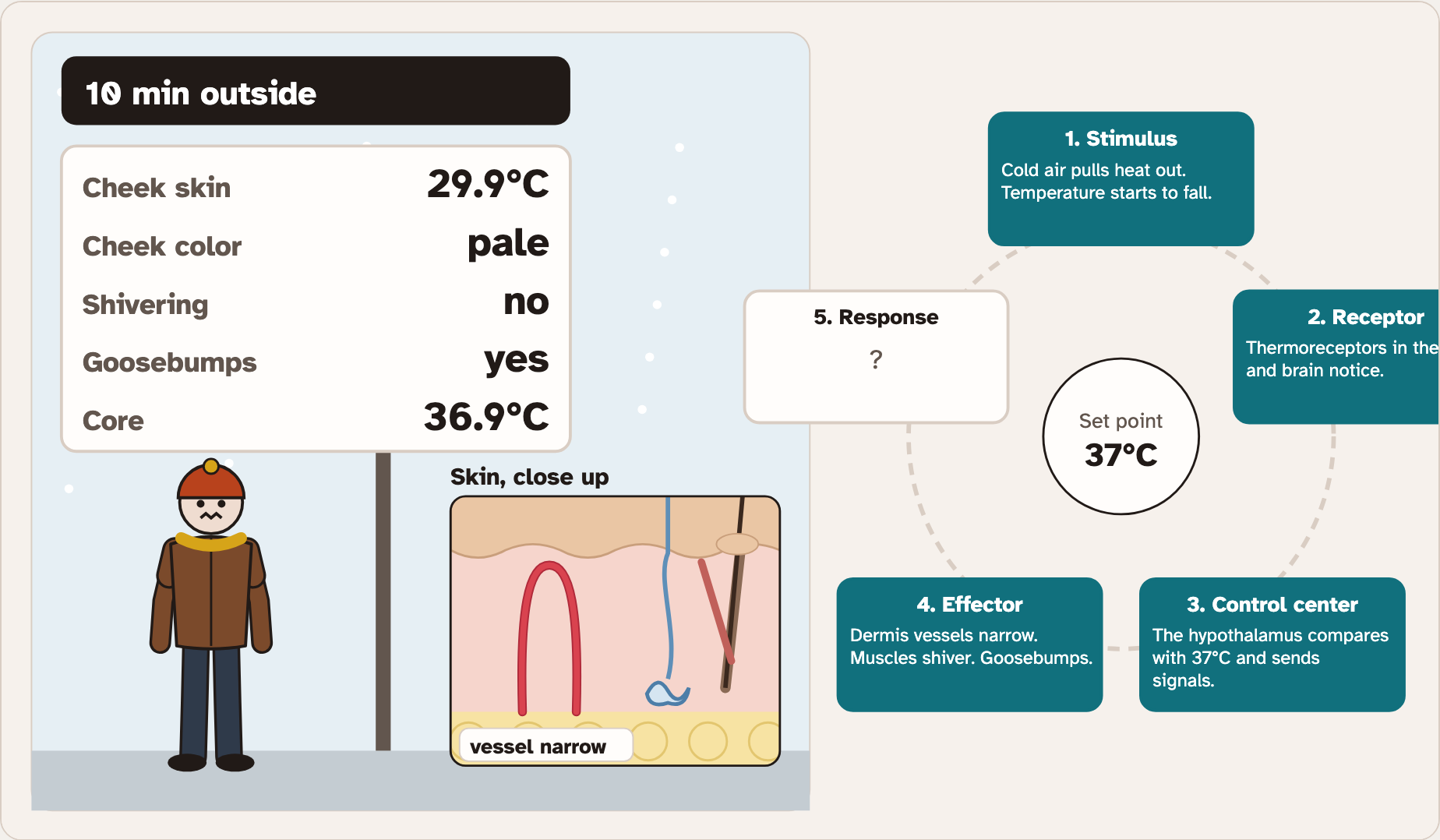
Watch the window into the dermis during practice. Look at the blood vessel and at the color of the face.
Screenshot: mrsajdak.com/thermoregulation, Tab 3
PART 3 · LEARN IT · 1 OF 4
Wide vessels: vasodilation
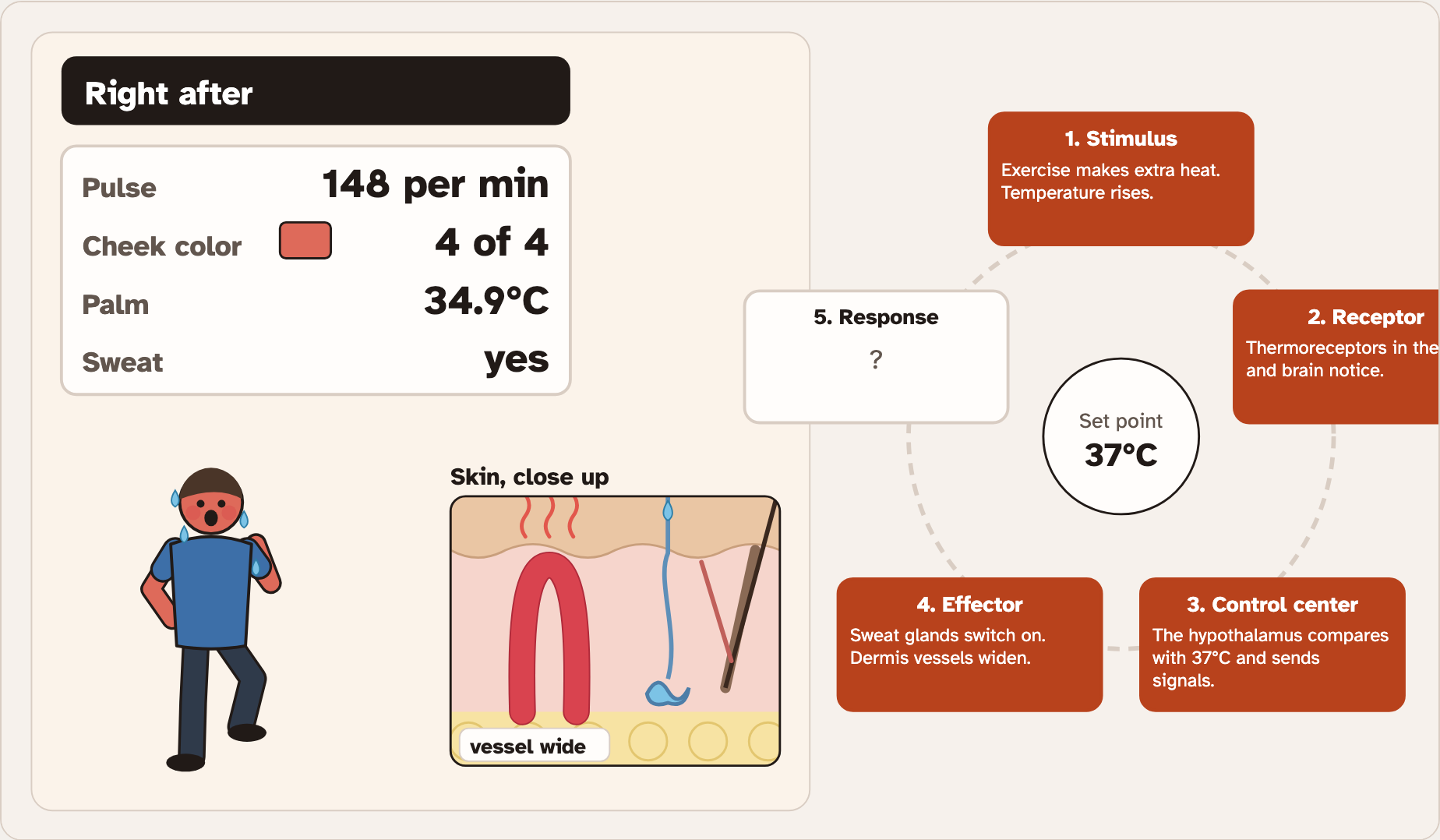
When you are too hot, the smooth muscle in the walls of the dermis vessels relaxes and they widen. More warm blood flows near the surface, and heat leaves. A hot face looks red.
Screenshot: mrsajdak.com/thermoregulation, Tab 3
PART 3 · LEARN IT · 2 OF 4
Narrow vessels: vasoconstriction
When you are too cold, the vessels narrow. Warm blood stays deep, less heat leaves, and the skin looks pale.
Screenshot: mrsajdak.com/thermoregulation, Tab 4
PART 3 · LEARN IT · 3 OF 4
Sweat glands
Sweat glands are coiled tubes deep in the dermis. Each opens onto the skin as a pore. When you are hot, nerves switch them on and they pour water onto the skin.
Photo: Le-prof-histo, CC BY-SA 4.0
PART 3 · LEARN IT · 4 OF 4
Why humid heat is dangerous
Humid air is already full of water vapor, so sweat drips off instead of evaporating. The body makes the same heat but cannot get rid of it, so the core climbs.
Photo: Mr.ちゅらさん, CC0
PART 3 · QUESTION 10
Talk to the coach
The coach says
“It is 90°F, the same as last week when the humidity was 40%. Same practice.”
Your reply
Use two numbers from Question 8 or 9, and the word evaporate.
Think
Is the temperature the problem, or is it where the sweat goes?
PART 3 · THE BIG IDEA
When you are hot, dermis vessels widen and sweat glands switch on. Sweat cools only when it evaporates, so in humid air the body keeps heating up.
IN YOUR WORDSWhy is a humid 90°F day more dangerous than a dry one?
DAY 2 · START HERE
Why do you shiver with a fever, when you are already warm?
Yesterday: how heat leaves. Today: who decides when.
DAY 2 · TAB 4 · QUESTIONS 11 TO 15
Part 4. The loop
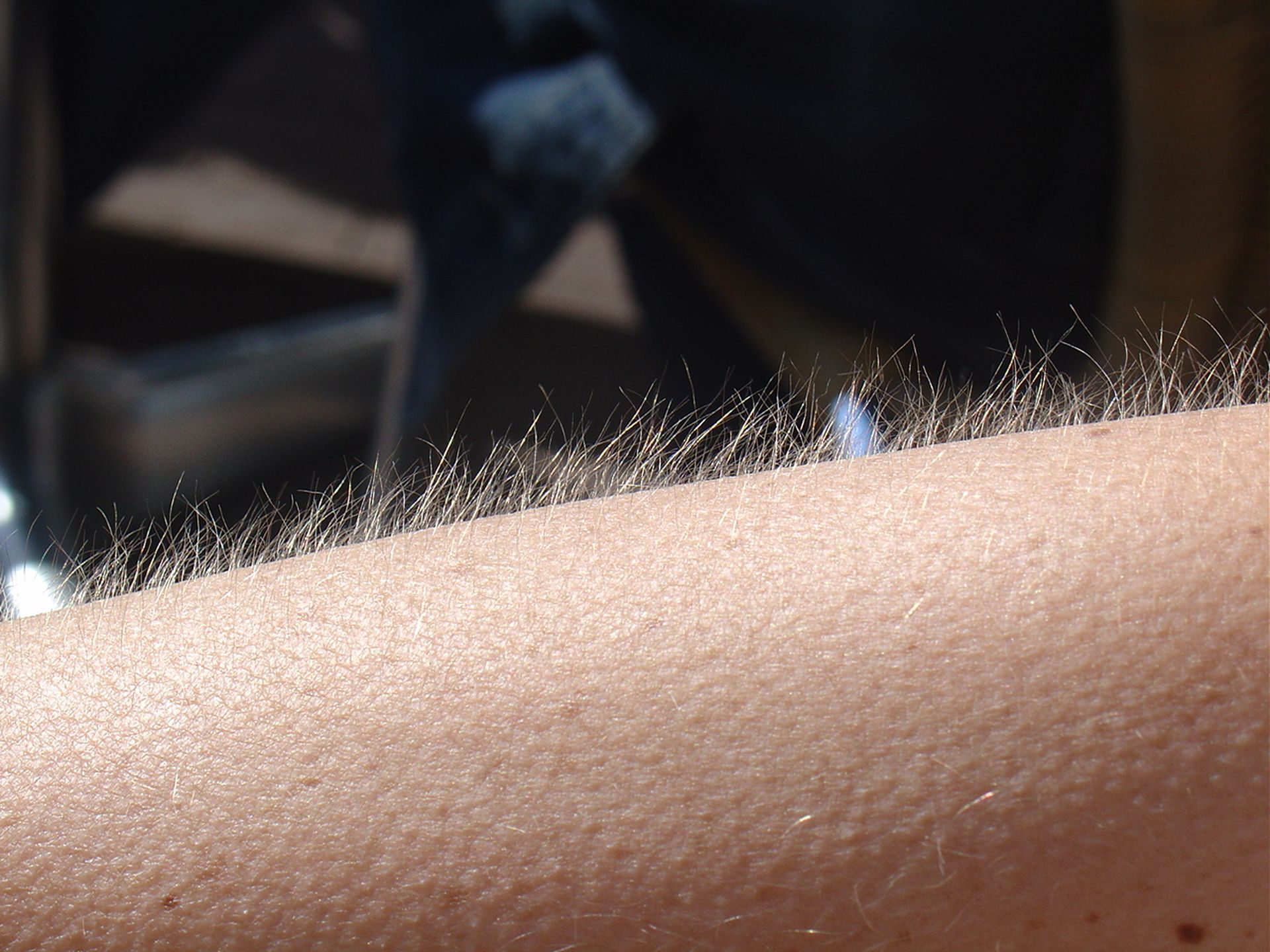
Nobody decides to get goose bumps, to sweat, or to go pale in the cold.
One part of your brain does all of it, and it switches each one off again.
You will measure a body after exercise and at a cold bus stop.
Photo: EverJean, CC BY 2.0
PART 4 · QUESTION 11
After exercise
1
Pick Hot: exercise and Medium: step-ups.
2
At At rest, before, press Record this time.
3
Press Next time. Record again. Do all four times.
4
Watch the skin close up and the loop on the right.
5
Copy your four rows from the Exercise table.
PART 4 · QUESTIONS 12 AND 13
The cold side, and the loop
Question 12
Pick Cold: bus stop and Just a T-shirt. Record all four times. Watch the cheek and the core.
Question 13
Pick Build the loop. Place all eight cards. Then fill in the loop for too hot.
Watch for
Which number changes a lot? Which one barely moves?
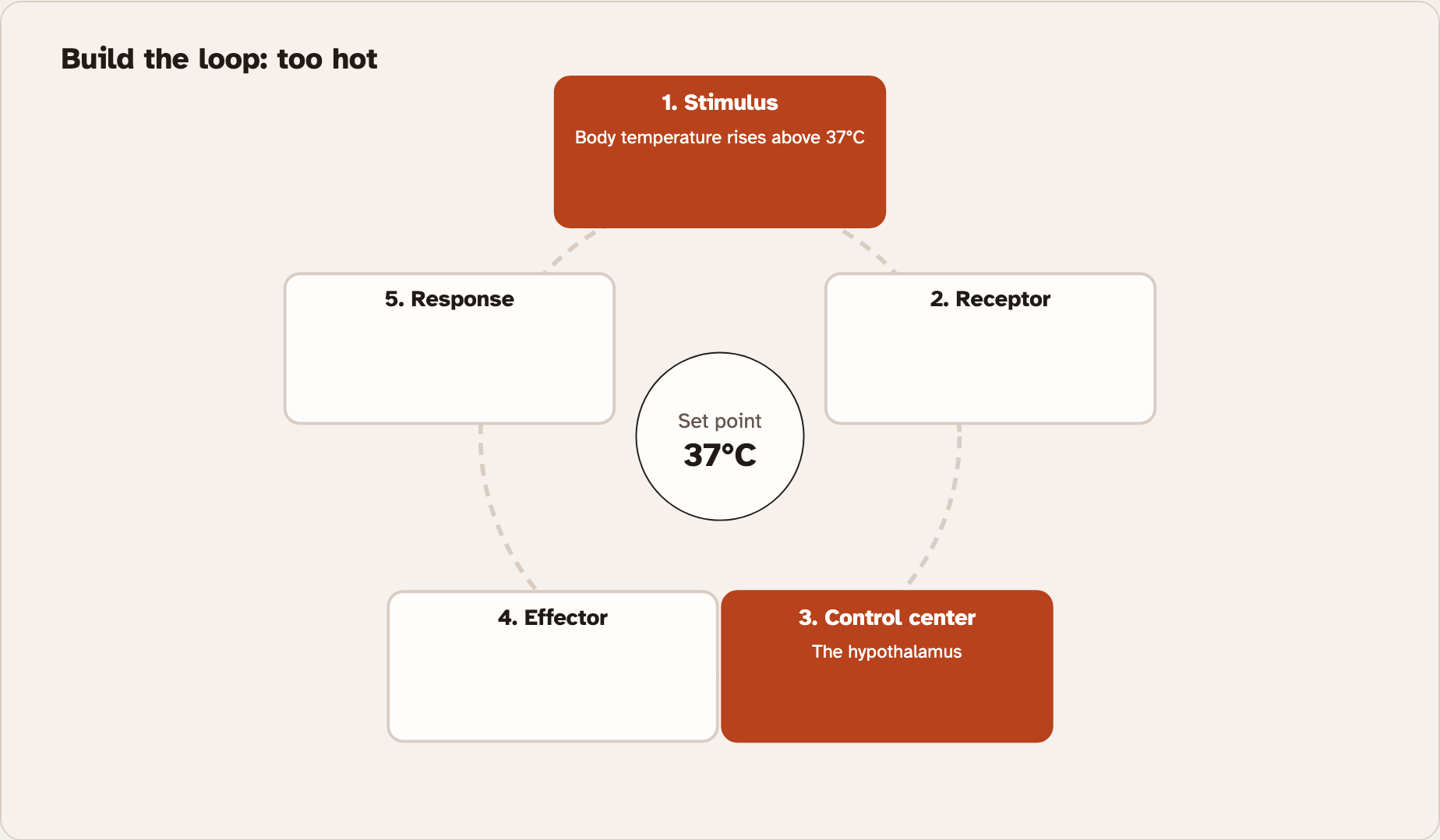
Two cards placed. Six to go.
Screenshot: mrsajdak.com/thermoregulation, Tab 4 · The pulse, colors and hours in Tabs 4 and 5 are from a model made to match typical results.
PART 4 · LEARN IT · 1 OF 4
The set point
The set point is the number the body tries to hold: about 37°C. Your temperature drifts a little all day, and each drift is pushed back. Holding the inside steady is homeostasis.
Screenshot: mrsajdak.com/thermoregulation, Tab 4
PART 4 · LEARN IT · 2 OF 4
Five parts of a feedback loop
Stimulus: a change. Receptor: notices it. Control center: compares with 37°C and sends signals (the hypothalamus). Effector: acts. Response: the change is undone.
Screenshot: mrsajdak.com/thermoregulation, Tab 4
PART 4 · LEARN IT · 3 OF 4
Negative means against the change
In negative feedback the response goes against the change. It does not mean bad. Near the set point, the receptors stop signaling and the effectors switch off, like an air conditioner.
Photo: Sgt. Bobby Yarbrough, U.S. Marine Corps, public domain
PART 4 · LEARN IT · 4 OF 4
Too cold: the other side
Same receptors, same hypothalamus, different effectors. Vessels narrow. Skeletal muscles shiver and make heat. Tiny muscles raise goose bumps. Cold fingers protect a warm core.
Photo: EverJean, CC BY 2.0
PART 4 · QUESTIONS 14 AND 15
Explain the loop
QUESTION 14
Who turned the sweat off?
Nobody told the sweat glands to stop, but at 4 minutes the sweating stopped.
Use the five parts of the loop and your Question 11 data.
Why is this called negative feedback?
QUESTION 15
Is the loop failing?
Use your Question 12 numbers: how much did the cheek drop, and how much did the core drop?
Explain with vasoconstriction and shivering.
PART 4 · THE BIG IDEA
The hypothalamus compares your temperature with the set point. Too hot: sweat and wide vessels. Too cold: narrow vessels and shivering. Each response pushes against the change, then switches off.
IN YOUR WORDSWhy does a cold cheek mean the loop is working?
DAY 2 · TAB 5 · QUESTIONS 16 TO 19
Part 5. Fever
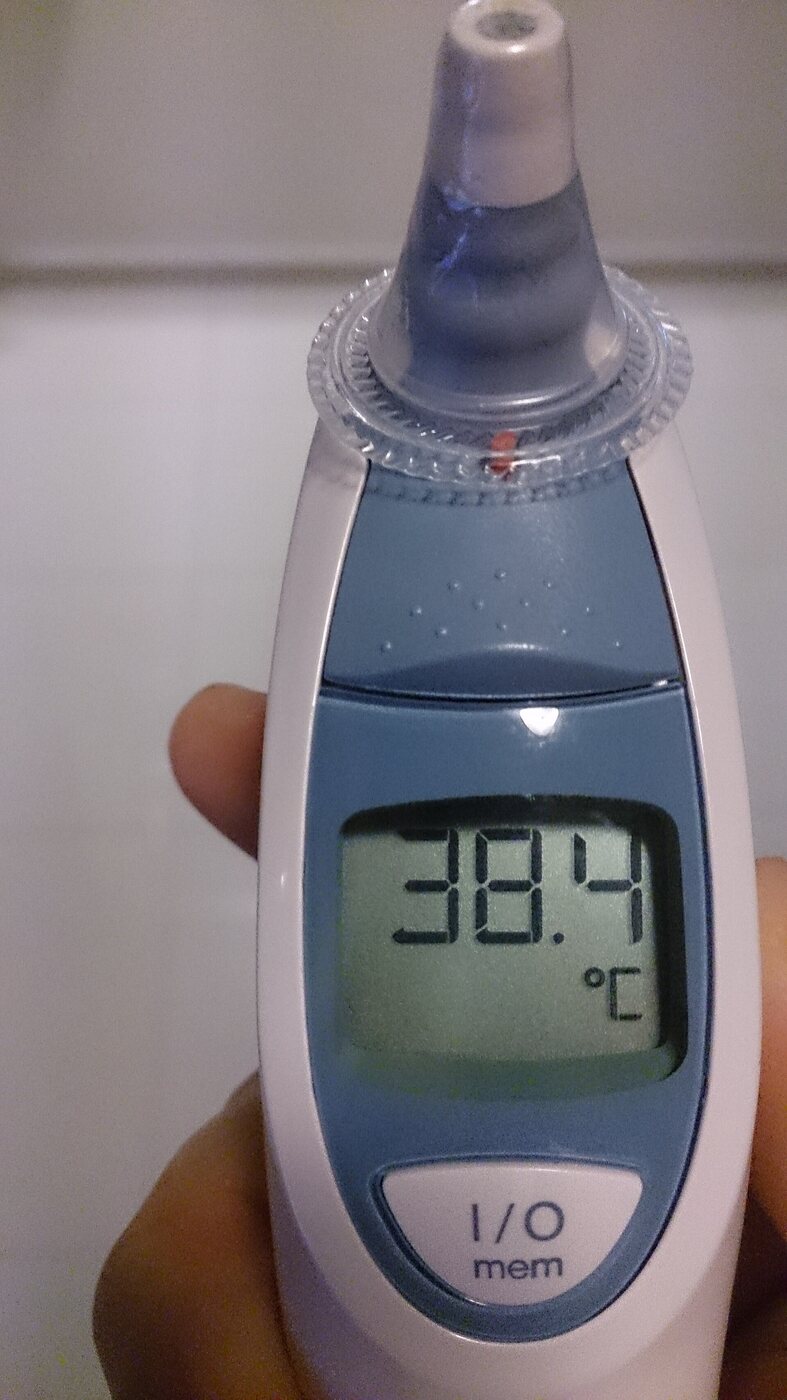
38.4°C is a fever. But the same loop is still running.
So why does a person with the flu shiver under blankets, then later soak the sheets with sweat?
You will follow a flu hour by hour.
Photo: ProjectManhattan, CC BY-SA 3.0
PART 5 · QUESTION 16
The flu, hour by hour
1
Pick 39°C and medicine None.
2
At hour 0, read the set point, the body, shivering and sweating.
3
Press Next hour. Each hour is added to the table.
4
Watch the dashed line (set point) and the solid line (body).
5
Copy hours 0, 1, 2, 6, 7 and 8.
PART 5 · QUESTION 17
Higher, and with medicine
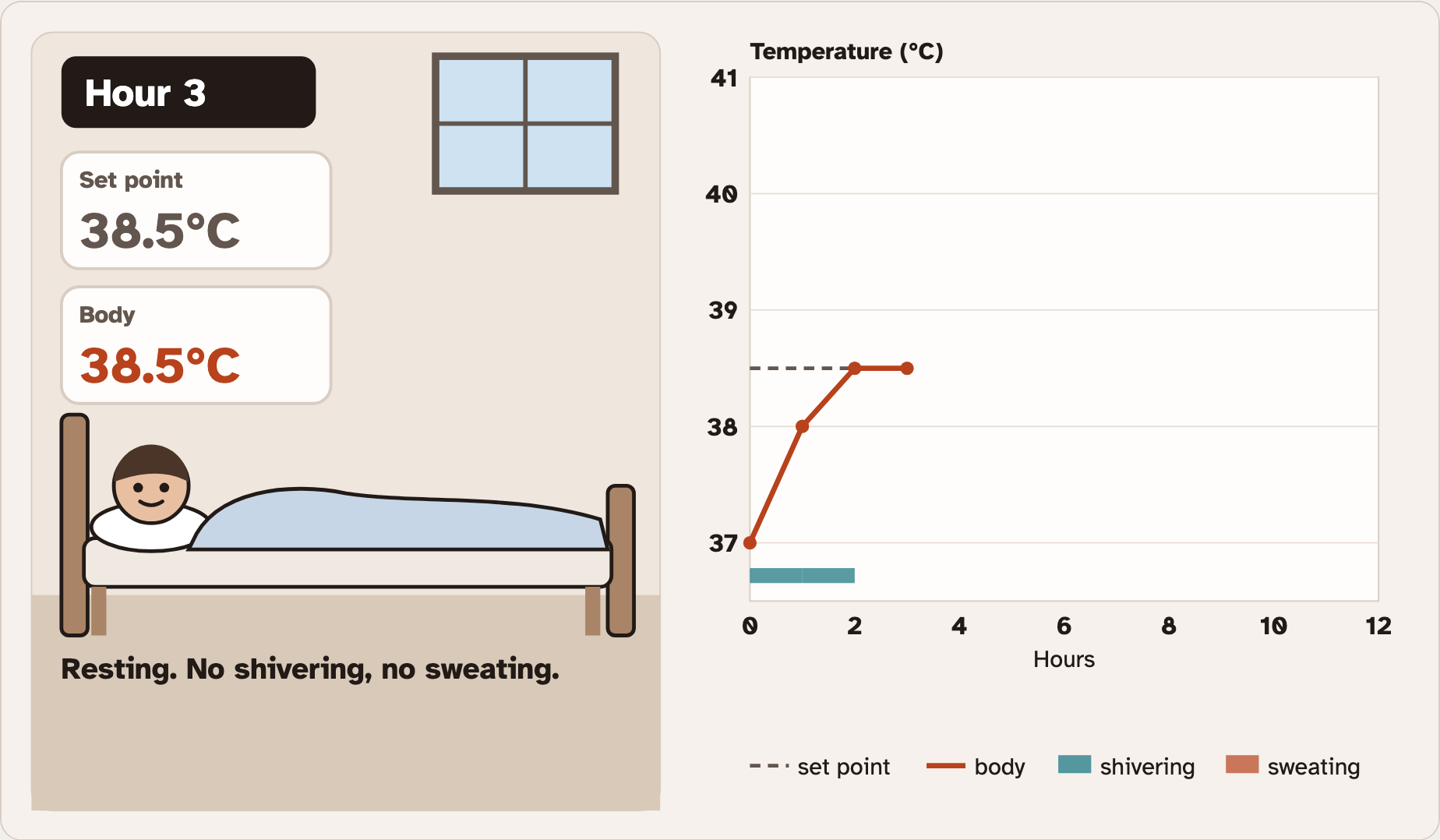
A 38.5°C fever at hour 3. This run is not on your worksheet.
QUESTION 17
A higher fever
Pick 40°C. Step through the hours. Count the hours of shivering.
QUESTION 17
Medicine
Back to 39°C. Pick Fever medicine at hour 3. What happens to the set point at hour 3?
Screenshot: mrsajdak.com/thermoregulation, Tab 5 · The pulse, colors and hours in Tabs 4 and 5 are from a model made to match typical results.
PART 5 · LEARN IT · 1 OF 4
The loop does not break
In an infection, chemicals called pyrogens tell the hypothalamus to raise the set point, for example to 39°C. The loop stays the same. Only its target moves.
Screenshot: mrsajdak.com/thermoregulation, Tab 5
PART 5 · LEARN IT · 2 OF 4
Compare with the set point
With the set point at 39°C, a body at 37°C is too cold for the loop. So it runs the cold side: pale skin and shivering, while the temperature is still normal.
Photo: EverJean, CC BY 2.0
PART 5 · LEARN IT · 3 OF 4
When the fever breaks
When the set point drops back to 37°C, a body at 39°C is now too hot. The vessels widen, the face flushes, and sweat pours out. The temperature is falling.
Photo: Le-prof-histo, CC BY-SA 4.0
PART 5 · LEARN IT · 4 OF 4
Why a fever?
A warmer body slows the growth of many germs and speeds up some immune cells. Above about 41°C a fever is dangerous: proteins in the cells start to lose their shape.
Photo: ProjectManhattan, CC BY-SA 3.0
PART 5 · QUESTION 18
Explain the fever
QUESTION 18a
Shivering at 37°C
At hour 0 the temperature is a normal 37°C, but the person shivers under two blankets.
Explain why.
QUESTION 18b
Talk to the relative
At hour 7 a relative says, “Look at all that sweat, the fever is getting worse.”
Use your Question 16 numbers to reply.
PART 5 · THE BIG IDEA
A fever is the same loop with a higher set point. Rising to it, the body shivers. When the set point drops, the body sweats its way back down.
IN YOUR WORDSWhy do you shiver at the start of a fever?
WRAP IT UP · QUESTION 19
One loop, both ways
The claim
“One negative feedback loop holds body temperature near its set point, whether you are too hot or too cold.”
Evidence, Part 4
Your exercise table and your bus stop table. What switched on, and what switched off?
Evidence, Part 5
Your fever table. What did the body do when it was below the set point? Above it?
Reasoning
Name the receptor, the control center and two effectors.
WRAP IT UP · BACK TO THE START
Revisiting the Phenomenon
Your cells make heat all day. How does your body stay at 37°C?
1In Photo C the hand is gone, but its print is warm. Which of the four ways out put heat into the surface?
2The hand in Photo B is also losing heat to the camera without touching it. Which way is that? Which tab showed it is the biggest way out at rest?
3After a run on a hot day, would the hand in Photo B look brighter or darker? Use what the dermis vessels do.
4At a cold bus stop the fingertips would go dark purple. Why is that good for the core? Use your Question 12 numbers.
Photos: Amfeli, CMPLab, Centro Universitario de Mérida, CC BY 4.0
LAST CHECK
Before you hand it in
Name, date and period are on top.
Both sides are done: Day 1 and Day 2.
Every table is full.
Your explanations use numbers from your own tables.
Done early? Open the Be the hypothalamus tab. Keep the core in the green band for 90 seconds.
Photo: Mr.ちゅらさん, CC0